Category: Science & Technology Key figures: Lyn Evans (LHC project leader, 1993–2008); Robert Aymar (CERN Director-General, 2004–2008); ATLAS, CMS, ALICE, and LHCb detector collaborations (roughly 10,000 scientists and engineers from over 100 countries)
Summary
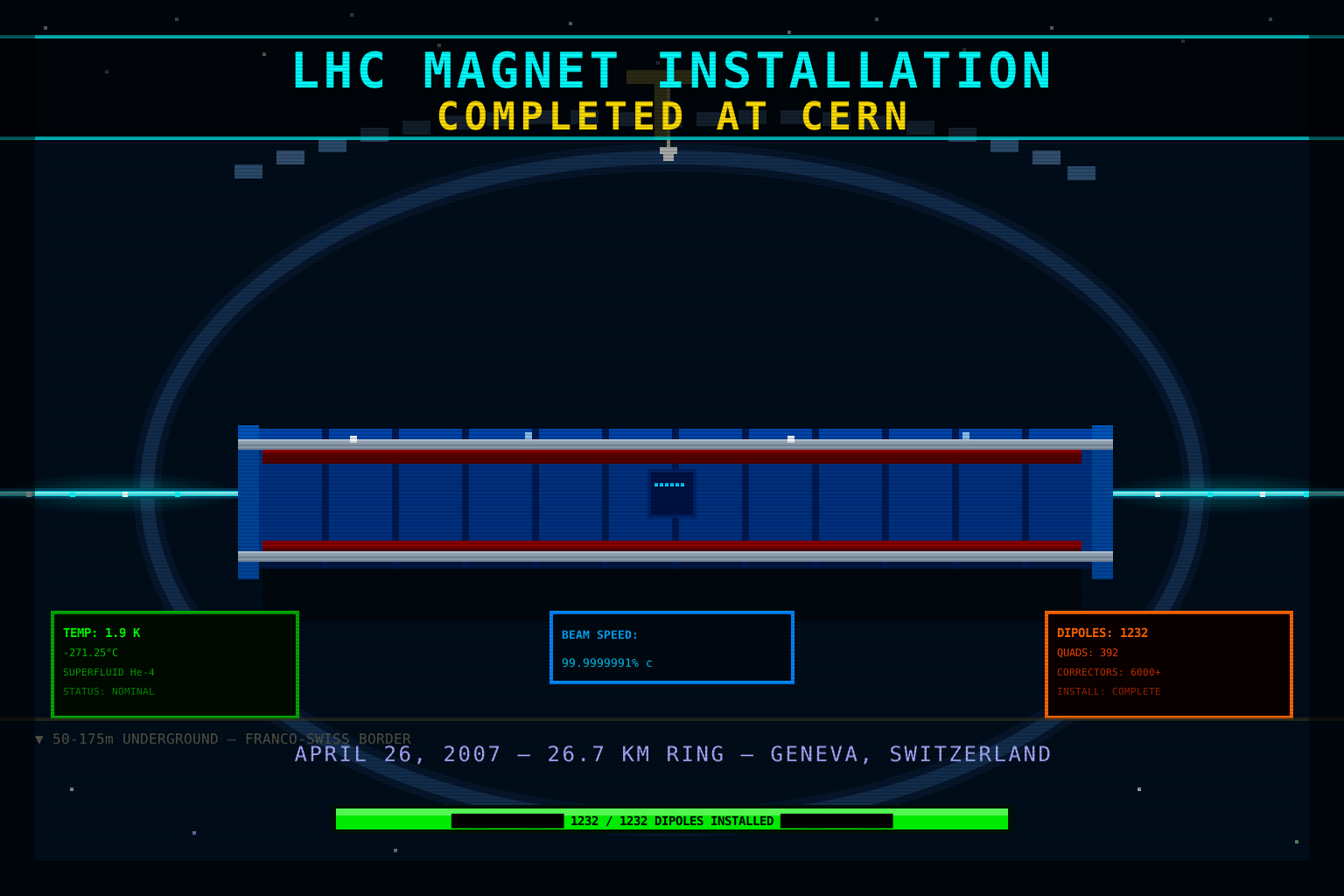
On April 26, 2007, the European Organization for Nuclear Research (CERN) achieved a major engineering milestone by lowering the last of 1,232 superconducting dipole magnets into the Large Hadron Collider (LHC) tunnel, approximately 50–175 metres beneath the Franco-Swiss border near Geneva, Switzerland. Each dipole magnet — weighing 27 metric tonnes and measuring 14.3 metres in length — was engineered to bend proton beams circulating at 99.9999991% the speed of light through the 26.7-kilometre circular tunnel. The completion of magnet installation represented the conclusion of the LHC’s primary underground infrastructure construction phase, positioning the project toward commissioning and the planned first beam circulation later in 2007.
The total installed magnet system comprised not only the 1,232 main dipoles but also 392 quadrupole magnets (for focusing the beam), and approximately 6,000 additional corrector magnets — a total of more than 9,600 superconducting magnets operating at 1.9 K (−271.25°C, colder than outer space), cooled by 120 tonnes of superfluid helium-4. The system represented the largest installation of superconducting technology ever assembled in a single facility.
Technical Architecture
The Superconducting Dipole Magnets
The LHC’s main dipole magnets were each designed to produce a magnetic field of 8.33 tesla — the highest field ever produced in an accelerator dipole at that time. At this field strength, the superconducting cables (composed of niobium-titanium filaments embedded in copper) carry electrical currents of approximately 11,850 amperes without electrical resistance, provided the temperature is maintained below 1.9 K using superfluid helium. The choice of niobium-titanium (NbTi) over the stronger niobium-tin (Nb₃Sn) alloy was driven by cost and manufacturing reliability: NbTi is more mechanically flexible and tolerant of manufacturing imperfections, even though Nb₃Sn would have allowed higher field strengths.
Each magnet was manufactured in three sites across CERN’s member states: the cold masses and coils were produced by European firms including Alstom/Jeumont (France), Ansaldo (Italy), and Babcock-Noell (Germany), then transported to CERN for integration into the tunnel. The magnets were lowered in sections through access shafts between 2 and 4 metres wide, using purpose-built lowering equipment — a process that required millimetre-precision alignment once in the tunnel, where each magnet was placed on a support stand and connected to its neighbours via superfluid helium pipes and electrical bus bars.
Cryogenic Infrastructure
The LHC’s cryogenic system — the largest in the world by volume of cryogenic fluid — was built alongside the magnet installation. Eight cryoplants (two per sector of the ring’s eight sectors) produce the liquid helium required to cool the magnets. The choice to operate at 1.9 K rather than the simpler 4.2 K (liquid helium’s normal boiling point) was motivated by the superfluid properties of helium-4 below 2.17 K: superfluid helium has an extremely high thermal conductivity (orders of magnitude higher than conventional liquid helium), allowing it to efficiently carry away the heat deposited by beam losses and equipment imperfections without the local boiling that could quench a magnet and dump the beam.
Beam Pipe and Vacuum System
The LHC’s two proton beams travel in opposite directions through separate beam pipes inside the same magnet cryostats — a “twin-aperture” design that required the dipole magnets to generate two independent magnetic fields in opposing directions within a single casing. The beam pipes operate at an ultra-high vacuum of 10⁻¹⁰ to 10⁻¹¹ torr — comparable to the vacuum of interplanetary space — to minimize beam-gas interactions. Creating and maintaining this vacuum across the full 26.7-kilometre ring required specialized baking of the beam pipe at approximately 300°C after installation to outgas contaminants from the pipe walls.
Construction History (1998–2007)
The LHC’s construction was authorized by CERN’s member states in 1994 and began in 1998, following the decommissioning of its predecessor, the Large Electron-Positron Collider (LEP), which had operated in the same tunnel from 1989 to 2000. Key milestones in the construction phase included:
- 1994: CERN member states formally approve LHC construction.
- 1998: Civil engineering of the eight LHC experimental caverns and underground infrastructure begins.
- 2000: LEP shuts down on November 2, 2000, after its final run reaches centre-of-mass energies up to 209 GeV. The tunnel is made available for LHC installation.
- 2003–2004: The first superconducting dipole magnets are tested and delivered to CERN from manufacturing partners in France, Italy, and Germany.
- April 2007: The 1,232nd and final dipole magnet is lowered into the tunnel.
The total cost of the LHC project — accelerator, detectors, and civil engineering — was approximately 4.6 billion Swiss francs ($3.8 billion USD at 2007 exchange rates), shared among CERN’s 20 member states and contributions from 100 non-member states, including significant funding from the United States Department of Energy and National Science Foundation.
The March 2007 Incident
The April 2007 completion occurred against a backdrop of a significant engineering setback in March 2007. During pressure testing of a magnet support structure at Fermilab’s test facility in Illinois (where components were being validated before shipment to CERN), a mechanical failure of the inner triplet quadrupole support structure caused a 35-tonne magnet to shift from its support frame. A subsequent analysis attributed the failure to an error in the finite-element stress calculation used to design the support: the calculation had not correctly accounted for the longitudinal force on the magnet assembly during the rapid quench-induced pressure pulse.
The incident required CERN and its U.S. partners (Fermilab and Lawrence Berkeley National Laboratory had designed the inner triplet magnets that focus the beam near the interaction points) to redesign the support structures and retrofit already-installed magnets in the tunnel with reinforcing support brackets — a process requiring months of additional work. The final magnet installation on April 26, 2007, despite this parallel repair effort, demonstrated the project team’s ability to manage concurrent construction and remediation on a compressed schedule.
Path to First Beam
Following the completion of magnet installation in April 2007, the LHC entered its commissioning phase — testing electrical connections, powering magnets to full field sector by sector, and checking the cryogenic system. Lyn Evans, the Welsh physicist who had led the project since 1993, supervised this process from CERN’s control center. The original schedule called for first beam circulation in late 2007 or early 2008, but the inner triplet support structure repairs and a subsequent programme of re-testing pushed the date to late 2008.
On September 10, 2008, the LHC successfully circulated its first proton beam — just one beam at low energy, in one direction — watched live by thousands of physicists via webcast from CERN and institutions worldwide. Nine days later, on September 19, 2008, during high-energy powering tests, an electrical fault between two bus-bar connections in sector 3-4 caused a quench and a subsequent helium leak that damaged 53 dipole magnets and required approximately 14 months of repair and additional safety-system upgrades. The LHC restarted in November 2009 and achieved its first proton-proton collisions at 7 TeV centre-of-mass energy on March 30, 2010.
The Higgs boson — one of the primary discovery targets for which the LHC was built — was announced by CERN on July 4, 2012, at a centre-of-mass energy of 8 TeV, fourteen years after LHC construction began. The discovery was awarded the Nobel Prize in Physics in October 2013 to theorists Peter Higgs and François Englert.
Significance
The April 26, 2007 completion of LHC magnet installation represented the conclusion of one of the most ambitious international scientific infrastructure projects in history. The LHC required coordination among physicists, engineers, and funding agencies from more than 100 countries, and pushed the limits of superconducting magnet technology, cryogenic engineering, vacuum systems, and beam physics simultaneously.
The LHC’s scale and collaboration model contrasted sharply with the private-sector technology milestones of the same period — the iPhone launch in June 2007 and the Facebook Platform opening in May 2007 — reflecting a different mode of large-scale technological development: a publicly funded, multi-decade, multi-national project oriented toward fundamental scientific knowledge rather than commercial application.
The magnet installation milestone also arrived the same year as the IPCC Fourth Assessment Report (February 2007), which represented the other major scientific mobilization of 2007: where climate science sought to redirect global attention toward an urgent risk, particle physics sought to answer the most fundamental questions about the nature of matter. Both reflected the capacity of organized scientific communities to produce knowledge at scales and time horizons that no individual institution could sustain alone.
The induced pluripotent stem cell breakthrough by Shinya Yamanaka’s laboratory (announced November 2007) similarly represented the 2007 frontier of basic-science ambition. Together, these three developments — LHC, IPCC AR4, and iPSC — made 2007 an unusually concentrated moment for foundational scientific progress.
Sources
- Large Hadron Collider — Wikipedia — technical specifications, construction history, and commissioning timeline.
- CERN LHC Design Report (Vol. I: The LHC Main Ring) — authoritative technical reference for magnet design, cryogenics, and beam parameters.
- LHC inner triplet failure at Fermilab — Fermilab Technical Note — confirms the March 2007 support structure failure and root-cause analysis.
- Lyn Evans — Wikipedia — confirms Evans’s role as LHC Project Leader 1993–2008.
- LHC First Beam — CERN Courier (September 2008) — first proton beam circulation on September 10, 2008.
- Discovery of the Higgs Boson — CERN press release, July 4, 2012 — confirms the discovery date and centre-of-mass energy.
- Nobel Prize in Physics 2013 — Nobelprize.org — awarded to Peter Higgs and François Englert.