Key figures: Richard Clark (Merck CEO), Judge Eldon E. Fallon (Eastern District of Louisiana, overseeing federal Vioxx MDL), Christopher Seeger and Mark Lanier (lead plaintiff attorneys), David Graham (FDA scientist whose 2004 Senate testimony linked Vioxx to tens of thousands of deaths)
Summary
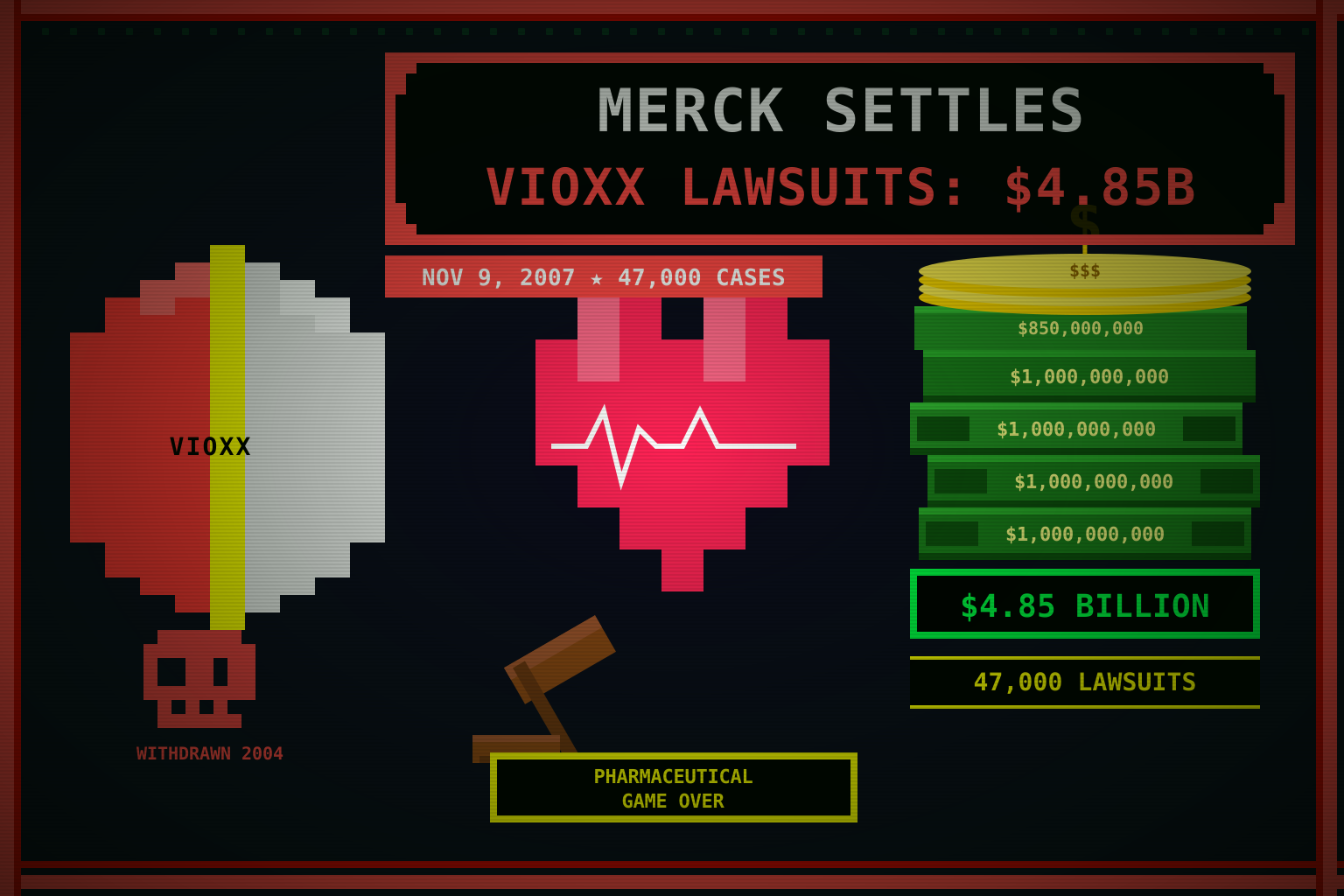
On November 9, 2007, pharmaceutical giant Merck & Co. announced a comprehensive $4.85 billion settlement to resolve approximately 47,000 lawsuits alleging that its pain medication Vioxx (rofecoxib) caused heart attacks, strokes, and other cardiovascular injuries in patients. The settlement came more than three years after Merck’s September 30, 2004 voluntary withdrawal of Vioxx from the global market, following interim results from the APPROVe clinical trial demonstrating a statistically significant doubling of cardiovascular event risk in patients who had taken Vioxx for 18 months or longer compared to placebo.
The $4.85 billion fund was structured through a complex claims-administration process overseen by a special master and claims administrator working alongside the federal Multidistrict Litigation (MDL) court in the Eastern District of Louisiana and coordinated state court proceedings in New Jersey, California, and Texas. To participate, plaintiffs were required to enroll by set deadlines, document that they had taken Vioxx for at least 30 consecutive days, and demonstrate a qualifying cardiovascular event (heart attack or ischemic stroke) occurring within 14 days of their last Vioxx dose or within the first 18 months of use (for heart attacks) or 30 days (for strokes). The varying enrollment thresholds and injury-severity tiers produced compensation ranging from tens of thousands to several million dollars per claimant, depending on age, pre-existing conditions, duration of use, and the severity of the cardiovascular event.
Merck did not admit liability or wrongdoing in the settlement agreement. The company’s decision to settle reflected the accumulated weight of trial outcomes: of the approximately 16 federal and state trials that had concluded by November 2007, Merck had won roughly half—but the losses had produced verdicts of extraordinary magnitude. A Texas state court jury had awarded $253 million to the widow of Robert Ernst in August 2005 (later reduced to $26 million on appeal due to Texas damages cap statutes), and a New Jersey federal jury had awarded $9 million in April 2006 in the first federal trial—both decisions sustained plaintiff narratives about Merck’s knowing concealment of cardiovascular risks.
Background: Vioxx’s Development and Withdrawal
Vioxx (rofecoxib) was a COX-2 selective non-steroidal anti-inflammatory drug (NSAID) approved by the FDA on May 20, 1999, for the treatment of osteoarthritis, acute pain, and dysmenorrhea. It was marketed as a superior alternative to traditional NSAIDs (such as ibuprofen and naproxen) that would reduce the gastrointestinal side effects—stomach ulcers and bleeding—associated with older drugs. The drug became one of the fastest-selling pharmaceuticals in history, with peak annual sales of approximately $2.5 billion; an estimated 80 million patients worldwide were prescribed Vioxx at some point during its five years on the market.
The VIGOR study (Vioxx GI Outcomes Research), published in November 2000 in the New England Journal of Medicine, was the first large-scale clinical trial of Vioxx. It demonstrated a significant reduction in gastrointestinal events compared to naproxen—but also showed a 4-fold higher rate of heart attacks in Vioxx patients (0.4% vs. 0.1% for naproxen). Merck attributed the disparity to naproxen’s cardioprotective effects rather than Vioxx-associated cardiovascular harm—a position the company maintained publicly through 2004. Internal Merck documents disclosed in litigation (including emails circulated among scientists and marketing staff) suggested that some researchers internally recognized the cardiovascular signal earlier than public statements acknowledged.
On September 30, 2004, Merck voluntarily withdrew Vioxx from the global market after interim results from the APPROVe trial (Adenomatous Polyp PRevention On Vioxx) showed that patients who had taken Vioxx for 18 months or longer had double the rate of serious cardiovascular events compared to placebo recipients. FDA scientist Dr. David Graham testified before the Senate Finance Committee on November 18, 2004, estimating that Vioxx had caused between 88,000 and 139,000 excess heart attacks in the United States, of which approximately 30–40% were fatal—a figure that attracted enormous media attention and sharpened the legal environment Merck faced in subsequent litigation.
Litigation Timeline
| Date | Event |
|---|---|
| September 30, 2004 | Merck voluntarily withdraws Vioxx from global market |
| November 18, 2004 | FDA scientist David Graham testifies Vioxx caused 88,000–139,000 excess heart attacks |
| February 2005 | Federal MDL consolidated before Judge Eldon E. Fallon, Eastern District of Louisiana |
| August 19, 2005 | Texas jury awards $253M to widow of Robert Ernst (first trial) |
| April 5, 2006 | Federal MDL jury awards $9M in Humeston v. Merck (first federal trial) |
| February 2007 | New Jersey judge dismisses 4,500 cases lacking sufficient cardiovascular evidence |
| June 2007 | Merck reaches 11 consecutive state-court trial wins, shifting litigation dynamics |
| November 9, 2007 | $4.85 billion settlement announced, covering approximately 47,000 enrolled claims |
| May 2008 | Claims enrollment deadline; approximately 47,000 claims ultimately processed |
The litigation’s trajectory—initial plaintiff wins followed by a Merck winning streak—created conditions for settlement. By mid-2007, Merck had won roughly six consecutive trials and defendants’ counsel argued the company might continue winning indefinitely. But plaintiff attorneys controlling the MDL threatened to overwhelm federal courts with thousands of additional cases, and Merck’s board concluded that settlement offered greater financial certainty than continued litigation whose outcome was genuinely unpredictable.
Settlement Structure
The $4.85 billion Vioxx Settlement Agreement established three separate programs:
- MI (Myocardial Infarction) Program — for plaintiffs alleging heart attack claims, with graduated compensation tiers based on duration of Vioxx use (30+ days vs. 18+ months) and patient age at event.
- IS (Ischemic Stroke) Program — for plaintiffs alleging ischemic stroke, with proof requirements including Vioxx use within 30 days of the stroke.
- Gate criteria — all claimants required ≥85% enrollment rate in the relevant claim category to trigger fund distribution; Merck used this threshold as leverage to discourage holdout litigation.
A separate $230 million fund addressed attorney fee arrangements. The settlement administrator processed claims through 2009–2010, with most distributions completed by 2010.
Financial Impact on Merck
At the time of settlement, $4.85 billion represented approximately 20% of Merck’s annual revenue (2007 revenues were approximately $24 billion) and nearly 70% of its annual net income ($7.2 billion in 2006). The settlement was pre-funded through a combination of cash reserves and insurance. Merck’s stock, which had fallen from approximately $45 in September 2004 (pre-withdrawal) to below $28 in 2005, had partially recovered to approximately $55 by November 2007—reflecting investor relief that the litigation liability was finally quantified and bounded.
The economic environment of late 2007 added additional context: the U.S. stock market had peaked on October 9, 2007 at 14,164, and the subprime mortgage crisis was generating widening financial instability—making Merck’s resolution of its largest liability a relative point of corporate stability even as broader markets deteriorated. The Northern Rock bank run in September 2007 exemplified the corporate financial fragility of the period; Merck’s settlement, by contrast, represented a managed resolution of corporate liability through the legal system rather than market collapse.
Regulatory and Legal Aftermath
The Vioxx settlement accelerated regulatory reform in pharmaceutical safety monitoring. Congress passed the FDA Amendments Act of 2007 (signed into law September 27, 2007, just weeks before the Vioxx settlement announcement), which granted the FDA new authority to require post-market safety studies, mandate Risk Evaluation and Mitigation Strategies (REMS), and impose civil penalties for failure to conduct required studies—authorities directly responsive to the Vioxx failure. The legislation was the most significant expansion of FDA post-market authority since the Kefauver-Harris Amendments of 1962.
The case also overlapped with major legal developments in 2007. Ledbetter v. Goodyear Tire & Rubber Co., decided by the Supreme Court in May 2007, similarly represented a landmark year for the interaction between litigation, statutory interpretation, and corporate accountability—two cases that, together, shaped how courts and Congress understood the limits of civil liability as a mechanism for corporate deterrence.
Significance
The Merck Vioxx settlement was historically significant as one of the largest pharmaceutical settlements ever reached and a watershed moment in pharmaceutical liability, regulatory policy, and the ethics of drug development and marketing. The $4.85 billion figure—unprecedented at the time for a single drug liability—demonstrated the financial consequences of inadequate safety surveillance and raised questions that reshaped pharmaceutical industry practices for the following decade. Drug companies substantially increased investment in post-market surveillance, pharmacovigilance systems, and clinical risk communication. The FDA’s expanded authority under the 2007 Amendments Act created a more demanding regulatory environment for drug approval and monitoring.
The Vioxx case became a foundational reference point in debates about FDA independence, the adequacy of pre-approval clinical trial designs (the VIGOR and APPROVe trials were both industry-sponsored), and the pharmaceutical industry’s financial relationships with physicians and academic researchers. It also raised structural questions about COX-2 inhibitors as a class: Celebrex (celecoxib), manufactured by Pfizer and Searle, remained on the market after the FDA reviewed its cardiovascular profile and determined its benefit-risk profile remained acceptable at approved doses—a contrast that illustrated the complexity of population-level drug risk assessment.