Summary
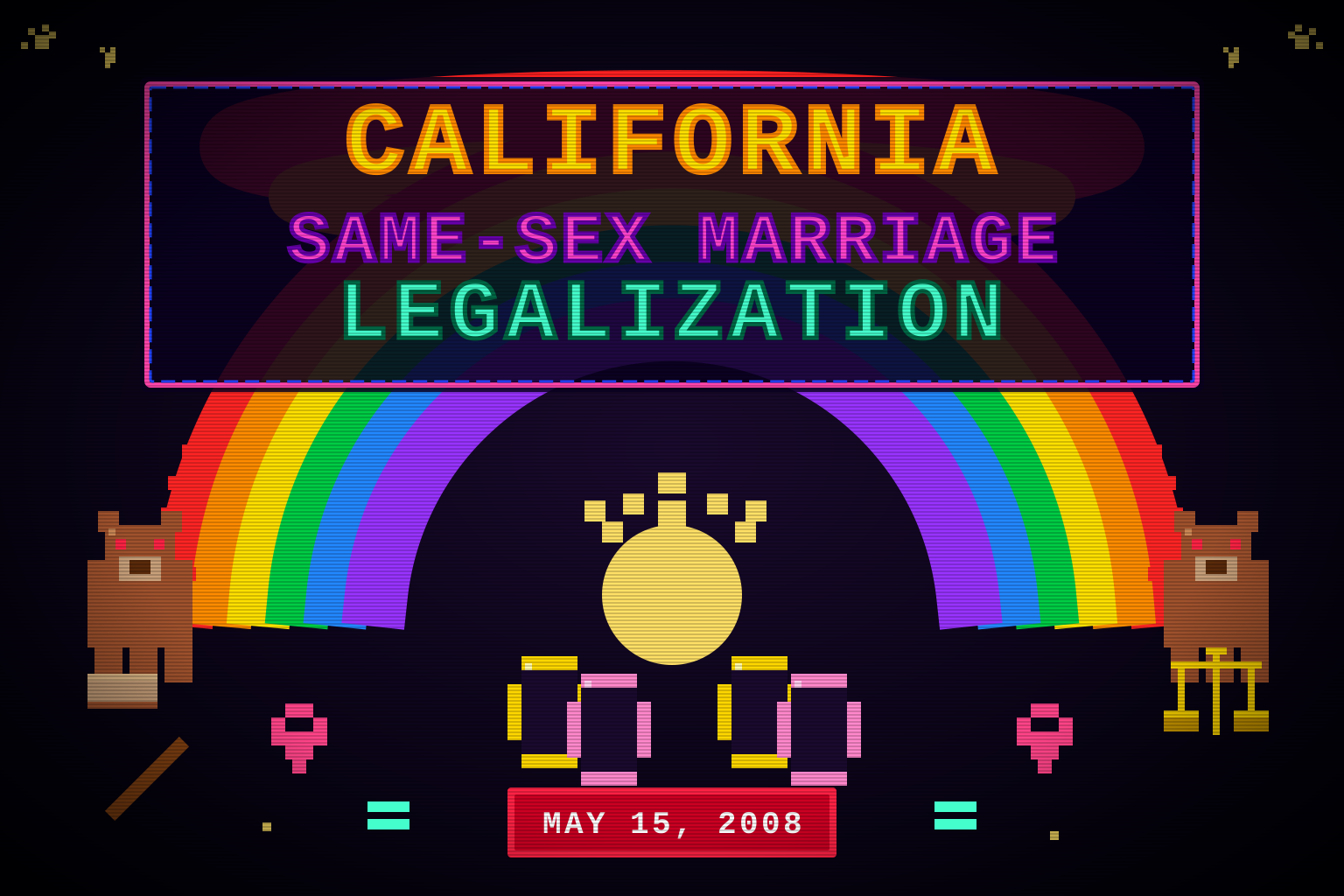
On May 15, 2008, the California Supreme Court issued its landmark decision in In re Marriage Cases, ruling 4–3 that California’s law restricting marriage to opposite-sex couples violated fundamental constitutional rights of due process and equal protection under the California Constitution. The decision legalized same-sex marriage in California, making the state the second in the U.S. (after Massachusetts in 2004) to recognize marriage equality. The decision took effect on June 16, 2008, and approximately 18,000 same-sex couples married over the next four months before California voters approved Proposition 8 on November 4, amending the state constitution to restrict marriage to opposite-sex couples.
The Court’s Decision
The 4–3 majority opinion was written by Chief Justice Ronald M. George, who held that California’s statutory and constitutional provisions limiting marriage to opposite-sex couples violated the state constitution’s guarantee of equal protection and the fundamental right to marry. The majority opinion broke significant new legal ground by holding that sexual orientation is a suspect classification under California law, requiring strict scrutiny of any discriminatory state action — a standard previously applied only to race, religion, and national origin in California courts.
Three justices dissented. Justice Marvin Baxter argued that the majority had overreached by redefining an institution that the legislature and prior ballot measures had established, warning that the court was acting as a super-legislature on a contested social question. Justices Ming Chin and Carol Corrigan each wrote separate dissents questioning whether such fundamental change should proceed through judicial decision rather than democratic deliberation. The majority responded that constitutional protections cannot be made conditional on majority approval.
The case consolidated six lawsuits challenging California’s Family Code § 308.5, enacted by voters in 2000 as Proposition 22, which defined marriage as “a union between a man and a woman.”
The Marriage Window: June 16 – November 4, 2008
The decision took effect on June 16, 2008. County clerks across California reported lines outside their offices within hours of opening. San Francisco Mayor Gavin Newsom — who in February 2004 had ordered the city clerk to issue same-sex marriage licenses in defiance of state law (licenses subsequently voided by the California Supreme Court in Lockyer v. City and County of San Francisco) — officiated at the marriage of Del Martin, 87, and Phyllis Lyon, 84, partners for 55 years and among the plaintiffs in the underlying litigation. Martin passed away on August 27, 2008, having achieved the legal recognition she had sought for decades.
Over the 141 days the marriage window remained open, an estimated 18,000 same-sex couples married in California. State registrar figures show marriages peaking in June and July 2008 before tapering as November’s election approached. Couples came from across the United States and internationally; unlike Massachusetts, California imposed no residency requirement.
Proposition 8 and Its Aftermath
On November 4, 2008 — the same night that Barack Obama was elected president — California voters approved Proposition 8 with 52.3% of the vote, amending the state constitution to define marriage as “only between a man and a woman.” Future same-sex marriages were immediately halted. The California Supreme Court held in Strauss v. Horton (2009) that Proposition 8 was a valid constitutional amendment rather than an impermissible revision, but that the roughly 18,000 marriages performed during the window remained legally recognized.
A federal constitutional challenge — Perry v. Schwarzenegger (later Hollingsworth v. Perry) — filed in May 2009 argued that Prop 8 violated the Fourteenth Amendment. U.S. District Judge Vaughn Walker ruled against Prop 8 in August 2010 after a full trial, finding the measure irrational under any standard of review. After appeals, the U.S. Supreme Court dismissed the case on standing grounds in June 2013, allowing same-sex marriages to resume in California. The equal-protection reasoning developed in In re Marriage Cases and in the Walker trial directly informed Obergefell v. Hodges (June 26, 2015), which established a federal constitutional right to same-sex marriage in all fifty states.
Significance
The California Supreme Court’s decision was the most significant legal victory for LGBTQ rights in U.S. history to that date, elevating marriage equality from a regional Massachusetts precedent to a state representing roughly one-eighth of the U.S. population. Chief Justice George’s opinion provided the most fully developed constitutional framework for marriage equality any appellate court had articulated — particularly the novel holding that sexual orientation triggers strict scrutiny — a framework that shaped every major marriage-equality case that followed. The subsequent passage of Proposition 8 demonstrated the political volatility of judicial rulings on contested social issues and energized both the marriage-equality movement and its opponents, making California the central battleground in the national debate for the next seven years.
Sources
- Wikipedia: In re Marriage Cases — https://en.wikipedia.org/wiki/In_re_Marriage_Cases
- California Courts: California Supreme Court Decision, S147999 (May 15, 2008) — https://www.courts.ca.gov/opinions/documents/S147999.PDF
- Lambda Legal: In re Marriage Cases case summary — https://www.lambdalegal.org/in-court/cases/ca_in-re-marriage-cases
- Britannica: Proposition 8 — https://www.britannica.com/topic/Proposition-8