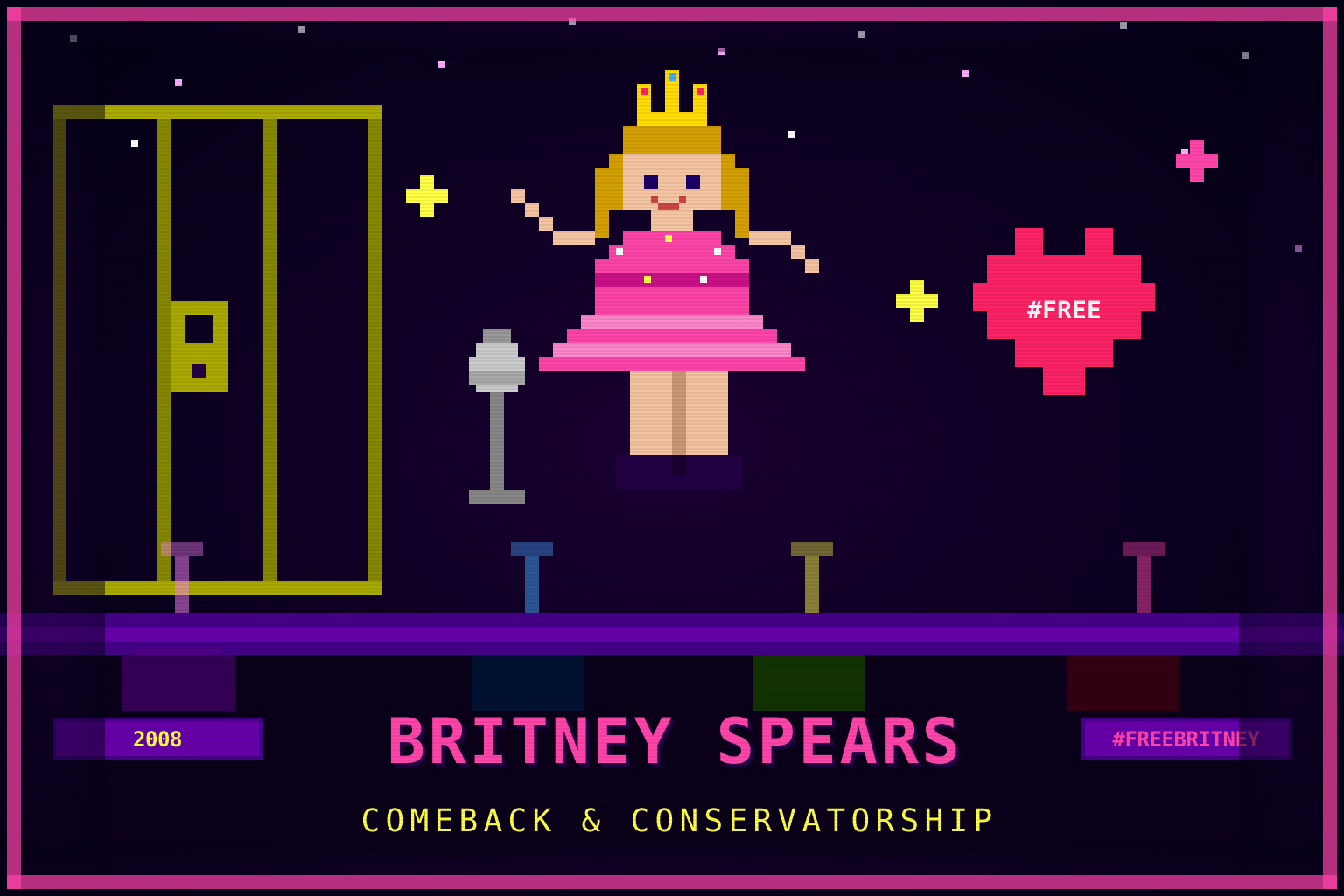
Key figures: Britney Spears (pop singer), Jamie Spears (father/conservator), Lynne Spears (mother), Britney’s legal representatives
Summary
Britney Spears’ hospitalization and subsequent conservatorship in January 2008 marked the most significant turning point in her career and personal life. On January 3, 2008, after erratic behavior and custody disputes over her two children, Spears was placed on a 72-hour involuntary psychiatric hold at Cedars-Sinai Medical Center in Los Angeles. Emerging from the hospital on January 5, Spears was hospitalized a second time at the end of January, and on February 1, 2008, she was formally placed under a temporary conservatorship that granted her father, Jamie Spears, control over her personal decisions and financial assets. The conservatorship would remain in effect for over a decade, becoming one of the most contentious legal arrangements in entertainment history and ultimately sparking a global “#FreeBritney” movement that challenged assumptions about fame, mental health, and legal autonomy.
The crisis came after a turbulent 2007 during which Spears had lost custody of her two young sons (Sean Preston, age 2, and Jayden, age 1), filed for divorce from dancer Kevin Federline, appeared publicly in visibly distressed states, and withdrew from professional life. Media coverage was relentless and often cruel; paparazzi photographs were ubiquitous, and tabloid speculation was intense.
Career Before 2008
Born on December 2, 1981, in McComb, Mississippi, Britney Lynn Spears rose to fame as a pop star following her 1998 debut single “…Baby One More Time,” which became a global phenomenon and sold over 10 million copies worldwide. Through the late 1990s and 2000s, she released multiple platinum albums (Oops!… I Did It Again, 2000; Britney, 2001; In the Zone, 2003; Blackout, 2007) and was one of the world’s highest-earning entertainers, with Forbes estimating her annual income at over $30 million at the peak of her commercial success in 2002. Her personal life was intensely scrutinized — her romantic relationships, divorce from dancer Kevin Federline (married November 2004, divorced July 2007), custody battles over their sons Sean Preston (born September 14, 2005) and Jayden James (born September 12, 2006), and perceived instability became constant media fodder.
2007: The Escalating Crisis
The events of 2007 form the direct backdrop to the January 2008 crisis. A chronology of key moments:
- February 17, 2007: Spears shaved her head at a hair salon in Tarzana, California. Paparazzi photographs of the incident circulated globally within hours, an early demonstration of how the emerging celebrity-media ecosystem — TMZ had launched in November 2005 and was aggregating and monetizing paparazzi footage in near-real time — amplified personal distress into public spectacle.
- March 2007: Entered the Promises Malibu rehabilitation center but departed within 24 hours, twice.
- October 1, 2007: A Los Angeles court commissioner ordered supervised visitation, stripping Spears of joint legal and physical custody of her sons. Coverage was relentless.
- November 2007: Kevin Federline’s attorney filed for primary custody; a judge granted it on November 26, 2007, ordering Spears to have no overnight visits with her children.
- December 2007: Checked into Promises voluntarily but again departed within a day.
By the end of 2007, the tabloid and entertainment press had turned a vulnerable woman’s mental health crisis into a commercial product. Publications such as People, US Weekly, and In Touch devoted cover after cover to Spears; TMZ published surveillance-style footage nightly. Mental health advocates and some journalists at the time raised concerns that media coverage was worsening the situation, but commercial incentives overwhelmed ethical considerations.
The Conservatorship
On January 3, 2008, Spears refused to return her sons following a scheduled visitation, prompting a standoff after which she was taken to Cedars-Sinai for psychiatric evaluation and placed on an involuntary 72-hour hold. She was hospitalized a second time at the end of January, and on February 1, 2008, Los Angeles Superior Court Judge Reva Goetz granted a temporary conservatorship, naming her father, Jamie Spears, and the attorney Andrew M. Wallet as conservators of both her person (personal and medical decisions) and her estate (financial decisions).
The conservatorship was originally filed for 90 days but was extended repeatedly and ultimately lasted 13 years, until November 2021. During this period, Jamie Spears and later co-conservators controlled Britney’s career decisions, personal relationships, medical care, and financial assets. Reports later emerged of restrictive conditions: Spears was required to work against her wishes, placed on psychiatric medications she disputed, denied reproductive choices, and restricted from basic autonomy decisions. She was contractually obligated to perform, generating estimated hundreds of millions of dollars that were controlled by conservators and their attorneys. Court filings from 2021 revealed the estate had grown from approximately $7 million at the conservatorship’s inception to over $60 million under its management — largely through Spears’ own labor.
The Circus Album and Return to Commercial Success
Spears’ public career did not cease entirely — it thrived under the conservatorship even as her autonomy was allegedly stripped away. Her fifth studio album Circus was released on December 2, 2008 — her twenty-seventh birthday — debuting at number one on the US Billboard 200 chart with first-week sales of 505,000 copies. Lead single “Womanizer” became her first number one single on the Billboard Hot 100 since “…Baby One More Time” in 1999, nearly a decade earlier, reaching number one on the Billboard Hot 100 chart dated October 25, 2008. The commercial success of Circus made Spears one of the best-selling artists of 2008–2009 despite — or, critics argued, because of — the heightened public attention from the conservatorship crisis.
She undertook the Circus Tour from March to November 2009, grossing approximately $131.8 million from 96 shows in North America, Europe, and Oceania, making it the seventh highest-grossing concert tour of 2009. She later held the Britney: Piece of Me Las Vegas residency from 2013 to 2017. Her autonomy and agency during all this activity were constrained by the conservatorship.
The #FreeBritney Movement and 2021 Resolution
Beginning around 2014, as details of the conservatorship emerged through court filings and a 2016 documentary, public concern about Spears’ welfare and the appropriateness of the conservatorship grew. A grassroots #FreeBritney movement emerged across social media, eventually gaining mainstream media attention.
In 2021, Spears gave emotional testimony to the court describing the conservatorship as abusive and exploitative. Public outcry intensified, culminating in a September 29, 2021 court ruling that terminated the conservatorship effective November 12, 2021, after 13 years. Her father was removed as conservator in September 2021; a probate court judge ruled the arrangement was no longer necessary.
Significance
The 2008 conservatorship and its 13-year duration had several profound impacts:
Mental Health and Celebrity: The crisis forced a reckoning over how celebrity culture, paparazzi harassment, and public scrutiny contribute to mental health crises. The same year, singer Amy Winehouse — who swept five Grammy Awards that February — faced a parallel, tabloid-amplified struggle, and the two cases together became touchstones in later debates over how celebrity culture treats vulnerable artists. The gap between perceptions of Spears’ alleged instability and the later revelation that she was functional and competent raised troubling questions about who decides when someone “needs” legal conservatorship.
Legal Reform: The case prompted substantive reforms to conservatorship law in California and other states. In 2021, California enacted conservatorship-reform legislation (Assembly Bill 1194), tightening court oversight and accountability, part of a wave of reform spurred in part by Spears’ case.
Gender and Power: The conservatorship highlighted gendered patterns in how female celebrities are controlled, infantilized, and exploited in comparison to male counterparts. Legal scholars and activists linked the case to broader patterns of paternalism and financial coercion in the entertainment industry.
Artist Agency and Autonomy: Spears’ experience became a touchstone for debates about artist autonomy, the ethics of compulsory labor in entertainment, and the rights of performers against managers, labels, and family members.
The January 2008 crisis and ensuing conservatorship represent one of the most significant inflection points in modern celebrity, raising enduring questions about autonomy, mental health, legal justice, and the ethics of fame.