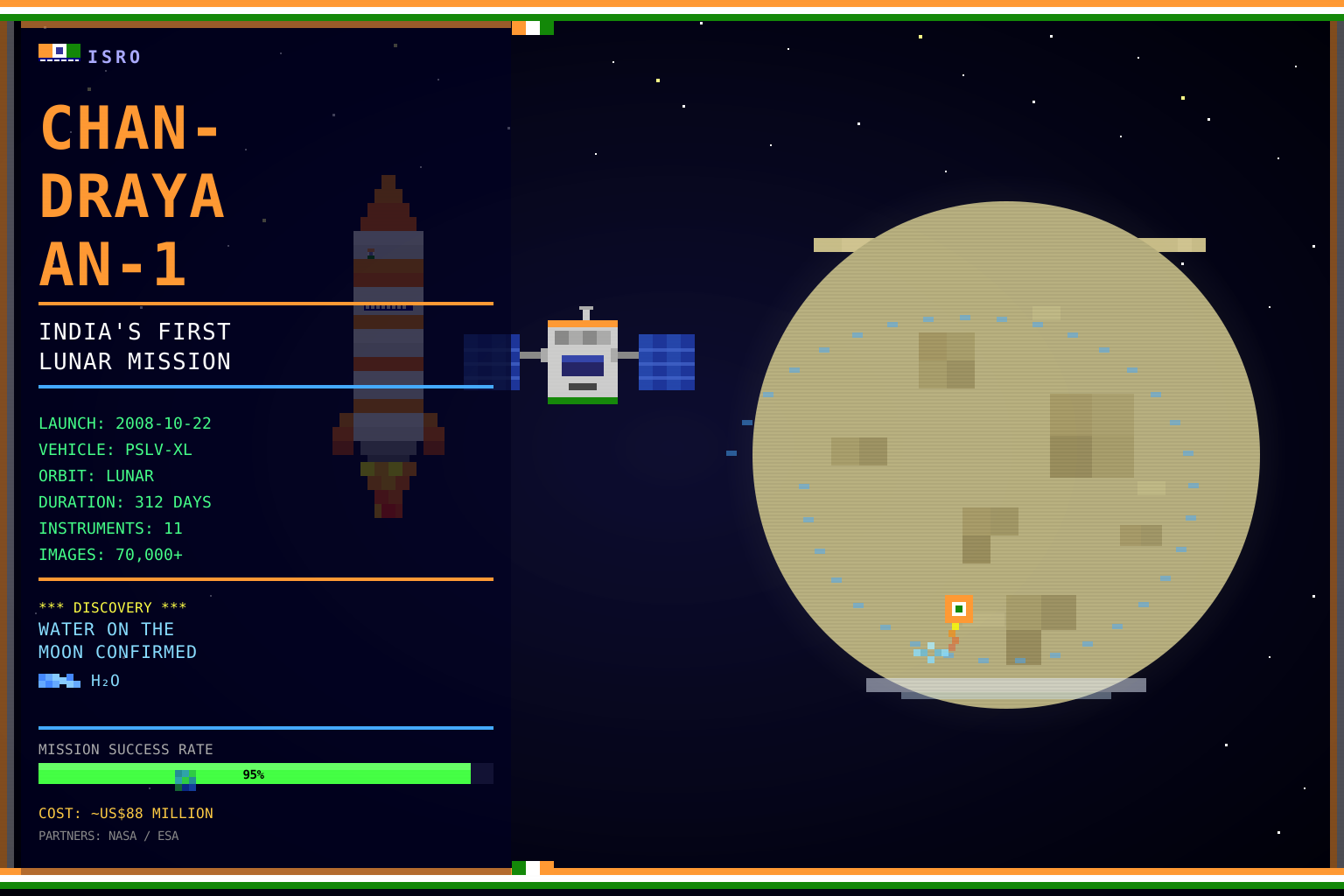
Key figures: Indian Space Research Organisation (ISRO), G. Madhavan Nair (ISRO Chairman), NASA and ESA (instrument partners)
Summary
Chandrayaan-1, India’s first mission to the Moon and its first deep-space mission, launched on October 22, 2008, at 00:52 UTC aboard a PSLV-XL rocket from the Satish Dhawan Space Centre at Sriharikota. Developed by the Indian Space Research Organisation (ISRO), the uncrewed orbiter entered lunar orbit on November 8, 2008, making India the fourth nation or agency to reach the Moon with an orbiter.
The spacecraft carried eleven scientific instruments — a mix of Indian-built payloads and international contributions from NASA, the European Space Agency (ESA), Bulgaria, and other partners. On November 14, 2008, it released the Moon Impact Probe (MIP), which carried the Indian flag and struck the lunar surface near the south pole, at a site later named Jawahar Point, making India the fourth entity to place an object on the Moon.
ISRO lost radio contact with Chandrayaan-1 on August 28, 2009, ending the mission after 312 days — short of its intended two years — but the agency reported that at least 95% of the mission’s objectives had been achieved. The orbiter returned more than 70,000 images of the lunar surface. The mission cost roughly ₹386 crore (about US$88 million).
The Discovery of Lunar Water
Chandrayaan-1’s most consequential result came from NASA’s Moon Mineralogy Mapper (M3), an imaging spectrometer aboard the orbiter. In September 2009, scientists announced that M3 data revealed absorption features characteristic of water (H₂O) and hydroxyl (OH) molecules bound in the lunar soil, most pronounced toward the polar regions. The finding, corroborated by other spacecraft, overturned the long-held assumption that the Moon’s surface was entirely dry and reshaped scientific thinking about lunar resources and the origin of water in the inner Solar System.
The mission also produced high-resolution mineralogical and topographic mapping of the Moon and confirmed water-ice signatures in permanently shadowed polar craters, findings later built upon by subsequent lunar exploration.
Significance
Chandrayaan-1 established India as a spacefaring nation capable of independent deep-space exploration on a modest budget, and it laid the groundwork for the later Chandrayaan-2 (2019) and Chandrayaan-3 (2023) missions — the latter achieving the first soft landing near the lunar south pole. Its detection of lunar water was among the most significant planetary-science results of the decade.
The mission was one of several landmark 2008 space and big-science achievements, arriving the same year as NASA’s Phoenix Mars Lander confirmed water ice on Mars, SpaceX’s Falcon 1 reached orbit as the first privately developed liquid-fueled rocket, and CERN’s Large Hadron Collider circulated its first beam.