Key figures: Peter Smith (Principal Investigator, University of Arizona), Barry Goldstein (Project Manager, NASA Jet Propulsion Laboratory), Ed Sedivy (Lockheed Martin spacecraft program manager)
Summary
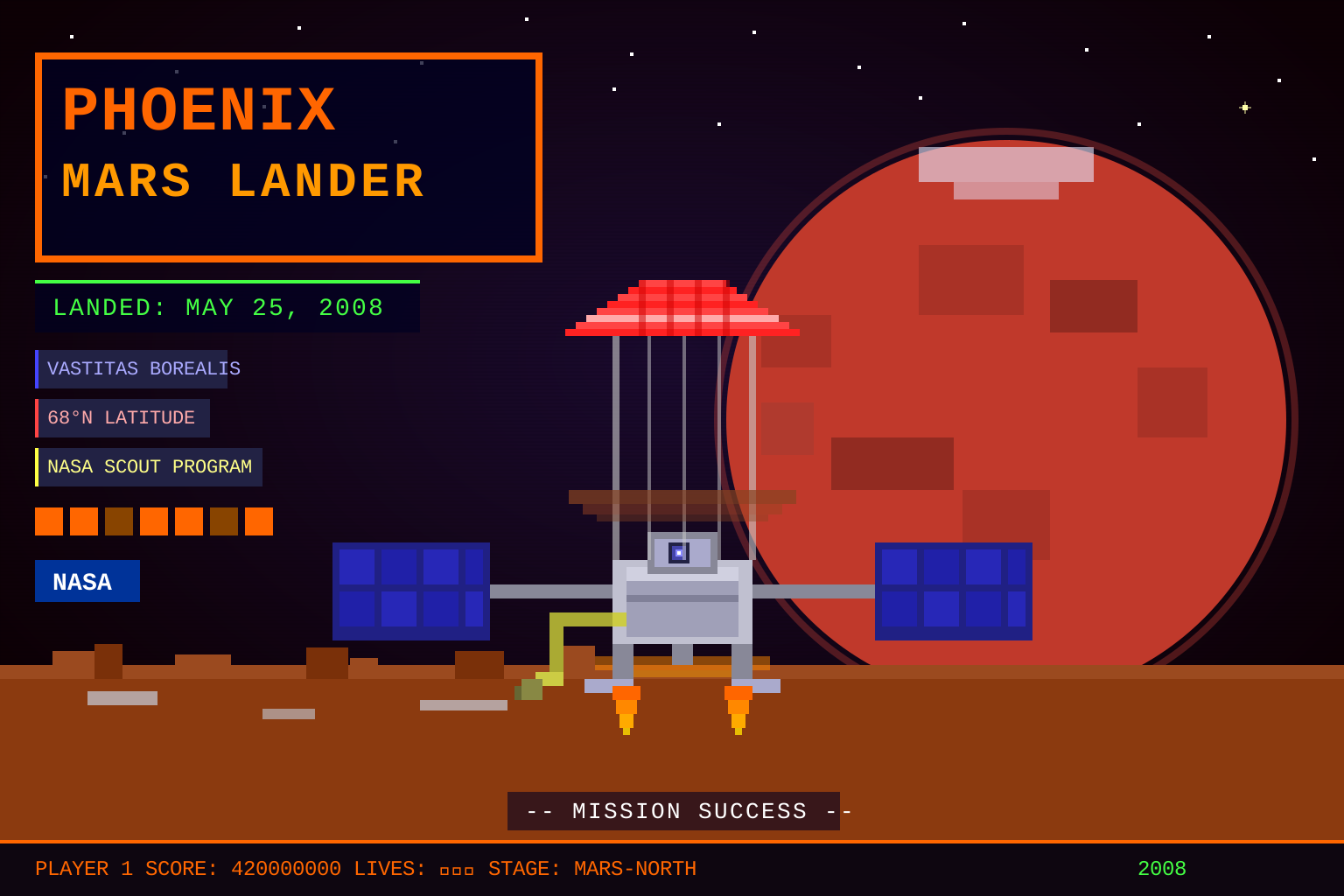
On May 25, 2008, NASA’s Phoenix spacecraft touched down in the northern arctic plains of Mars — the Vastitas Borealis region near 68° north latitude — becoming the first probe to land in a Martian polar region. Launched from Cape Canaveral on August 4, 2007, Phoenix descended through the thin Martian atmosphere at roughly 12,700 miles per hour and, unlike the airbag-cushioned Mars rovers, used a heat shield, parachute, and pulsed descent thrusters to settle gently on three legs — the first successful powered landing on Mars since the Viking probes of 1976. The mission was led by the University of Arizona under Principal Investigator Peter Smith, the first Mars surface mission led by a public university, and was managed by NASA’s Jet Propulsion Laboratory with the spacecraft built by Lockheed Martin. It was the inaugural flight of NASA’s Mars Scout Program, a line of competitively selected, lower-cost missions, at a total cost of approximately $420 million.
Phoenix carried a 2.35-metre robotic arm designed to dig into the icy soil, along with a suite of instruments including the Thermal and Evolved-Gas Analyzer (TEGA), a wet-chemistry laboratory, and cameras. On June 19, 2008, the lander photographed bright chunks of material exposed at the bottom of a trench nicknamed “Dodo-Goldilocks”; when the same spot was imaged four days later, the chunks had vanished, indicating they were water ice that had sublimated on exposure. On July 31, 2008, NASA confirmed the finding when TEGA heated a soil sample and detected water vapour released as the ice melted — the first direct, in-situ confirmation of water ice on Mars. Phoenix also detected perchlorate, a reactive chlorine-based salt, in the soil, a result with significant implications for the planet’s chemistry and potential habitability, and observed snow falling from Martian clouds.
Powered by two solar arrays, Phoenix was never designed to survive the harsh Martian arctic winter. As sunlight dwindled with the approach of winter, the lander’s power declined, and NASA received its last signal on November 2, 2008, after a primary mission of 90 sols that was extended to about five months of operation. Attempts to re-establish contact after the following winter were unsuccessful, and the mission was formally concluded in 2010.
Significance
Phoenix delivered the first ground-truth confirmation of water ice on Mars, transforming a long-standing inference from orbital data — NASA’s Mars Odyssey had detected subsurface hydrogen in 2002 — into a directly observed fact. By landing in the arctic and analysing the frozen soil in place, the mission advanced the central “follow the water” strategy of Mars exploration and sharpened the scientific case that the planet’s polar regions preserve a record of its climate history and possible past habitability. The unexpected discovery of perchlorate reshaped assumptions about Martian soil chemistry and informed the interpretation of later results, including those of the Curiosity rover. As the first successful entry in the Mars Scout Program and the first Mars mission led by a university, Phoenix also demonstrated a lower-cost, competitively selected model for planetary exploration, and its powered soft-landing experience fed forward into the entry, descent, and landing designs of subsequent NASA missions.