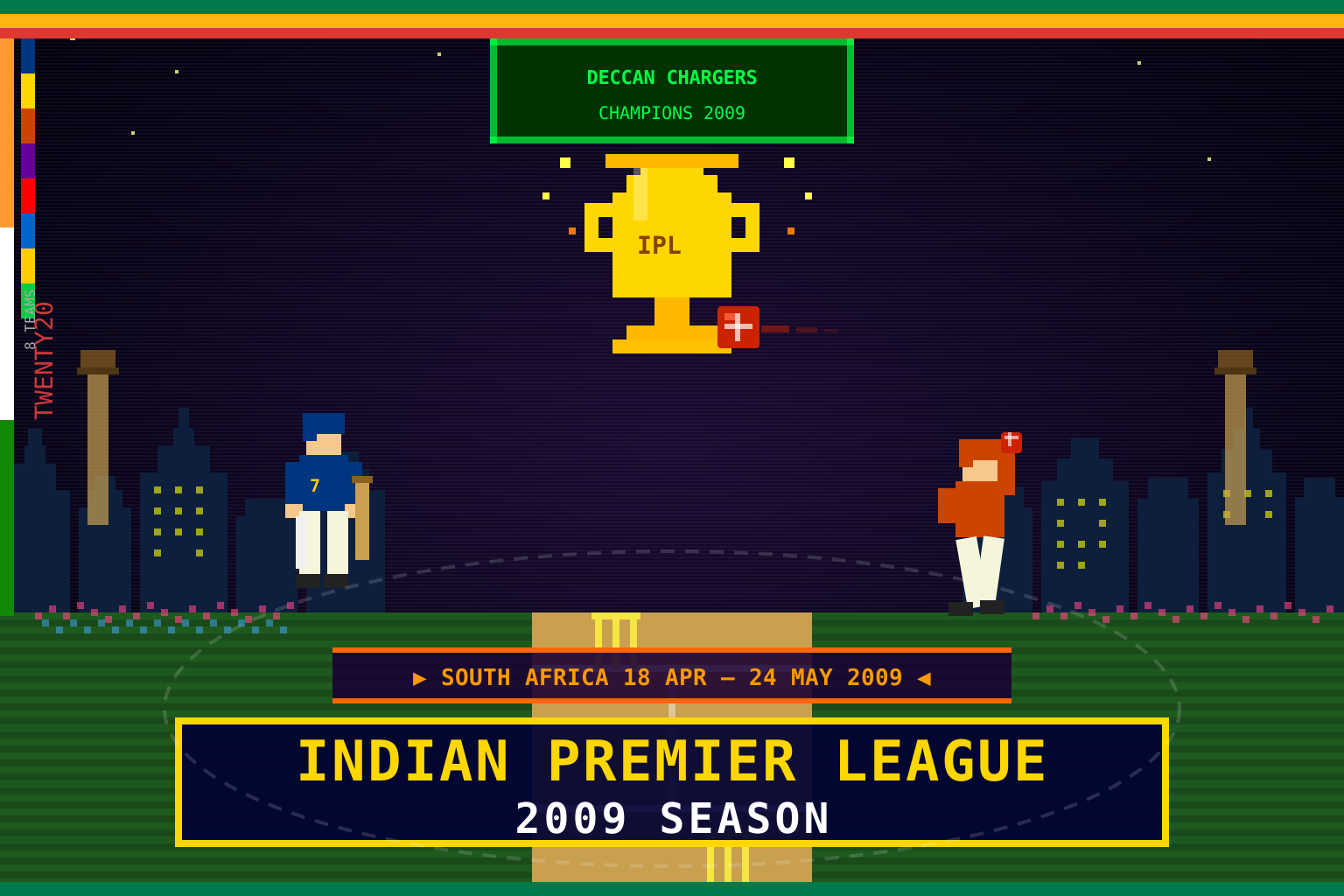
Indian Premier League 2009 Season
Date: 18 April–24 May 2009 Location: South Africa (relocated from India) Category: People & Sports Key figures: Lalit Modi (IPL Commissioner), Adam Gilchrist (Deccan Chargers captain), Anil Kumble (Royal Challengers Bangalore captain), Matthew Hayden (Chennai Super Kings), RP Singh (Deccan Chargers)
Summary
The second season of the Indian Premier League (IPL) ran from 18 April to 24 May 2009 and became the first — and, to date, only — full IPL season played entirely outside India. The Board of Control for Cricket in India (BCCI) relocated the tournament to South Africa after the Indian government indicated it could not guarantee security for matches that clashed with the country’s general election. Eight franchise teams competed across South African venues, with the Deccan Chargers — who had finished last in the inaugural 2008 season — defeating the Royal Challengers Bangalore by 6 runs in the final at the Wanderers Stadium, Johannesburg, on 24 May 2009.
The relocation demonstrated the tournament’s portability: it was organised in a matter of weeks, retained its large Indian television audience, and attracted a broad international playing roster. The season consolidated the IPL’s status as a leading commercial force in world cricket.
The relocation to South Africa
Background and decision
India’s 2009 general election — the world’s largest democratic exercise — was held in phases between mid-April and mid-May 2009, overlapping with the planned IPL window. IPL Commissioner Lalit Modi sought central government security guarantees for match venues during the election period; when adequate assurances were not forthcoming, the BCCI decided in March 2009 to move the entire season abroad rather than postpone it.
South Africa’s Cricket South Africa (CSA) was selected as host within a fortnight of the announcement — an unusually rapid logistical undertaking. Matches were staged at venues including the Wanderers Stadium (Johannesburg), Newlands (Cape Town), Kingsmead (Durban), SuperSport Park (Centurion), and St George’s Park (Port Elizabeth), with the knockout matches held at the larger grounds.
Attendance and audience
Match-day attendance in South Africa was lower than at Indian venues, reflecting the tournament’s dislocation from its home fan base. Its commercial engine, however — driven principally by Indian television rights and sponsorship — remained intact, and the season retained strong broadcast viewership in India.
Tournament highlights
Deccan Chargers’ turnaround
The Deccan Chargers, representing Hyderabad, had finished eighth and last in the 2008 IPL season. Their 2009 championship is regarded as one of franchise cricket’s most striking single-season reversals.
- Adam Gilchrist’s leadership: The Australian wicketkeeper-batsman, who had retired from international cricket in early 2008, captained the Chargers and was among the tournament’s most influential batsmen. He was named the season’s most valuable player.
- Bowling strength: Left-arm fast bowler RP Singh led the tournament’s wicket-takers, and off-spinner Pragyan Ojha supported a balanced attack.
- The final: In the decider at the Wanderers on 24 May 2009, the Deccan Chargers posted 143 for 6 in their 20 overs; Royal Challengers Bangalore, captained by Anil Kumble, were restricted to 137 for 9. Kumble, who took four wickets, was named player of the match despite finishing on the losing side.
Season awards
| Award | Player | Team |
|---|---|---|
| Orange Cap (most runs) | Matthew Hayden | Chennai Super Kings |
| Purple Cap (most wickets) | RP Singh | Deccan Chargers |
| Most Valuable Player | Adam Gilchrist | Deccan Chargers |
Matthew Hayden’s 572 runs led the run charts, while RP Singh’s 23 wickets topped the bowling. New Zealand fast bowler Shane Bond, playing for the Kolkata Knight Riders, drew attention as one of the tournament’s quickest bowlers; his decision to prioritise IPL participation contributed to a wider dispute between New Zealand Cricket and players over franchise commitments.
Commercial and cultural impact
The franchise model
The IPL’s franchise structure — drawing on North American and European professional-sports leagues — had been a novel proposition only two years earlier. By 2009 it had established itself as one of cricket’s most valuable commercial properties, underpinned by long-term broadcast rights and corporate sponsorship. Franchise revenue in South Africa depended far less on gate receipts than on television and sponsorship income, which is why the relocation, despite reducing crowds, did not undermine the tournament’s finances.
Celebrity ownership
The IPL’s celebrity franchise owners became prominent public figures during the 2009 season. Bollywood actor Shah Rukh Khan’s Kolkata Knight Riders drew media coverage out of proportion to the team’s on-field results, while Preity Zinta’s Kings XI Punjab and Shilpa Shetty’s Rajasthan Royals — the 2008 champions — reinforced the crossover between cricket and entertainment culture that broadened the league’s audience.
Effect on international cricket
The 2009 season intensified a structural shift in cricket’s labour market. Shane Bond’s contract dispute with New Zealand Cricket was the year’s most visible case, but several players across the game began negotiating their international commitments around IPL availability. In response, the BCCI and ICC worked toward player-availability arrangements defining a protected IPL window — an early step in the accommodations that franchise cricket would compel from the sport’s governing structures over the following years.
The ICC Champions Trophy 2009, held in South Africa in September and October 2009, took place later the same year at some of the same venues, underlining South Africa’s emergence as a flexible host for international cricket.
Significance
Portability proved: The relocation to South Africa demonstrated that the IPL was not dependent on Indian venues, since its financial base lay in television and sponsorship rather than local gate receipts. The precedent was echoed in 2020, when the IPL was again relocated (to the United Arab Emirates) because of the COVID-19 pandemic.
Twenty20 as prime-time television: The 2009 season confirmed Twenty20 cricket’s capacity to hold prime-time audiences, reshaping how broadcasters packaged the game.
Franchise sport in South Asia: The IPL’s success validated the transplantation of the franchise-sports model to South Asia, opening pathways for later franchise leagues across other sports in India.
Sources
- Wikipedia — 2009 Indian Premier League
- Wikipedia — 2009 Indian Premier League final
- ESPNcricinfo — Deccan Chargers v Royal Challengers Bangalore, Final, Johannesburg, 24 May 2009 (full scorecard)
Related
- ICC Champions Trophy 2009 — International ODI championship in South Africa, same year
- Super Bowl XLIII — Steelers championship — Parallel franchise-sports championship model in 2009
- NBA Finals 2009 — Los Angeles Lakers Championship — Franchise sports championship parallel
- Usain Bolt’s 2009 world records — Athletic peak performance in 2009
</content>