Key figures: Lowell McAdam (Verizon CEO), AT&T, T-Mobile, Sprint, Nokia Siemens Networks, Ericsson, Samsung
Summary
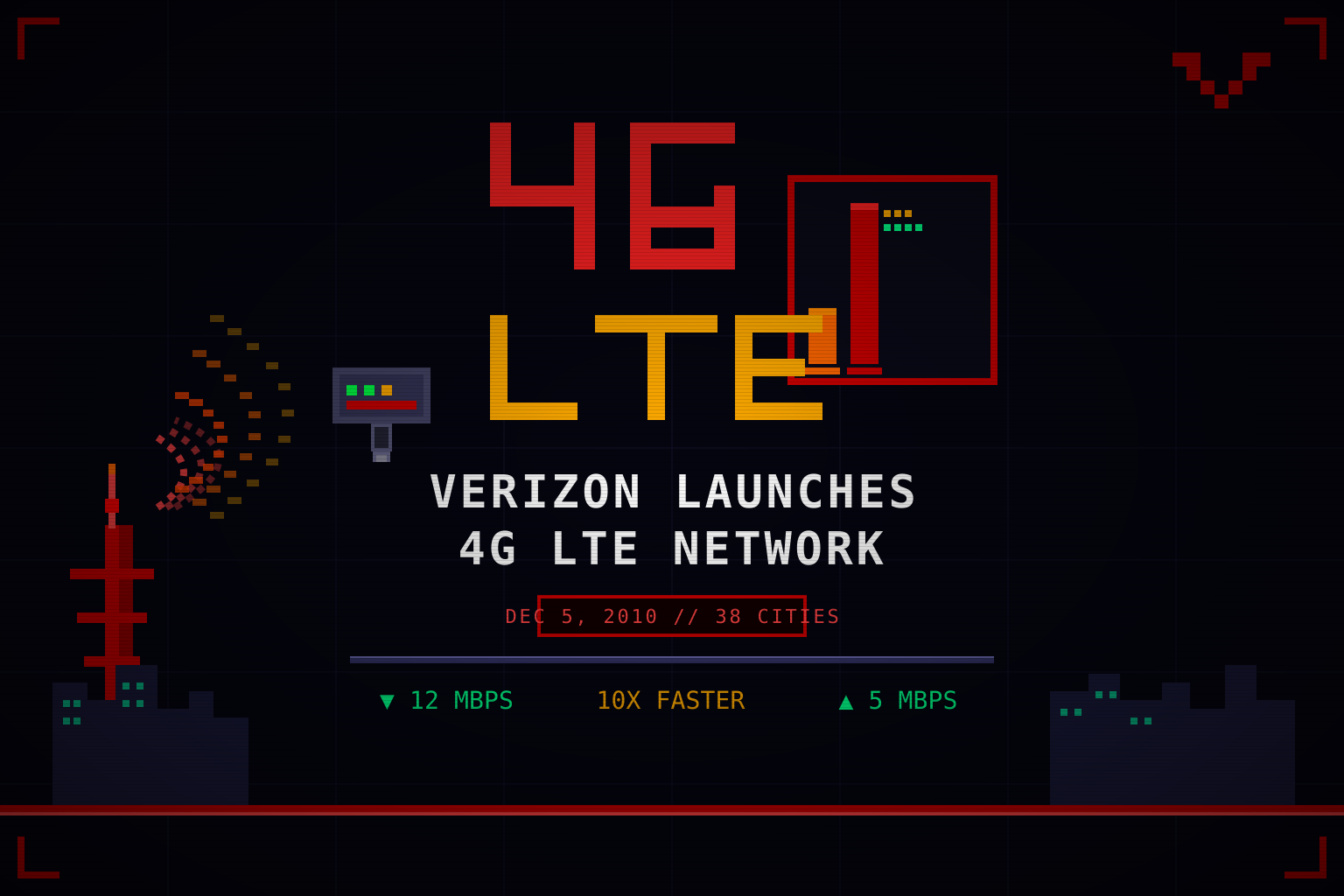
On December 5, 2010, Verizon Wireless launched its commercial Long Term Evolution (LTE) network, becoming the first major U.S. carrier to deploy fourth-generation (4G) mobile broadband at scale. The launch marked the beginning of the 4G era for North American carriers and represented one of the largest infrastructure investments in telecommunications history.
The initial Verizon LTE deployment covered 38 cities and over 60 airports, with downstream speeds of 5–12 Mbps and upstream speeds of 2–5 Mbps—approximately 10 times faster than Verizon’s existing 3G EV-DO network (which peaked at 1–2 Mbps). The first LTE devices available were USB modems: the LG VL600 and Pantech UML290, both priced at $99.99 with a two-year contract. Data plans ranged from $50/month (5 GB) to $80/month (10 GB), pricing that was comparable to the carrier’s 3G offerings but delivered dramatically superior throughput.
The rollout was methodical: Verizon announced the launch date six weeks in advance, allowing developers and equipment manufacturers to prepare. By year-end, only data-only devices (modems) were available; LTE smartphones would not launch until 2011, but the infrastructure investment signaled Verizon’s commitment to transitioning the entire network toward LTE over the following years.
Technical Innovation and Infrastructure
Verizon’s LTE network deployment required massive capital investment and technological transition:
Spectrum allocation: Verizon deployed LTE on its 700 MHz spectrum, acquired in the 2008 FCC auctions. The 700 MHz band offered superior propagation characteristics (longer range, better building penetration) compared to higher-frequency spectrum, making it ideal for nationwide LTE deployment.
Network architecture: LTE represented a fundamental shift from the voice-centric circuit-switched architecture of previous generations (1G–3G) to an all-IP, packet-switched architecture. This transition required new core network infrastructure, new base stations (eNodeBs), and new device modems—a transformation that was technically complex and expensive.
Equipment partnerships: Nokia Siemens Networks, Ericsson, and Samsung provided LTE infrastructure equipment. The diversity of suppliers prevented any single vendor from monopolizing the 4G build-out and allowed competitive pricing.
Testing and validation: Verizon deployed limited LTE in select markets starting in 2009 (Austin, Kansas City) to test coverage, device performance, and network reliability before commercial launch. This careful approach minimized launch disruptions.
Competitive Context
Verizon’s December 2010 LTE launch gave it a significant head start over competitors:
- AT&T: AT&T announced its own LTE launch for late 2011, but delayed deployment and coverage lagged Verizon. AT&T’s 4G brand initially focused on HSPA+ (3G evolution), creating confusion in the market.
- T-Mobile: T-Mobile lacked the capital and spectrum holdings for rapid LTE deployment. The carrier continued its 3G expansion and would not launch LTE until 2012.
- Sprint: Sprint committed to WiMAX (not LTE) as its 4G standard, a strategic error that forced the carrier to later abandon WiMAX and build an LTE network from scratch, ceding competitive ground to Verizon and AT&T.
- MetroPCS: The carrier announced a limited LTE deployment in Las Vegas but lacked the capital to scale nationally.
By committing first and most decisively to LTE, Verizon positioned itself to capture early 4G market demand and to establish 4G-first devices as a consumer expectation.
Market Implications
The 2010 Verizon LTE launch had several strategic implications:
Device ecosystem acceleration: The availability of 4G infrastructure created demand for LTE-capable devices, spurring manufacturers (Samsung, HTC, Motorola, Nokia) to accelerate LTE phone and tablet development. By 2012, LTE smartphones were becoming mainstream.
Data consumption growth: 10x faster data speeds reduced the friction for bandwidth-intensive applications. Video streaming, high-resolution photo sharing, and real-time mobile gaming became practical; this acceleration in data consumption drove growth in wireless data revenue and influenced content strategies for media companies, streaming services, and social platforms.
Spectrum value: LTE’s technical efficiency (delivering more capacity per MHz of spectrum) validated high prices for spectrum in subsequent FCC auctions. The 2011 and subsequent auctions saw carriers bidding aggressively for spectrum, accelerating the transition to LTE as the industry standard.
Network infrastructure transition: The move from circuit-switched to packet-switched (IP) networks was a watershed moment. It enabled the network to become more like the internet—connectionless, stateless, and fundamentally compatible with web services and OTT (over-the-top) applications. This transition empowered startups and disrupted traditional telecom service revenue models by enabling competitors to offer calling, messaging, and video over IP.
Regulatory and Policy Context
Verizon’s LTE launch occurred within a specific regulatory environment that shaped the technology’s deployment:
700 MHz spectrum auction (2008): The FCC auctioned 700 MHz spectrum recovered from the analog television broadcast transition, raising $19.6 billion — the largest spectrum auction in U.S. history at the time. Verizon spent approximately $9.4 billion acquiring 700 MHz C-block licenses, which became the primary band for its LTE network. The auction’s open-access requirements (mandating open devices and open applications on C-block spectrum) were negotiated partly through Google’s advocacy and contributed to the open-standards ecosystem that LTE represented.
Net neutrality and 4G: The December 5, 2010 LTE launch occurred just 16 days before the FCC adopted the 2010 Open Internet Order on December 21, 2010. The Open Internet Order imposed lighter net-neutrality obligations on mobile broadband than on fixed broadband, acknowledging mobile networks’ capacity constraints — a distinction that enabled carriers to implement traffic prioritization on nascent 4G networks. This lighter-touch mobile regulatory approach would be contested for years.
Capital investment scale: Verizon committed approximately $6–7 billion per year in capital expenditure to build out its 4G LTE network between 2010–2015, with the total 4G build-out eventually exceeding $30 billion. This capital commitment, concentrated in a single carrier, accelerated U.S. deployment relative to European and Asian markets where spectrum licensing costs and carrier fragmentation slowed build-out. By the end of 2011, Verizon’s LTE covered more than 175 markets and approximately 200 million people — roughly two-thirds of the U.S. population.
LTE Rollout Timeline
| Date | Event |
|---|---|
| June 2008 | FCC auctions 700 MHz spectrum; Verizon wins C-block for $9.4B |
| 2009 | Verizon deploys limited LTE trials in Austin, TX and Kansas City, MO |
| December 5, 2010 | Commercial LTE launch: 38 cities, 60+ airports; USB modem devices only |
| Q1 2011 | First LTE smartphones: HTC Thunderbolt (February), LG Revolution (May) |
| End of 2011 | Coverage expanded to 175 markets, ~200 million people; AT&T launches its own LTE |
| 2012 | LTE smartphones become mainstream; iPhone 5 (September 2012) adds LTE support |
| 2013 | T-Mobile launches LTE; Sprint begins LTE deployment after abandoning WiMAX |
The Competitive Response and Implications
Verizon’s LTE launch forced immediate recalibration among competitors:
- AT&T fast-tracked its own LTE deployment, despite having previously invested in HSPA+ as its “4G” brand.
- T-Mobile, lacking capital for rapid LTE deployment, became a takeover target. The carrier would eventually be acquired by Deutsche Telekom and later gain spectrum and momentum through various transactions.
- Sprint’s commitment to WiMAX proved disastrous and contributed to the carrier’s long-term decline in market share and financial performance.
This competitive divergence—with Verizon and AT&T pursuing LTE aggressively, while T-Mobile and Sprint fell behind—reshaped the U.S. wireless market structure. By 2020, Verizon and AT&T would dominate the market, while T-Mobile and Sprint would merge. The 2010 LTE launch was the crucial inflection point.
Significance
Verizon’s December 2010 4G LTE launch marked the beginning of the transition from mobile phone networks (primarily optimized for voice) to mobile data networks (optimized for broadband). The implications were profound:
-
Infrastructure transition: LTE and its successors (5G) would require hundreds of billions of dollars in capital investment from carriers worldwide, making telecommunications infrastructure a capital-intensive business for decades to come.
-
Data over voice: With 4G LTE’s speed and efficiency, voice calling became a commodity service, while data became the revenue driver. This shift disadvantaged carriers with legacy voice-centric business models and advantages carriers with spectrum holdings and infrastructure capital.
-
Mobile-first ecosystem: LTE’s speed enabled the mobile-first consumer and enterprise ecosystem that emerged in the 2010s. Ride-sharing (Uber), streaming video (Netflix, YouTube), social media, cloud services, and e-commerce all depended on reliable high-speed mobile data. Verizon’s LTE launch was a necessary (though not sufficient) condition for these industries’ growth.
-
Competitive narrowing: The capital and spectrum requirements for 4G deployment created barriers to entry, consolidating the wireless industry from four major carriers to effectively two (Verizon and AT&T) by 2020. This consolidation reduced consumer choice but enabled the carriers to fund sustained infrastructure upgrades.
-
Global standard: LTE became the globally dominant 4G standard, adopted by carriers worldwide. This contrasted with 3G, which had fragmented into GSM, CDMA, and WCDMA. Standardization on LTE simplified device manufacturing and enabled true global roaming, supporting the emergence of global smartphone brands and apps.
Sources
- Verizon Wireless Launches 4G Network Dec. 5 — NBC Bay Area
- 2010 Year in Review: LTE Becomes a Reality with Verizon, MetroPCS Launches — Fierce Network
- Verizon 4G LTE Launch — NBC News
- Verizon Wireless Launches Its LTE Network: Let The 4G Wars Begin — Forrester