Key figures: Steve Jobs (Apple), Andy Rubin (Android/Google), Paul Otellini (Intel), Steve Ballmer (Microsoft)
Summary
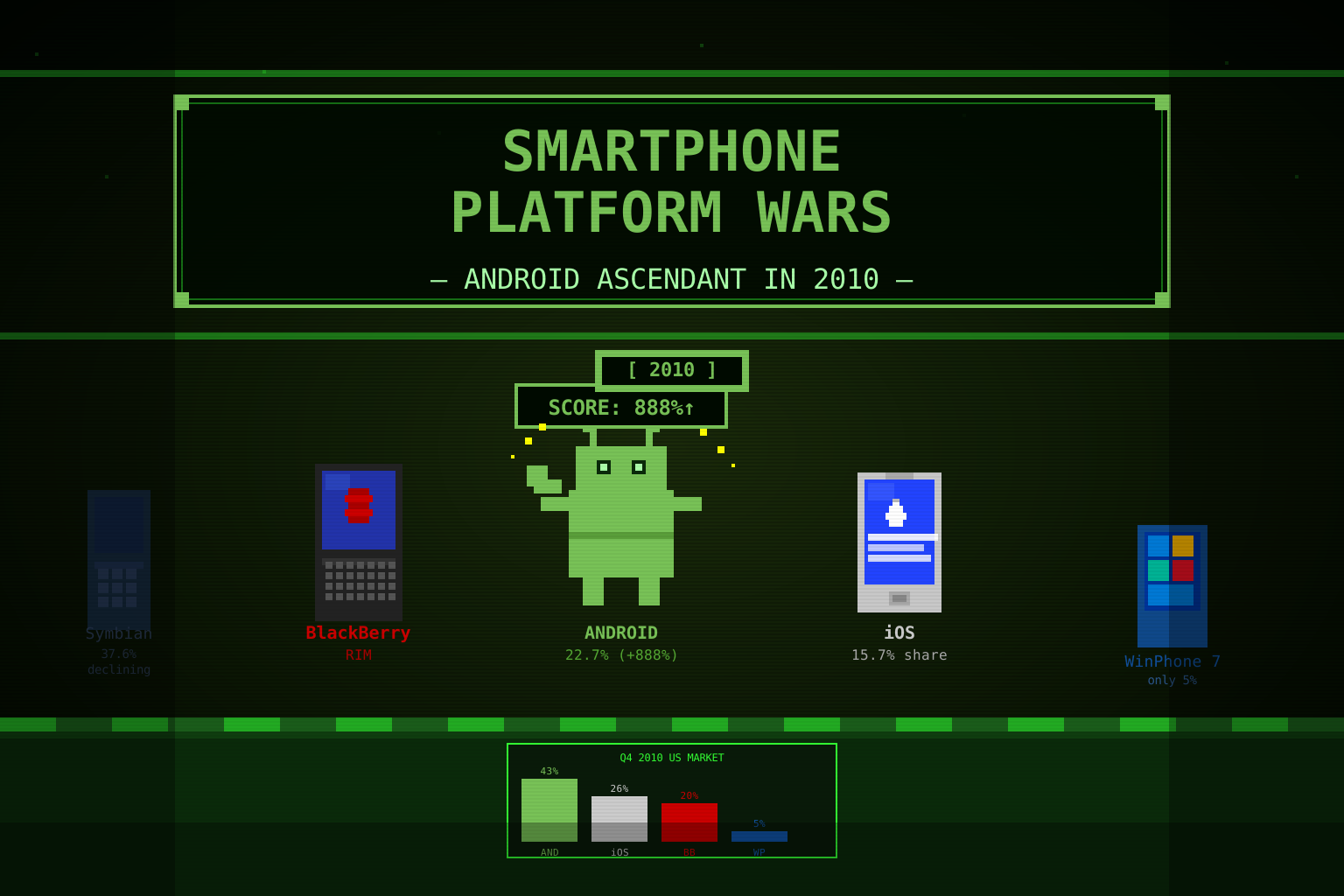
The year 2010 marked a decisive inflection point in smartphone platform competition. At year’s start, the market remained fragmented: Symbian dominated globally (37.6% share with 111.5 million units), but Apple’s iPhone and Google’s Android were ascending rapidly. By year-end, Android had captured 22.7% of global smartphone sales—a remarkable 888% surge from 2009—leapfrogging Apple’s iOS (15.7% share) to claim the second position and establishing a three-way dominant platform ecosystem alongside BlackBerry RIM.
The shift was particularly pronounced in the U.S. market, where quarterly growth rates proved extraordinary. In Q4 2010, Android accounted for 43% of U.S. smartphone sales, compared to 26% for iOS and 20% for BlackBerry. Meanwhile, Microsoft’s new Windows Phone 7 (launched October 2010) captured only 5% of Q4 U.S. sales, marking a strategic failure for the company’s late entry into the mobile revolution.
The year’s smartphone launches drove this competition: Apple’s iPhone 4 (June), with its revolutionary Retina display and FaceTime video calling, generated enormous demand. Google’s Android ecosystem flourished through manufacturer partnerships: HTC Desire (March), Samsung Galaxy S (June), and a flood of other handsets ran the increasingly competitive open-source platform. Simultaneously, the maturation of mobile app ecosystems—Apple’s App Store reaching 300,000+ apps by year-end; Google Play growing rapidly—shifted competition from hardware alone to services, content, and developer ecosystems.
The Rise of Android
Android’s 888% growth from 2009 to 2010 was the result of several factors:
Hardware diversity: Unlike iOS, which ran exclusively on Apple’s hardware, Android’s open licensing model attracted numerous manufacturers. HTC, Samsung, Motorola, and smaller vendors all released Android phones at various price points, making smartphones more accessible to emerging markets and cost-conscious consumers.
Carrier partnerships: Verizon Wireless, AT&T, and T-Mobile all aggressively promoted Android phones as iPhone alternatives. Verizon’s Droid line (starting in late 2009) provided a branded Android competitor to AT&T’s exclusive iPhone arrangement. By 2010, every major U.S. carrier offered multiple Android devices.
Software maturity: Android 2.2 Froyo (July 2010) and Android 2.3 Gingerbread (December 2010) added crucial features—froyo’s just-in-time compiler doubled application performance; both versions added USB tethering and mobile hotspot capabilities that iOS lacked, directly attracting enterprise and power users.
Developer ecosystem: Google’s Play Store (formerly Android Market) rapidly accumulated applications, reaching parity with the App Store by late 2010, reducing the “app gap” that had previously favored iOS.
The iOS Defense
Apple responded to Android’s surge not by expanding hardware compatibility but by deepening the integrated Apple ecosystem:
- iPhone 4 (June): The Retina display (326 ppi, highest pixel density of any smartphone at the time) set a new industry standard, rendering Android phones’ lower-resolution screens noticeably inferior. FaceTime introduced video calling as a standard feature.
- iOS 4 (June 21): Multitasking, folders, and Game Center added organizational and gaming capabilities.
- iPad (April): Positioned between iPhone and laptop, it established a new computing category and created an ecosystem lock-in effect, as users bought multiple Apple devices.
Despite these innovations, iOS fell from roughly 25% U.S. market share in Q1 2010 to 26% in Q4—essentially flat—while Android tripled from ~15% to ~43%. The gap between Apple’s rate of innovation and Android’s rate of market acquisition was stark.
BlackBerry’s Decline and Windows Phone’s Failure
By 2010, cracks were emerging in other platforms:
BlackBerry RIM: Once dominant in enterprise, RIM held ~20% of Q4 2010 U.S. smartphone sales, but its aging OS and lack of consumer-friendly features—no capacitive touchscreen parity, limited app ecosystem, poor media handling—relegated it to business users and older demographics. The launch of iPhone and Android’s rapid maturation made the BlackBerry a luxury rather than a necessity.
Windows Phone 7 (October 21, 2010): Microsoft’s radical redesign, with a new tile-based “Metro” interface, was critically praised for innovation but arrived too late and too incomplete. Shipping without copy-paste (added in February 2011), third-party multitasking, or significant app catalog, Windows Phone 7 captured only ~5% of Q4 U.S. sales. The platform’s failure to gain traction was a turning point: Microsoft would never recover meaningful smartphone market share.
App Ecosystems and the Developer Economy
By 2010, the competition extended far beyond hardware to software ecosystems and developer economics:
Apple App Store: Opened July 2008 with roughly 500 apps, the App Store reached 225,000 apps and 5 billion cumulative downloads by June 2010. On August 30, 2010, it passed the 250,000-app milestone, closing the year at approximately 300,000 apps and 7 billion downloads total. Apple’s 70/30 revenue split with developers (Apple keeping 30%) channeled a wave of small developers into full-time businesses, with “app developer” emerging as a viable independent profession in 2010. The iOS 4 platform upgrade introduced multitasking, app folders, and Game Center — extending the App Store’s addressable market to social gaming at scale.
Google Android Market: Android’s open platform attracted developers through lower submission barriers (no upfront review gatekeeping, $25 one-time developer fee vs. Apple’s $99/year). The Android Market reached approximately 100,000 apps by year-end 2010, still trailing the App Store but growing rapidly. Android’s market was more fragmented across device types but benefited from the diversity of hardware at multiple price points.
Revenue dynamics: Apple’s App Store generated $1.43 billion in developer revenues in 2010, growing ~90% from 2009. Games dominated (accounting for roughly 70% of App Store revenue), with companies like Angry Birds developer Rovio ($67 million revenue in 2010, up from $75,000 in 2009) demonstrating the platform’s potential for exponential startup growth. The emergence of freemium mechanics (in-app purchases enabled by iOS 4) was beginning to reshape app monetization.
Video and streaming: Mobile video became practical in 2010 as a byproduct of faster processors and 3G data. YouTube’s platform evolution included a mobile-optimized interface, and Netflix began streaming to mobile devices, foreshadowing the 4G-enabled video economy that would emerge in 2011–2012.
Market Structure in 2010
By year-end, the global smartphone market had crystallized into a two-tier structure:
| Platform | 2010 Global Share | 2010 US Q4 Share | Trajectory |
|---|---|---|---|
| Symbian | 37.6% (dominant outside US) | ~10% | Declining |
| Android | 22.7% (888% YoY growth) | 43% | Accelerating |
| iOS | 15.7% | 26% | Sustained growth |
| BlackBerry | ~10-15% | 20% | Declining |
| Windows Mobile/Phone | 4.2% | 5% | Failing |
The emergence of a duopoly was visible by Q4: iOS and Android combined for ~70% of U.S. smartphone sales and would exceed 80% by 2011. This two-platform dominance—unlike the five-way split of 2008—would define the next decade of mobile computing and reshape the competitive landscape for software, hardware, services, and media.
Significance
The 2010 smartphone platform wars represented more than a commercial competition; they marked the structural shift from phone-as-device to phone-as-platform. Apple’s model—proprietary hardware and software, premium pricing, ecosystem lock-in—proved vulnerable to Android’s model—open architecture, manufacturer diversity, rapid iteration, and OEM partnership.
The outcome was not winner-take-all but rather a durable two-player market in which:
-
Openness beat exclusivity (in market share): Android’s openness allowed rapid proliferation across price tiers and geographies, outpacing iOS’s premium-focused distribution.
-
Carrier partnerships mattered: Verizon’s exclusive iPhone deal with AT&T ended post-2010; this shift to multi-carrier Android distribution accelerated Android’s growth and reduced iPhone’s market leverage.
-
Developer ecosystems became paramount: The race shifted from installed base to app availability and quality, a dynamic that heavily favored both iOS and Android and hastened the decline of BlackBerry and Windows Phone.
-
The app economy emerged: 2010 marked the inflection point at which apps—not voice, text, or even mobile web browsing—became the defining value proposition of smartphones. This shift validated Android’s lower barriers to entry (free OS, open source, multiple manufacturers) as the sustainable competitive model.
The 2010 smartphone wars laid the foundation for the next decade’s mobile-first economy: e-commerce, social media, content streaming, and services all became phone-first in strategy and execution. The Android-iOS duopoly also established the two-sided platform economics (developers vs. users) that would characterize the digital economy through the 2010s.
Sources
- Gartner: Android OS Sales Trump iOS and RIM, Grew 888 Percent in 2010 — TechCrunch
- Android Smartphone Sales Leap to Second Place in 2010, Gartner Says — Computerworld
- Smartphone U.S. Market Share Analysis — ResearchGate
- Android is 10 Years Old — World Economic Forum