Key figures: Vinod Khosla (Khosla Ventures), John Doerr (Kleiner Perkins), BrightSource Energy, Solyndra, Fisker Automotive
Summary
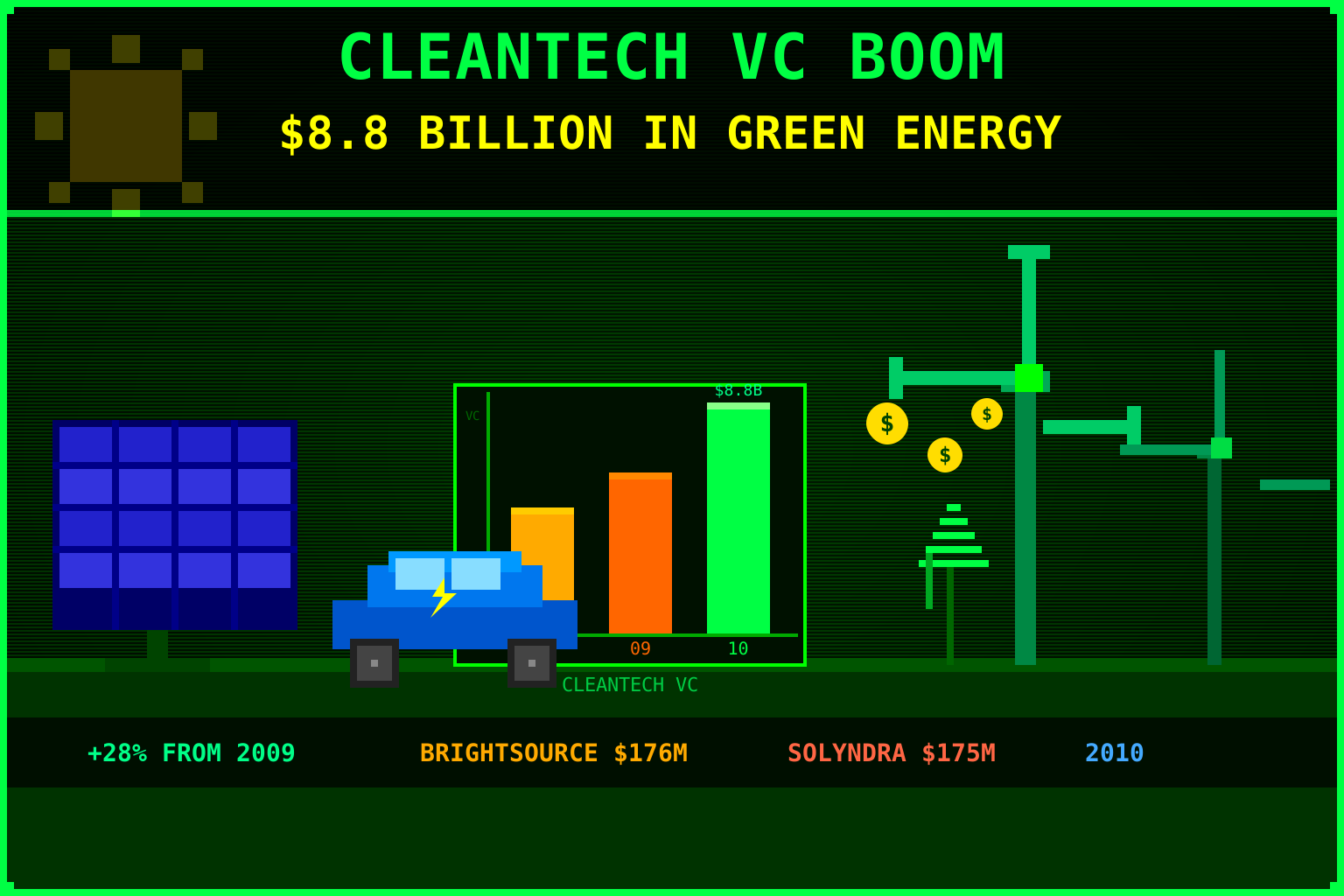
In 2010, cleantech and renewable energy attracted unprecedented venture capital funding, with global clean energy investment reaching $243 billion and cleantech-specific venture capital climbing to $8.8 billion—a 28% increase from 2009. This surge reflected two convergent dynamics: the recovery of venture capital broadly post-financial crisis (visible in the $21.8 billion total U.S. VC market) combined with accelerating policy support for renewable energy, climate action, and energy independence.
The U.S. cleantech venture capital market specifically deployed $1.5 billion across 68 financing rounds in Q2 2010 alone, a 63.8% increase in capital from Q2 2009. Major funding rounds went to solar companies: BrightSource Energy ($176 million), Solyndra ($175 million), and others; wind energy companies; and smart-grid and energy-storage startups. For a period, cleantech ranked among the highest-growth venture sectors, attracting not only traditional VC firms but also megafunds like Kleiner Perkins and newly established climate-focused funds like Khosla Ventures (founded 2004 by Vinod Khosla).
This 2010 cleantech boom represented the apex of a multi-year surge in venture investment in climate-related technologies, fueled by:
- Growing climate consciousness and policy action (Obama administration support; EU climate targets)
- High oil prices (2007–2008 spike, sustained at $70–90/barrel through 2010)
- Venture investors’ conviction that energy and materials innovation (analogous to IT) could drive exponential efficiency gains
- Government support mechanisms: tax credits, grant programs (e.g., U.S. Department of Energy grants), and preferential procurement
The Cleantech Sectors of 2010
Venture capital in 2010 concentrated on four primary sectors:
Solar photovoltaics: Solar received the largest share of cleantech VC funding, with companies developing next-generation cell technologies (thin-film, multi-junction, perovskites), manufacturing automation, and residential/commercial deployment platforms. BrightSource (concentrated solar thermal), Solyndra (thin-film solar), and companies like SunPower benefited from venture backing.
Wind energy: Wind received 40% VC and PE growth in 2010, with $277 million invested compared to $198 million in 2009. Funding focused on offshore wind turbine technology, blade aerodynamics, and control systems that could reduce Levelized Cost of Energy (LCOE).
Energy efficiency: Smart building technologies, HVAC optimization, and behavioral energy-management startups attracted strong VC interest. These companies promised low-risk paybacks through operational cost savings, making them attractive to risk-averse fund managers.
Smart grid and energy storage: Utilities were beginning to digitize grid infrastructure, creating opportunities for demand-response software, grid management platforms, and battery storage. Tesla’s energy division and battery startups like Ener1 attracted significant funding.
Policy Drivers and Expectations
The 2010 cleantech boom was underpinned by optimism about policy support:
-
Obama administration: The 2009 stimulus package included $90 billion for clean energy and energy efficiency R&D and deployment. The EPA’s authority to regulate CO₂ emissions (upheld by the Supreme Court) created regulatory certainty for renewables. Feed-in tariff policies and renewable portfolio standards (RPS) in multiple states guaranteed long-term demand.
-
International climate policy: The Copenhagen Accord (December 2009) and ongoing UNFCCC negotiations created expectations of a binding global climate agreement, spurring private-sector confidence in climate-related investments.
-
Energy security: Oil price volatility and supply concerns (Persian Gulf geopolitical risk) created national security rationales for renewable energy, attracting bipartisan political support.
-
China’s green initiatives: China’s massive renewable energy expansion and manufacturing of solar panels and wind turbines created a global renewable energy market that venture-backed companies could service.
Investment Narratives and Expectations
Venture investors in 2010 framed cleantech through an innovation-driven narrative: that exponential improvements in solar efficiency, wind capacity factors, battery energy density, and grid intelligence could make renewables cheaper than fossil fuels within a decade, enabling a complete energy transition. This narrative paralleled the IT revolution—Moore’s Law in semiconductors, exponential growth in computing power—and implied that venture-scale capital could drive similar exponential improvements in energy technology.
This optimism was captured in Khosla Ventures’ explicit mission and in prominent venture investors’ rhetoric. John Doerr famously stated that climate change was a “fundamental challenge” for venture capital and technology, attracting top talent to cleantech from successful tech exits (e.g., Elon Musk founding Tesla; founders from Google and Apple launching cleantech startups).
Competitive Dynamics
2010 cleantech investment saw intense competition among venture firms to establish themselves in the space:
- Kleiner Perkins backed Fisker Automotive ($204 million+ raised by 2011) and participated in numerous solar and battery deals.
- Khosla Ventures focused on “black swan” technologies and systemic solutions.
- VantagePoint Capital specialized in renewable energy.
- Traditional generalist VCs (Accel, Sequoia, Google Ventures) allocated meaningful capital to cleantech, signaling the sector’s legitimacy.
Global Investment Landscape
While U.S. venture capital dominated cleantech headlines, the global picture was shaped as much by government-directed investment and manufacturing scale as by Silicon Valley:
China’s emergence: China deployed approximately $54.4 billion in clean energy investment in 2010 — the largest single-country total globally, exceeding the U.S. figure ($34 billion) and Germany’s ($41.2 billion). This included state-backed loans to solar manufacturers (Yingli, JinkoSolar, Suntech), wind turbine manufacturers (Goldwind, Sinovel), and grid infrastructure. China’s 12th Five-Year Plan (announced in 2010, effective 2011) set binding targets of 15% non-fossil energy by 2020 and established the government as the anchor customer for domestic renewable manufacturers. This state-backed scale manufacturing, not venture-funded innovation, was the dominant force in driving solar panel prices down 75% between 2008–2013.
Europe’s position: Germany led European cleantech investment at $41.2 billion, primarily through its Energiewende (energy transition) policy that included solar feed-in tariffs guaranteeing above-market prices for 20 years. Spain, which had established similar solar feed-in tariffs in 2007–2008, began pulling back support in 2010 due to fiscal constraints from the European sovereign debt crisis, foreshadowing how policy dependency would destabilize solar investment.
United States breakdown: The U.S. $34 billion total comprised: solar ($6.3 billion), wind ($11.6 billion), smart grid ($5.5 billion), energy efficiency ($4.2 billion), biofuels ($3.1 billion), and other categories. The $1.5 billion in Q2 2010 venture capital was thus a fraction of total clean energy investment — the larger flows came from project finance for utility-scale wind and solar, corporate R&D, and federal stimulus dollars.
Comparative investment density: Bloomberg New Energy Finance’s 2010 report identified the “investment density” gap — U.S. cleantech investment per GDP was $0.22 per $1,000 GDP, compared to Germany’s $1.32 per $1,000 GDP, reflecting the U.S.’s reliance on private capital and tax incentives rather than direct state investment. This structural difference would persist and help explain why European solar deployment outpaced U.S. deployment through much of the 2010s despite smaller VC markets.
Major 2010 Funding Rounds
Beyond the aggregate figures, specific 2010 cleantech funding rounds illustrate the scale and diversity of investment:
| Company | Round | Amount | Category |
|---|---|---|---|
| BrightSource Energy | Series D | $176M | Concentrated solar thermal |
| Solyndra | DOE loan + VC | $535M total | Thin-film solar manufacturing |
| Fisker Automotive | Series C + DOE | $529M total | Electric vehicles |
| Better Place | Series B | $350M | EV infrastructure |
| A123 Systems | IPO proceeds | $380M | Advanced batteries |
| Tesla Motors | IPO | $226M | Electric vehicles (see: Tesla IPO) |
| Silver Spring Networks | Series D | $75M | Smart grid software |
The diversity of these rounds — spanning solar, wind, EVs, batteries, and grid software — reflected venture capital’s broad interpretation of “cleantech,” which encompassed any technology reducing carbon intensity, improving energy efficiency, or reducing resource consumption.
The Harbingers of Downturn
Despite the bullish environment, 2010 contained seeds of the cleantech downturn that would follow:
-
Chinese competition: Chinese solar manufacturers (Yingli, JinkoSolar) were scaling production and lowering manufacturing costs faster than venture-backed U.S. companies could improve margins, squeezing profitability for non-differentiated technologies.
-
Policy uncertainty: The failure of the Copenhagen Accord to produce a binding global agreement, combined with U.S. political gridlock around climate legislation, created doubts about the durability of renewable energy policies.
-
Technology realism: While progress was real (solar efficiency improved 30% from 2005–2015), the pace fell short of the exponential improvements that venture investors had anticipated, creating a gap between expectations and reality.
-
Capital intensity: Cleantech required significant capital intensity (manufacturing, scale deployment) that differed from the software model venture capital was optimized for. Scaling a solar company or battery manufacturer required $500 million–$1 billion+ in capital, exceeding traditional VC fund sizes.
These factors would later precipitate a cleantech venture crash: dozens of companies failed (including Solyndra’s 2011 bankruptcy despite 2010 funding); venture capital cleantech investment fell from $8.8 billion in 2010 to ~$2 billion by 2015; and many VC firms exited the space. However, in 2010, this contraction was not yet visible.
Significance
The 2010 cleantech venture capital boom represented a pivotal moment in the history of climate innovation funding:
-
Validation of clean energy as venture-scale business: 2010 proved that venture capital, not only government R&D and utilities, could be mobilized for energy transition. This opened the door for venture-scale climate investments in subsequent decades (carbon capture, sustainable materials, climate adaptation).
-
The innovation gap between technology and policy: 2010 revealed the mismatch between venture capital’s innovation cycle (5–10 year returns) and energy policy cycles (20+ year decarbonization timelines). This insight shaped later climate financing discussions, emphasizing the need for blended finance (venture + government + institutional capital) and patient capital.
-
Solar cost curve: Despite the venture bubble and failures, 2010–2020 saw solar photovoltaic costs decline 90% due to continued innovation, manufacturing scale, and policy support—partially driven by venture-backed companies but primarily enabled by Chinese manufacturing competition. This validated the core thesis that technology could drive down renewable energy costs, though with a longer timeline than venture investors anticipated.
-
Founder formation: 2010’s cleantech boom seeded a generation of climate entrepreneurs and engineers who would drive the next wave of climate innovation in the 2020s: many of the founders of 2020s climate startups (Stripe Climate, Breakthrough Energy Ventures, etc.) were trained in 2010s cleantech ventures.
-
Institutional adoption of climate risk: The 2010 cleantech boom, followed by the bust, educated institutional investors, corporates, and policymakers about the long-term importance and investment scale required for energy transition—laying groundwork for the sustained climate investment that characterized the 2020s.
Sources
- Cleantech Sectors of Solar, Wind and Smart Grid All Up in Venture Capital Investments in 2010 — Mercom Capital Group
- 2010 Clean Energy Investment Hits a New Record — Renewable Energy World
- Cleantech Investments Rebound and See More Green in Q1 2010 — CB Insights
- Cleantech Investment On The Rise Again In The US — TechCrunch