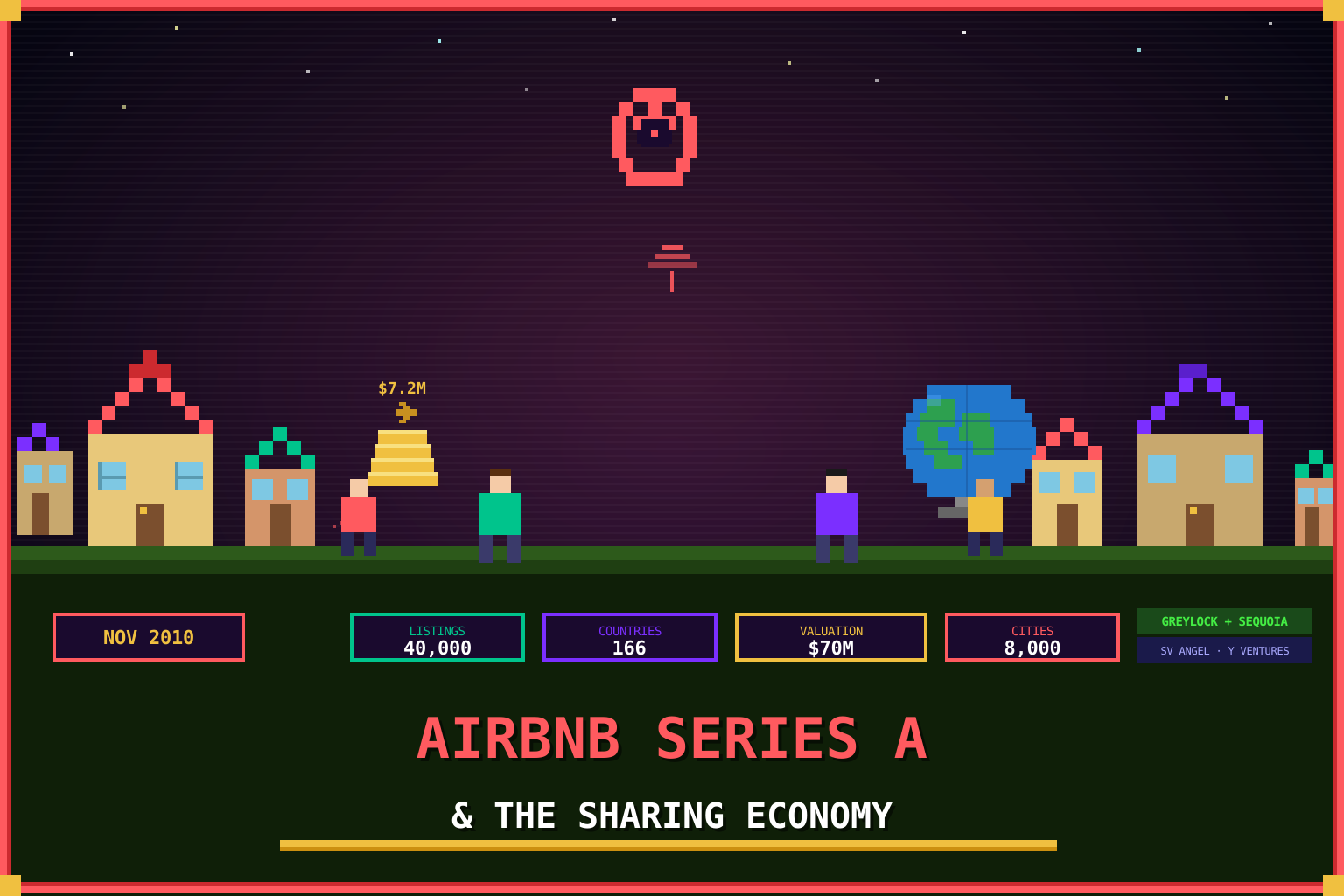
Key figures: Brian Chesky (co-founder and CEO), Joe Gebbia (co-founder and CPO), Nathan Blecharczyk (co-founder and CTO), Reid Hoffman (Greylock Partners), Alfred Lin (Sequoia Capital), Keith Rabois (venture partner), Elad Gil (venture partner), Jeremy Stoppelman (Yelp founder, investor), Ron Conway (SV Angel), Ashton Kutcher (early investor and advisor)
Summary
In November 2010, Airbnb — the peer-to-peer home-sharing platform co-founded in August 2008 by Brian Chesky, Joe Gebbia, and Nathan Blecharczyk — closed a $7.2 million Series A funding round led jointly by Greylock Partners and Sequoia Capital, two of Silicon Valley’s most storied venture firms. Additional participants included Y Ventures, venture partners Keith Rabois and Elad Gil, Yelp founder Jeremy Stoppelman, actor and investor Ashton Kutcher, and seed fund SV Angel (Ron Conway). The post-investment valuation was approximately $70 million — placing a two-year-old company, operating in a category that did not yet have established terminology, at a price most traditional investors would have found inconceivable for an unlicensed short-term rental marketplace.
At the time of the Series A, Airbnb hosted approximately 40,000 listings across 8,000 cities and 166 countries. The platform had processed over 700,000 nights of bookings in the two and a half years since its founding. Monthly revenue was growing rapidly but had not yet reached breakeven on a consolidated basis; nonetheless, the founders and their new investors were confident that the marketplace dynamics — in which Airbnb earned a commission of 6–12% on each booking without owning any property — could scale to global profitability with relatively modest capital investment.
Greylock’s Reid Hoffman, who had co-founded LinkedIn and was one of the most networked figures in consumer internet investment, led Greylock’s diligence. Alfred Lin, who had served as COO of Zappos before joining Sequoia, led Sequoia’s engagement. Both investors argued internally that the combination of smartphone proliferation and growing online trust mechanisms (reviews, identity verification) had reached a threshold at which strangers could transact with strangers for short-term accommodation — a thesis that required significant trust in both technology and human behavior.
From Air Mattress to Series A: 2008–2010
The company’s founding story is one of the most cited in startup culture. In August 2008, with San Francisco hotel rooms fully booked during the Democratic National Convention in Denver, Chesky and Gebbia — recent graduates of the Rhode Island School of Design who had moved to San Francisco — inflated air mattresses in their living room and rented them to conference attendees via a makeshift website, “AirBed & Breakfast.” They charged $80 per night and made $1,000 in total that weekend.
Key milestones from founding through the Series A:
- August 2008 — AirBed & Breakfast launches during Denver DNC; three guests pay $80/night to sleep on air mattresses in Chesky and Gebbia’s apartment.
- October 2008 — Nathan Blecharczyk joins as technical co-founder; the site formally becomes airbedandbreakfast.com.
- March 2009 — Y Combinator (Winter 2009 batch) accepts Airbnb and provides $20,000 in seed funding for 6% equity. Paul Graham advises the founders to focus on New York City as the proof-of-concept market.
- April 2009 — The domain airbnb.com is registered; the company is incorporated as Airbnb, Inc.
- April 2009 — Seed round of $600,000 raised from Sequoia Capital, Y Ventures, and others.
- 2009–2010 — The founders famously produce custom Obama O’s and Cap’n McCain’s cereals to fund early operations, raising $30,000 in cereal sales before the Y Combinator round closes.
- Early 2010 — Paul Graham, whose initial skepticism (“this is the kind of thing I’d never do”) had shifted after seeing early traction, begins championing Airbnb as a marquee YC investment.
- Summer 2010 — Airbnb launches first European city presence (Barcelona, then London).
- November 2010 — $7.2 million Series A closes; Greylock and Sequoia lead.
Why Greylock and Sequoia Said Yes
The decision by both Greylock and Sequoia to co-lead the Series A — unusual for two firms of that prominence to share a round — reflected the difficulty of the investment thesis. Earlier, the company had been turned down by multiple prominent investors who cited regulatory risk, safety concerns, and skepticism about whether travelers would actually choose to sleep in strangers’ homes. Among the known rejections: Fred Wilson of Union Square Ventures (who later publicly called it one of his biggest investment mistakes) and multiple other Sand Hill Road firms.
Greylock and Sequoia, however, evaluated three data points that overrode the objections:
- User reviews were overwhelmingly positive: The review system Airbnb had implemented showed that guests and hosts consistently rated experiences highly, suggesting that the trust problem the business model appeared to face was being solved by the product itself.
- Repeat booking rates were unusually high: A large proportion of first-time guests returned for second bookings, indicating the experience was meeting or exceeding expectations — a strong signal of product-market fit.
- Growth was accelerating without advertising: Organic word-of-mouth and travel blog coverage had driven rapid listing and booking growth with minimal marketing spend, suggesting network effects were beginning to compound.
The Sharing Economy Concept
The term “sharing economy” — describing platforms that mobilize underutilized private assets by connecting owners with users through a trusted marketplace — began crystallizing in 2010, though it would not reach mainstream usage until 2011–2012. Airbnb was not alone: Uber was founded in 2009 and launched its mobile app in June 2010 in San Francisco; TaskRabbit (originally RUNmyERRAND) was founded in 2008; RelayRides (later Turo) launched in 2010. What distinguished Airbnb was the scale of its ambition — rooms could be listed and booked globally, not just locally — and the involvement of Greylock and Sequoia, whose combined imprimatur gave the sharing economy model institutional credibility.
The November 2010 Series A gave Airbnb the capital to pursue three priorities: investment in trust and safety mechanisms (including a partnership with identity verification services), international expansion (including dedicated country managers for the UK and Germany), and engineering resources to improve the mobile experience that was proving critical to spontaneous bookings. Ashton Kutcher’s involvement extended beyond capital: he served as an informal product advisor, particularly on the mobile and user experience dimensions, and provided access to a network of early adopters who influenced the platform’s early brand identity.
Investment in Context
Airbnb’s Series A occurred at the tail end of one of the most significant years in post-crisis venture capital. The broader venture capital recovery of 2010 — with $21.8 billion deployed across 3,277 deals — created an environment in which established firms competed aggressively for the most promising early-stage companies. Alongside the Groupon Series C in April 2010 (which had already demonstrated that platform marketplaces connecting local supply and demand could achieve billion-dollar valuations at 18 months), the Airbnb Series A signaled that a broader category — “marketplace businesses enabling trust between strangers” — was emerging as a venture capital thesis in its own right.
The Flash Crash of May 6, 2010 and sustained global unemployment (9.6% in the U.S. for the full year) had created an economic context in which many property owners were economically motivated to monetize spare rooms or second properties — a structural tailwind for Airbnb’s supply side that the company and its investors explicitly acknowledged in internal planning documents.
Regulatory Landscape in 2010
One of the most significant risks investors weighed was regulatory. In most jurisdictions, short-term home rentals by private individuals operated in a legal grey zone: residential leases often prohibited subletting, municipal regulations on hotels and bed-and-breakfasts did not contemplate peer-to-peer platforms, and tax treatment of rental income earned through an app was undefined. New York City, which would prove Airbnb’s largest single market, had a 2010 multiple-dwelling law that many legal analysts believed prohibited most Airbnb listings in apartment buildings — a regulatory risk that Greylock and Sequoia decided to bracket rather than resolve before investing.
This decision to invest despite, not after resolving, regulatory risk became a defining characteristic of sharing-economy venture capital: the theory was that if the product created sufficient consumer value and political constituency, regulatory frameworks would adapt — or that enforcement would remain patchwork. The theory proved partially correct: regulatory battles over Airbnb in New York, San Francisco, Berlin, Barcelona, and other cities would occupy a decade of legal and political energy, but the platform continued to grow throughout those disputes.
Significance
Airbnb’s Series A in November 2010 was a foundational moment in the rise of what would become known as the “sharing economy.” By placing $7.2 million behind a company that owned no property but had shown it could mobilize millions of spare rooms globally, Greylock and Sequoia validated an entirely new business model: the asset-light peer-to-peer marketplace, where value derived from trust mechanisms and network effects rather than physical assets or inventory.
Airbnb’s trajectory after 2010 proved the venture bet correct at a scale that exceeded expectations. The company reached a $1 billion valuation by early 2011 — just months after the Series A — passed $10 billion by 2014, and eventually went public on December 10, 2020 at a valuation exceeding $47 billion, the largest U.S. technology IPO of that year. The November 2010 Series A thus turned a $7.2 million investment into one of the most profitable bets in venture capital history.
More broadly, Airbnb’s 2010 funding round became a template referenced by an entire generation of marketplace founders and investors: a proof that regulated industries with entrenched incumbents (hotels) could be disrupted by trust-based technology platforms; that celebrities and angels investing alongside institutional firms could create media awareness as a form of user acquisition; and that asset-light marketplace businesses could achieve global scale at a capital efficiency previously impossible. Together with the broader venture capital recovery of 2010, the Airbnb and Groupon rounds wrote the initial chapters of the decade’s platform economy — a transformation that would reshape hospitality, transportation, food delivery, and dozens of adjacent industries before the decade was out.
Sources
- Airbnb Raises $7.2M in Series A Funding — FinSMEs
- Series A — Airbnb Funding Round Profile — Crunchbase
- Airbnb — Wikipedia
- The History of Airbnb: A Startup That Redefined Travel — Investopedia
- How Airbnb Survived the Rejection of Seven Investors — Inc. Magazine
- Fred Wilson on Missing Airbnb — AVC Blog