Key figures: Andrew Mason (Groupon CEO and founder), Eric Lefkofsky and Brad Keywell (co-founders and early backers), Yuri Milner (DST Global, lead investor), Roger Lee (Battery Ventures), Rob Solomon (COO, hired 2010)
Summary
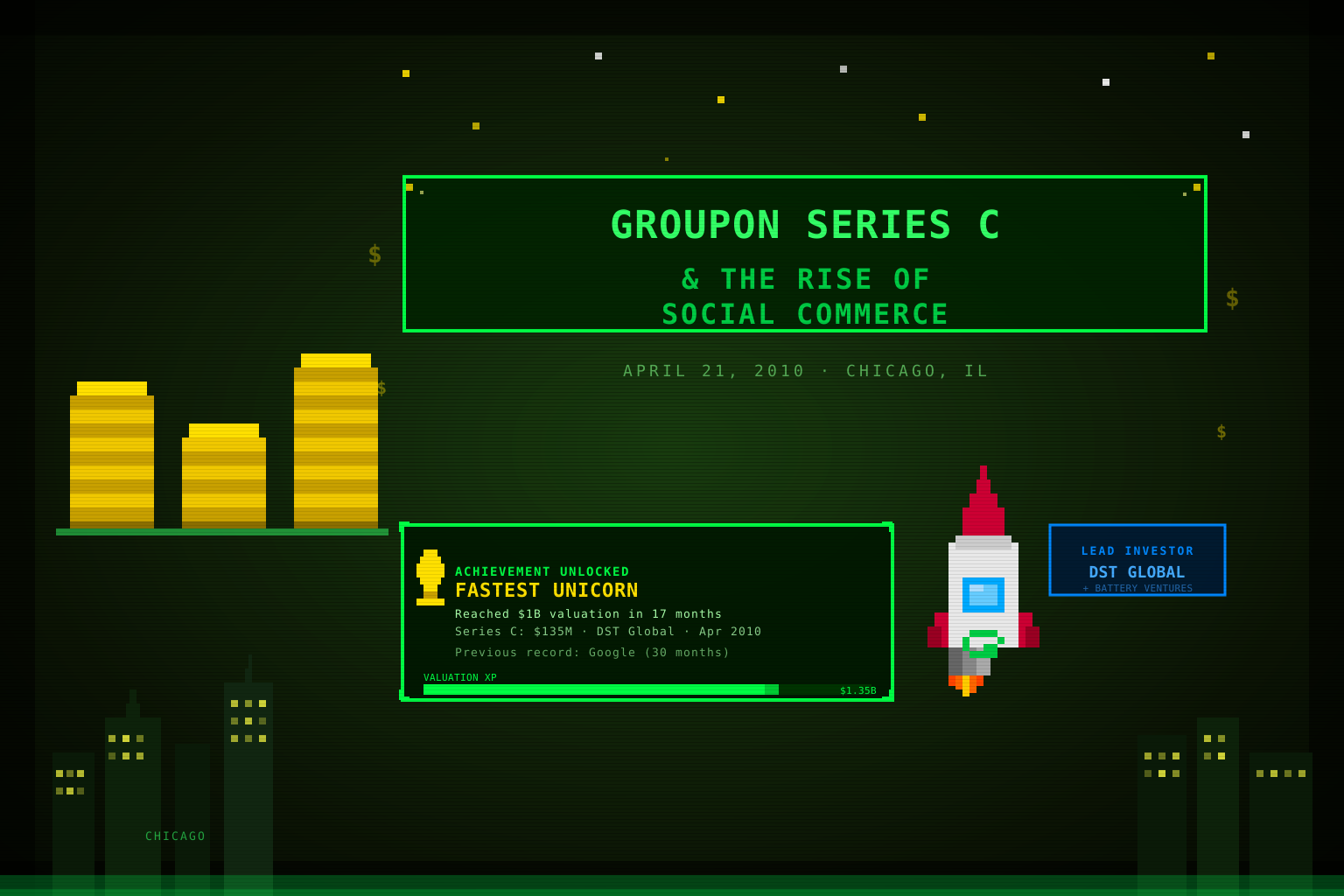
On April 21, 2010, Groupon — the Chicago-based daily-deals platform founded by Andrew Mason in November 2008 — announced that it had closed a $135 million Series C funding round led by DST Global, a Russia-based international internet investment group, with participation from returning investor Battery Ventures. The post-investment valuation was placed at $1.35 billion, making Groupon the fastest company by founding date to reach a billion-dollar valuation at that time: it had achieved the milestone in approximately 17 months. For comparison, Google took roughly 30 months to reach a comparable valuation following its 1998 founding.
The capital was deployed strategically: a portion fueled aggressive geographic expansion into international markets including Japan, the United Kingdom, Germany, and Russia, while the remainder was structured partly as secondary liquidity, allowing early employees and investors to realize cash gains. The secondary component was a signal of maturity unusual for a company of Groupon’s age and indicated that DST Global and Battery Ventures had sufficient confidence in the primary equity to compete with liquidity demand for shares.
Groupon’s earlier funding trajectory set the context: the company had raised $1 million in seed financing from investors including Eric Lefkofsky, $4.8 million in Series A financing in December 2008, and $30 million in Series B financing led by Accel Partners and New Enterprise Associates in April 2009. The Series C, at $135 million, represented a step-change in both scale and investor profile — DST Global had previously backed Facebook (at a $10 billion valuation in May 2009) and Twitter, situating Groupon within a select group of companies its investors believed were redefining commerce and communication on a global scale.
Groupon’s Business Model and 2010 Scale
Groupon operated a deceptively simple model: it partnered with local merchants — restaurants, spas, fitness studios, retail shops — to offer time-limited discount vouchers (typically 50–70% off regular price) to its subscriber base. Deals activated only when a minimum number of purchasers committed, creating a social pressure dynamic that incentivized users to share offers with friends. This “tipping-point” mechanic differentiated Groupon from simple coupon services and drove viral growth.
By April 2010, Groupon had:
- 35 million subscribers across North American cities
- Operations in 28 countries following early international expansion
- More than 1,000 employees, up from approximately 40 a year earlier
- Profitability on an operating basis in multiple markets — rare for a startup of its age and growth rate
- Estimated monthly revenue of $50 million across North American operations
The company’s revenue sharing arrangement with merchants — typically 50% of voucher revenue, with merchants receiving the other 50% — generated immediate cash flow on every deal sold, creating an unusually capital-light operational model for a marketplace business. Groupon essentially acted as a performance marketing channel for local businesses, which had historically struggled to access cost-efficient digital advertising.
Timeline of Key Milestones (2008–2010)
- November 2008 — Andrew Mason launches Groupon as a spinout from The Point, a social activism platform. First deal: a pizza offer at a restaurant in Chicago’s Monadnock Building.
- December 2008 — Groupon closes $4.8 million Series A, targeting rapid city-by-city expansion.
- April 2009 — $30 million Series B from Accel Partners and New Enterprise Associates; national U.S. expansion begins.
- Late 2009 — Groupon launches in international markets, beginning with Canada and the United Kingdom.
- January 2010 — Groupon surpasses 1 million subscribers; monthly revenue crosses $10 million.
- March 2010 — Groupon expands to 40 U.S. cities and 10 countries; subscriber base approaches 25 million.
- April 21, 2010 — $135 million Series C closes at $1.35 billion valuation; DST Global and Battery Ventures lead.
- December 2010 — Google offers $6 billion to acquire Groupon; Mason and board reject the offer, citing confidence in independent growth trajectory.
- December 2010 — Groupon closes $950 million Series G round at a $4.75 billion valuation, led by Morgan Stanley, Goldman Sachs, and T. Rowe Price — a pre-IPO round signaling imminent public offering.
DST Global and the Cross-Atlantic Investment Thesis
DST Global’s participation was itself a significant event in the 2010 venture landscape. Founded by Russian entrepreneur Yuri Milner, DST had developed a distinctive investment thesis: identify internet platforms already demonstrating hyper-scale growth in consumer adoption, invest at late seed or early institutional stages, and take minority positions that offered maximum upside on companies where user data indicated network effects were compounding. This approach prioritized revenue and user growth over traditional metrics like price-to-earnings ratios, which were inapplicable to pre-profitable internet companies.
Milner’s February 2009 investment of $200 million in Facebook at a $10 billion valuation — widely ridiculed at the time as vastly overpriced — had already made DST Global’s framework famous when Facebook’s value rose to $50 billion by 2010. The Groupon investment applied the same logic to commerce: a network with growing subscriber density in a given geography constituted a structural moat that would be expensive to replicate, regardless of Groupon’s current earnings. DST’s backing of Groupon thus signaled not merely confidence in one company but an endorsement of a broader thesis about network-effect-driven marketplaces.
This cross-Atlantic investment flow — Russian capital backing American social commerce via a thesis refined against social networks — was itself characteristic of 2010’s globalized venture landscape, where capital sources had diversified beyond Sand Hill Road and the traditional U.S. venture community.
The Daily-Deals Ecosystem and Competitive Response
Groupon’s rapid rise created a vast imitator ecosystem. By mid-2010, hundreds of daily-deals platforms had launched globally, including:
- LivingSocial (U.S., Washington D.C.-based; raised $25 million in Q4 2010 from Amazon)
- BuyWithMe (U.S., Boston-based)
- Woot (acquired by Amazon in June 2010 for approximately $110 million, representing a different but adjacent model)
- Groupon clones operating in Germany (CityDeal, which Groupon itself acquired in May 2010 for an estimated $170 million in stock), Japan, Brazil, and across Southeast Asia
The international expansion Groupon funded with its Series C capital was partly defensive: by rapidly entering markets before local competitors could establish dominant positions, Groupon sought to make its geographic footprint a structural moat. The CityDeal acquisition in May 2010 — within weeks of the Series C close — demonstrated the aggression of this strategy.
Significance
Groupon’s $1.35 billion valuation in April 2010 was a watershed moment in venture capital history. It demonstrated that venture investors would award premium prices to companies with explosive user growth, network effects, and plausible paths to scale, even if those companies were fewer than two years old. The Groupon funding also validated the “local commerce” thesis: that mobile and web technologies could fundamentally disrupt small business marketing and consumer purchasing behavior.
Beyond its immediate impact, Groupon’s 2010 moment reflected a broader shift in venture capital priorities — from pure web services toward commerce-enabling technology. This shift would define the early 2010s: venture capital began actively seeking “unbundling” opportunities, using technology and network effects to disrupt services previously controlled by intermediaries or local actors. The broader venture capital recovery of 2010 created the capital environment in which Groupon could raise at its historic valuation; conversely, Groupon’s success was itself data that encouraged further capital deployment into the sector.
Though Groupon would struggle in later years — its 2011 IPO at a $12.7 billion valuation was followed by a rapid decline as unit economics proved unsustainable and competition intensified — its 2010 Series C represented a genuine inflection point: the moment when venture capital’s appetite for disruption through network effects reached mass-market local commerce, and when a young company could achieve billion-dollar status through user adoption velocity alone, regardless of a clear path to sustainable profits. Seen alongside the Airbnb Series A closed eight months later, the Groupon round announced a new era in which technology startups could achieve the scale of established industry players at unprecedented speed.