Key figures: William Borucki (Kepler principal investigator, NASA Ames), Douglas Hudgins (Kepler program scientist, NASA HQ), Natalie Batalha (Kepler deputy science team lead)
Summary
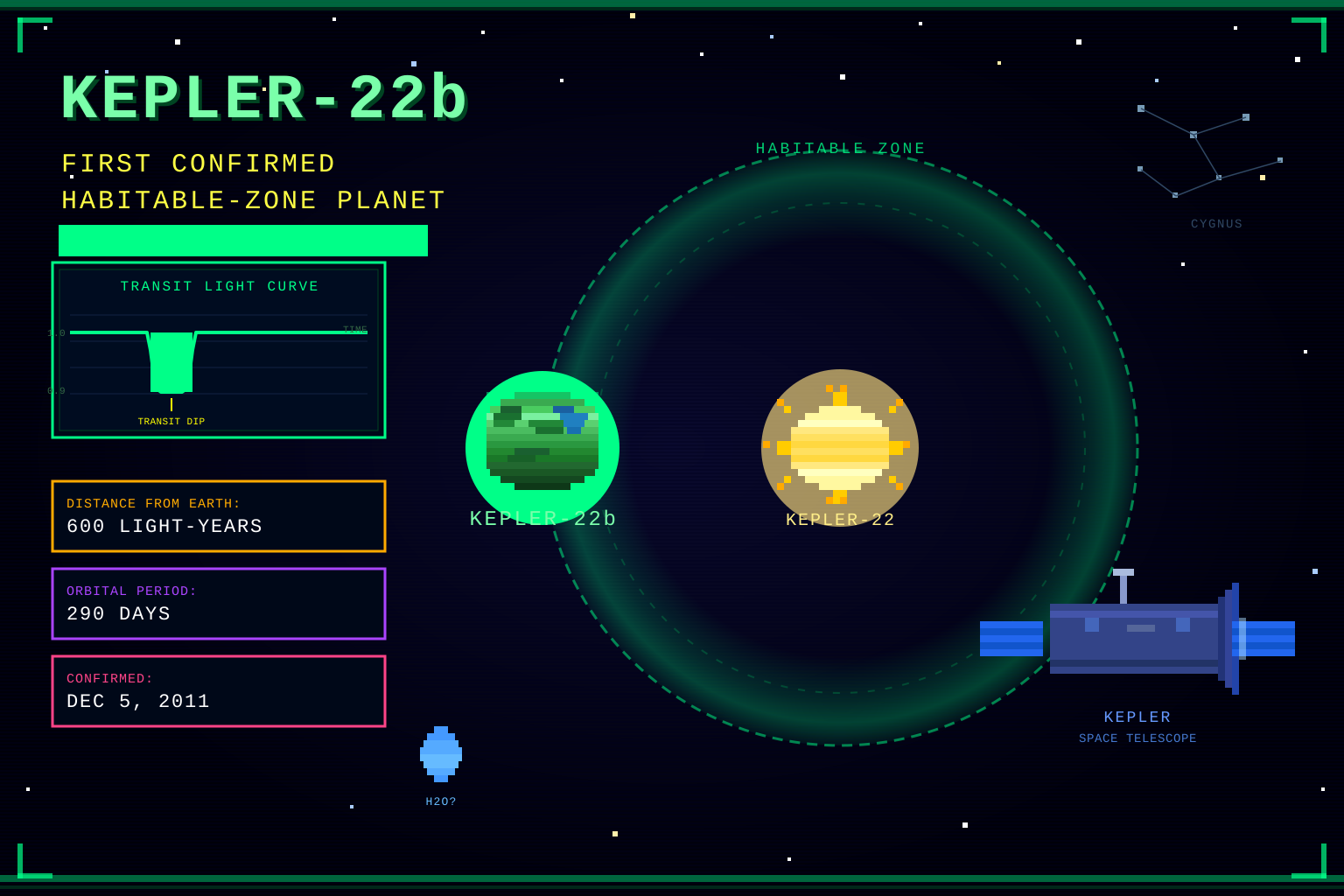
On December 5, 2011, NASA announced that its Kepler space telescope had confirmed Kepler-22b, the first known transiting planet found orbiting within the “habitable zone” of a Sun-like star — the region around a star where surface temperatures could allow liquid water to exist. Located approximately 600 light-years from Earth in the constellation Cygnus, Kepler-22b orbits its host star, Kepler-22, once every 290 days at a distance comparable to Earth’s distance from the Sun, adjusted for the star’s slightly lower luminosity. The announcement came during the third year of the Kepler mission, NASA’s dedicated planet-hunting telescope, and represented a milestone the mission had been specifically designed to reach.
Discovery and Confirmation
Kepler-22b’s first transit signal was detected on May 12, 2009, early in the Kepler mission’s survey of roughly 150,000 stars in a fixed patch of sky, using the transit method (detecting the periodic dimming of starlight as a planet crosses in front of its star). Confirming the signal as a genuine planet, rather than a false positive, required additional transit observations and took over two years; NASA formally confirmed Kepler-22b on December 5, 2011. Kepler principal investigator William Borucki noted the discovery came unusually quickly relative to the mission timeline, with the first transit captured just days after the spacecraft was declared operational.
Physical Characteristics
Kepler-22b has a radius of roughly 2.4 times that of Earth, making it, at the time, the smallest planet yet found orbiting within the habitable zone of a Sun-like star. Its mass and surface composition were — and remain — unknown, since the transit method measures a planet’s size but not directly its mass; scientists at the time speculated it could be a rocky world, an ocean world, or largely gaseous. Its host star, Kepler-22, is a G-type star similar to the Sun but roughly 3 percent less massive and slightly cooler. Estimated surface temperatures on Kepler-22b, assuming an Earth-like greenhouse effect, were calculated at around 22°C (295 K) — comparable to a mild spring day on Earth — though this estimate depended heavily on unknown atmospheric composition.
Significance
Kepler-22b’s confirmation was described by NASA as “a major milestone on the road to finding Earth’s twin.” It was the first of the mission’s “habitable zone” candidates to be confirmed among a growing catalog — NASA reported 2,326 planet candidates identified by Kepler as of the December 2011 announcement, of which 207 were approximately Earth-sized. While Kepler-22b’s larger size meant it was not considered a true Earth analog, its confirmation validated Kepler’s core methodology for identifying potentially habitable worlds around Sun-like stars and set the stage for the mission’s later, more Earth-sized habitable-zone discoveries.