Key figures: Maite Nkoana-Mashabane (South African Foreign Minister and COP17 President), Christiana Figueres (UNFCCC Executive Secretary), Connie Hedegaard (EU Climate Commissioner), Todd Stern (U.S. Climate Envoy), Xie Zhenhua (China’s chief negotiator), Jayanthi Natarajan (India’s Environment Minister)
Summary
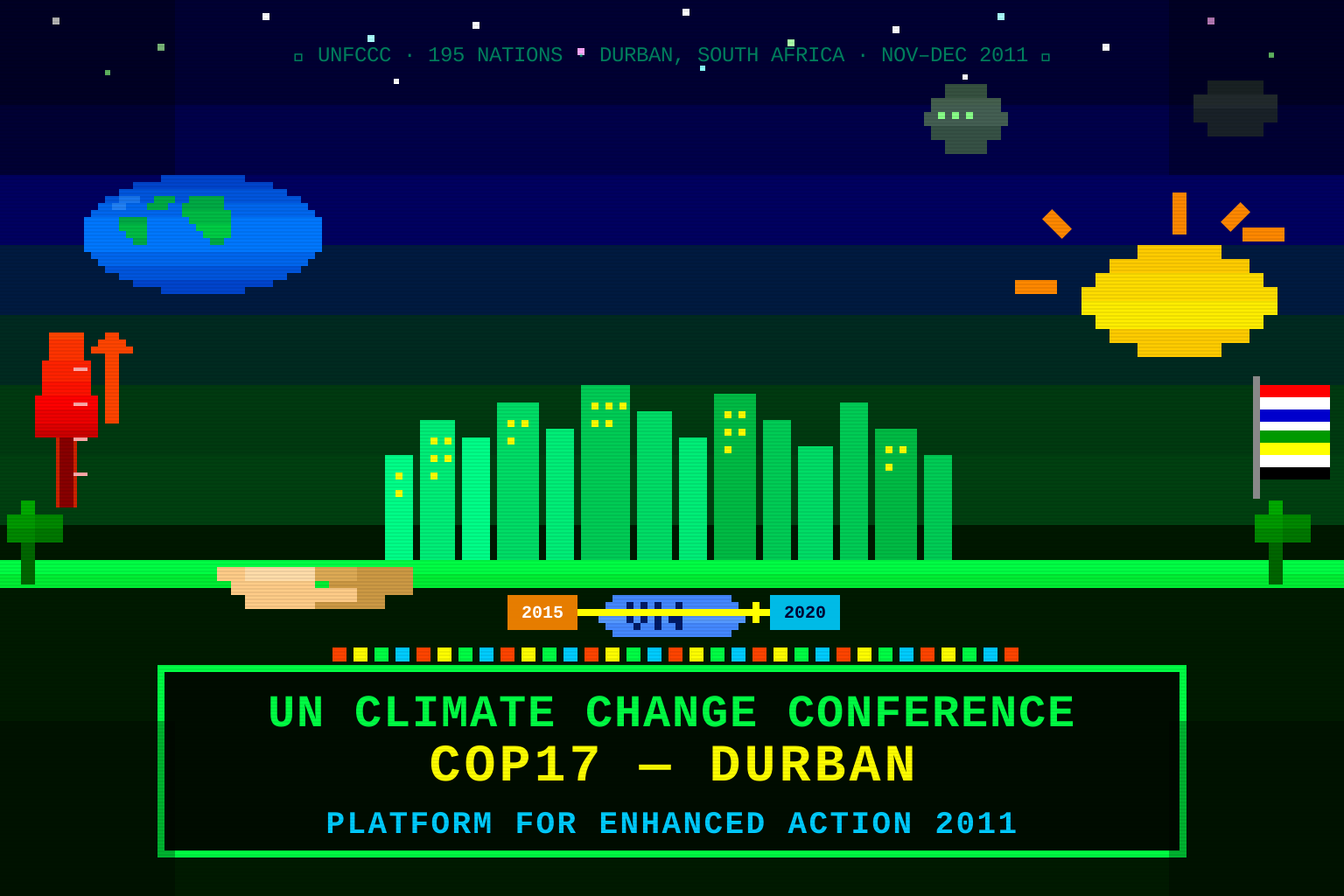
The 17th Conference of the Parties (COP17) to the UN Framework Convention on Climate Change (UNFCCC) convened in Durban, South Africa, from November 28 to December 11, 2011. After two weeks of intense negotiations—extending well past the scheduled closing date in a marathon overnight session—delegates from 195 nations agreed to the “Durban Platform for Enhanced Action,” a framework establishing a pathway toward a legally binding global climate agreement to be adopted by 2015 and take effect by 2020.
The agreement represented the most significant breakthrough in global climate negotiations since Kyoto (1997), resolving the central deadlock that had paralyzed the process since Copenhagen (2009): whether emerging economies, particularly China and India, would accept legally binding emissions commitments alongside developed nations. The Durban Platform answered in the affirmative, establishing that the post-2020 regime would apply equally to all countries.
Background: The Road from Kyoto to Durban
The Durban outcome can only be understood against the failure trajectory of the preceding decade:
- Kyoto Protocol (1997): Required developed nations (Annex I countries) to reduce emissions but exempted developing nations, including China and India, from binding targets. The United States signed but never ratified.
- Bali Action Plan (COP13, 2007): Launched a “two-track” process to negotiate both a second Kyoto commitment period and a broader framework including developing nations.
- Copenhagen Accord (COP15, 2009): The intended culmination of the Bali process collapsed into a non-binding political agreement, leaving the UNFCCC’s credibility severely damaged and setting no legally binding framework.
- Cancún Accords (COP16, 2010): Restored procedural trust, formalized the Copenhagen pledges (national emissions targets submitted voluntarily by countries accounting for approximately 80 percent of global emissions), and established the Green Climate Fund in principle. But no legally binding mechanism was created.
Durban thus arrived under enormous pressure: the Kyoto Protocol’s first commitment period was expiring at end-2012, key developed nations (Canada, Japan, Russia) were signaling they would not join a second Kyoto period, and scientific assessments (including the IPCC’s Fifth Assessment Report preliminary findings) were indicating accelerating climate impacts.
The Negotiations
The core divisions at Durban were threefold:
1. Second Kyoto Period: The European Union, small island states (AOSIS), and least-developed countries (LDCs) pushed for a second Kyoto commitment period. Canada (which formally withdrew from Kyoto on December 12, 2011—one day after COP17 closed), Japan, and Russia refused. The compromise: a second Kyoto commitment period beginning January 1, 2013, with its length left to be finalized later (the Doha Amendment at COP18 in 2012 set it to run through 2020), with the EU, Australia, and several other nations committing to emissions reductions; Canada, Japan, Russia, and the United States remained outside it.
2. Legal Form of the Post-2020 Agreement: This was the conference’s central drama. The EU proposed a new legally binding agreement for all parties. China and India argued this was inequitable given historical emissions responsibilities. The U.S. climate envoy Todd Stern insisted any new agreement apply equally to all major economies. The breakthrough language—”a protocol, another legal instrument, or an agreed outcome with legal force under the UNFCCC applicable to all Parties”—was deliberately ambiguous but definitively included major emerging economies.
3. Green Climate Fund: The fund, established in principle at Cancún, was formally operationalized at Durban with a governance framework and capitalization goal of $100 billion per year by 2020 from public and private sources. Its exact structure and funding mechanisms remained subject to later negotiation; the fund was formally inaugurated in Songdo, South Korea, in 2013.
The final plenary session ran approximately 20 hours past the scheduled December 9 closing, concluding in the early morning of December 11. The decisive moment came when EU Climate Commissioner Connie Hedegaard and South African Foreign Minister Maite Nkoana-Mashabane negotiated directly with India’s Jayanthi Natarajan over the legal language, producing the “legal force” formulation. The agreement was gaveled through at approximately 3:00 a.m. local time.
Key Outcomes
| Outcome | Details |
|---|---|
| Durban Platform mandate | All parties to negotiate a new agreement by 2015, effective 2020 |
| Second Kyoto Period | 2013–2020; EU, Australia, and others commit; Canada, Japan, Russia opt out |
| Green Climate Fund | Operationalized; $100 billion/year goal by 2020 |
| Technology Mechanism | Climate Technology Centre and Network (CTCN) formally launched |
| Transparency Framework | Biennial reports required from all parties on emissions and finance |
Scientific Context
The Durban negotiations occurred against a backdrop of alarming scientific data. The International Energy Agency’s World Energy Outlook 2011 (published November 9) warned that if existing power plants and infrastructure were allowed to run their full lifetimes without modification, they would alone emit enough CO₂ to lock in warming of 2°C above pre-industrial levels. In other words, if no new fossil fuel infrastructure were built after 2017, 2°C was already effectively baked in. The IEA called for an “energy sector revolution” within five years.
Atmospheric CO₂ concentrations measured at Mauna Loa Observatory reached 391.65 parts per million in 2011—the highest in at least 800,000 years based on ice core records. Global average temperature anomaly in 2011 was approximately 0.54°C above the 1951–1980 baseline (NASA GISS data), making 2011 the 35th consecutive year with above-average global temperatures.
Significance
Foundation for the Paris Agreement
COP17’s Durban Platform became the direct legal and political foundation of the Paris Agreement (2015). The 2020 implementation timeline, the universal applicability framework, and the “legal force” language all carried forward into Paris. Critically, the structure of nationally determined contributions (NDCs)—countries submitting their own emissions targets subject to international review—reflected the compromise between legally binding form and national determination of ambition first articulated at Durban.
The EU’s position that it would only accept a second Kyoto period in exchange for a roadmap to a universal agreement proved decisive in forcing this outcome. Without that bargain, the UNFCCC process might have split permanently into a developed-nations-only Kyoto track and a voluntary-pledge framework outside it.
Financial Architecture
The Green Climate Fund’s operationalization at Durban created the financial architecture for subsequent climate agreements. The $100 billion annual goal—contested in terms of definition, accounting methodology, and actual delivery—became the central financial commitment in international climate politics. By 2020, developed nations had mobilized approximately $80 billion annually in public and private climate finance toward this goal, though developing nations and civil society organizations disputed whether the figure accurately represented new and additional funding.
Post-Fukushima Energy Context
The March 2011 Tōhoku earthquake and subsequent Fukushima Daiichi nuclear disaster had reshaped global energy policy in ways that influenced Durban’s political dynamics. Germany had announced an accelerated nuclear phaseout by 2022; Japan suspended nuclear operations at most of its 54 reactors. The resulting shift toward fossil fuels—particularly in Japan and Germany—increased global carbon emissions pressure even as negotiations sought to reduce it. COP17 delegates acknowledged this tension, with renewable energy advocates arguing it underscored the urgency of a binding framework while nuclear advocates noted the risks of premature energy transition.
Developing World Perspectives
For small island states and least-developed countries, Durban was bittersweet. The Alliance of Small Island States (AOSIS) and African Group had pushed for a legally binding agreement with 2015 target date; the Durban Platform delivered the framework but deferred substantive action to 2020. Island nations facing existential risk from sea-level rise—including Tuvalu, Kiribati, and the Maldives—had lobbied intensely for a 1.5°C warming limit rather than 2°C. The 1.5°C target was not adopted at Durban (it would be included in the Paris Agreement’s aspirational language in 2015), but small island state advocacy kept it alive in the negotiating text.
Sources
- UNFCCC COP17 Durban Conference Report — comprehensive conference outcomes and negotiating text
- Durban Platform for Enhanced Action (Wikipedia) — historical summary and impacts
- Grubb, M. (2012). “Durban and the future of the climate negotiations.” Journal of Environmental Law, 24(2), 283–291 — scholarly analysis of legal frameworks
- International Energy Agency. (2011). World Energy Outlook 2011. OECD/IEA — energy sector analysis framing Durban urgency
- Bodansky, D. (2012). “The Durban Platform: Issues and Options for a 2015 Agreement.” Center for Climate and Energy Solutions — policy analysis of legal implications
Related
- Tōhoku Earthquake and Tsunami — the Fukushima nuclear disaster that reshaped energy politics ahead of COP17
- 2011 Renewable Energy Expansion — solar and wind growth accelerating the post-Fukushima energy transition
- Eurozone Sovereign Debt Crisis — economic fragility complicating nations’ climate-finance commitments
- Occupy Wall Street — concurrent critique of economic systems’ failure to address collective crises