Category: Society & Economics
Key figures: Andrew Mason (founder and CEO), Eric Lefkofsky (co-founder and executive chairman), Brad Keywell (co-founder), Kal Vepuri (COO), Morgan Stanley and Goldman Sachs (lead underwriters), LivingSocial (primary competitor, Amazon-backed)
Summary
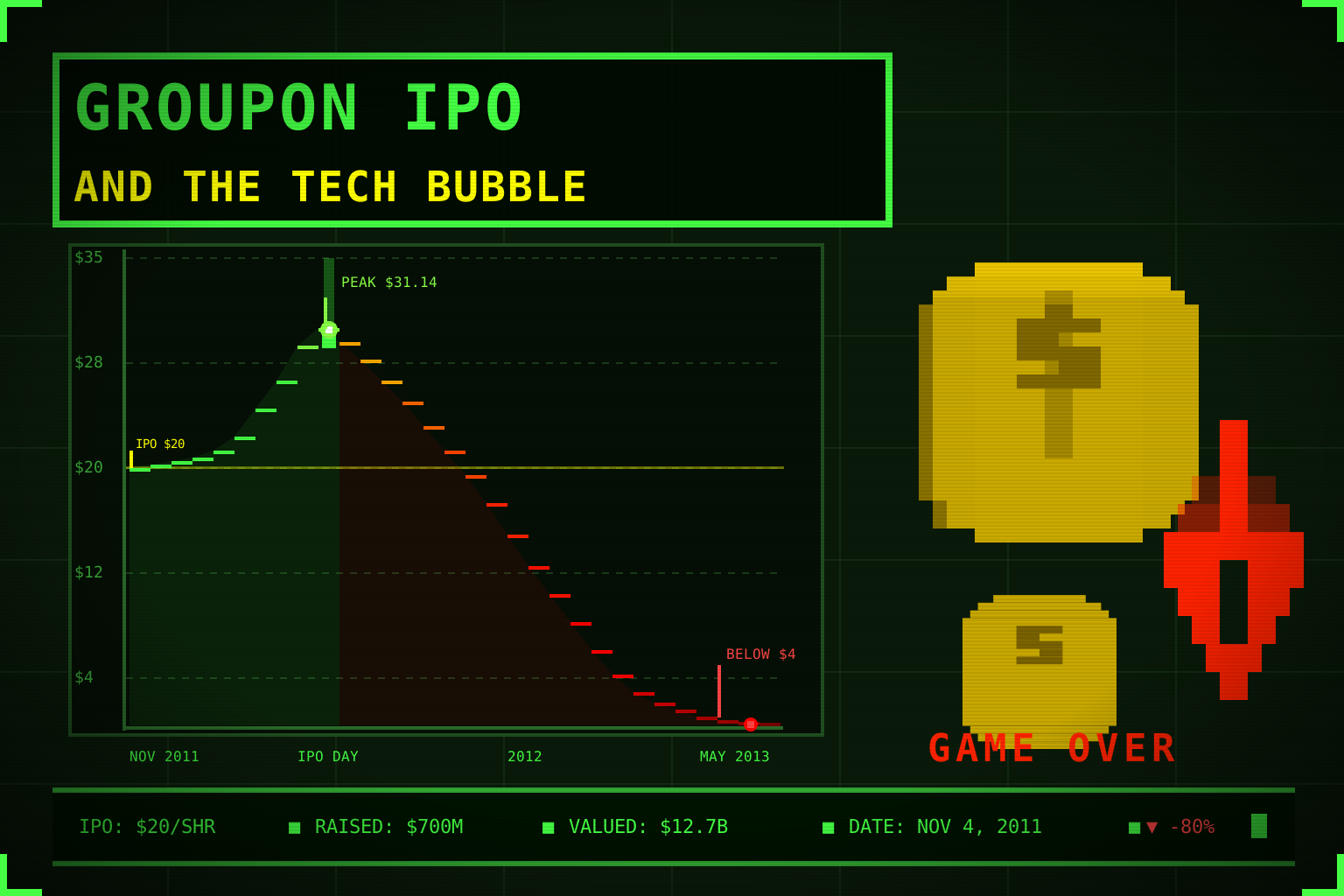
Groupon, the Chicago-based daily-deal coupon platform, went public on November 4, 2011, at an IPO price of $20 per share, raising approximately $700 million in what became one of 2011’s most scrutinized technology debuts. The offering valued the company at approximately $12.7 billion—more than three times the $3.5 billion valuation at which it had declined Google’s acquisition offer in December 2010—making it the largest U.S. internet IPO since Google’s own $1.67 billion offering in August 2004.
Shares opened at $28 and peaked at $31.14 on the first day before closing at $26.11, a 31% gain on the offering price. However, within eighteen months the stock had fallen to below $4—a collapse that destroyed billions in investor wealth and became one of the defining cautionary tales of the web 2.0 boom.
Background and Rise
Groupon was founded in November 2008 by Andrew Mason, Eric Lefkofsky, and Brad Keywell in Chicago, Illinois. The concept was simple: aggregate consumer demand for local business discounts by offering a “deal of the day” that only activated once a minimum number of buyers committed. This “group coupon” (hence “Groupon”) mechanic theoretically aligned merchant and consumer interests: merchants received guaranteed volume, consumers received significant discounts, and Groupon took a 50% commission on revenue generated.
The model achieved viral growth at extraordinary speed. By the end of 2010, Groupon operated in over 500 markets in 44 countries, employed approximately 10,000 people, and reported revenues of $713 million for the year—making it the fastest-growing company in history to reach $1 billion in annual revenue run rate. These figures attracted enormous investor attention and the December 2010 acquisition approach from Google, which Groupon declined at a reported offer between $5.3 billion and $6 billion.
The Google Acquisition Offer
In December 2010, Google reportedly offered between $5.3 billion and $6 billion to acquire Groupon—which would have been the largest acquisition in Google’s history at the time. Groupon’s board, led by Lefkofsky, declined the offer, betting that the company’s trajectory justified a higher public-market valuation. The decision was widely covered as a bold act of entrepreneurial confidence; in retrospect, it represented the peak of Groupon’s negotiating position.
The declined acquisition offer set the context for the IPO: the company had publicly demonstrated it believed itself worth more than $6 billion and needed the IPO to prove it.
Accounting Controversies and SEC Scrutiny
Groupon’s path to IPO was complicated by serious accounting questions. In its initial S-1 registration statement filed June 2, 2011, Groupon used a non-standard metric called ACSOI (Adjusted Consolidated Segment Operating Income), which excluded online marketing expenses—Groupon’s largest cost category—from its profit calculation. This allowed the company to present a more favorable financial picture than GAAP (generally accepted accounting principles) permitted.
The SEC questioned the ACSOI metric, and Groupon was forced to file a substantially revised S-1 in September 2011 that eliminated ACSOI and restated its financial results. The restatement was significant: Groupon’s 2010 revenues were restated from approximately $713 million to $312.9 million after accounting for merchant revenue shares returned to businesses (Groupon had been booking gross revenues including the merchant’s portion rather than net revenues representing only Groupon’s commission). Additionally, Groupon restated its Q1 2011 results, revealing net losses substantially larger than originally disclosed.
The accounting controversy attracted press scrutiny and analyst skepticism even before the IPO priced, creating the first major test of investor appetite for a company whose business model relied on growth outpacing questions about unit economics.
IPO Timeline and Market Reception
| Date | Event |
|---|---|
| June 2, 2011 | Initial S-1 filed; ACSOI metric attracts SEC questioning |
| September 2011 | Revised S-1 filed; financial restatement disclosed |
| October 28, 2011 | IPO roadshow begins |
| November 3, 2011 | IPO priced at $20/share (above initial $16–$18 guidance range) |
| November 4, 2011 | Shares debut; open at $28, close at $26.11 (+31%) |
| March 30, 2012 | Groupon discloses material weakness in financial controls |
| June 2012 | Stock falls below $10 |
| November 2012 | One year post-IPO: stock at approximately $3 |
| February 28, 2013 | Andrew Mason fired as CEO; stock at $4.53 |
| 2016 | Stock trades below $3 |
Despite the S-1 controversies, strong investor demand pushed the IPO price to $20—above the $16–$18 guidance range—and initial trading produced a 31% first-day gain. However, the institutional-investor euphoria masked fundamental concerns: the business model faced structural challenges that would become apparent within quarters.
The Competitive Landscape
Groupon’s primary competitor, LivingSocial, received a $175 million investment from Amazon in late 2011 at a valuation reported around $3.75 billion—creating a well-capitalized rival operating the same business model in the same markets. The existence of a nearly peer competitor meant Groupon faced sustained pricing and marketing wars that compressed margins without building defensible competitive advantages.
The daily-deal market also attracted hundreds of smaller regional competitors, and established players like Yelp, Amazon Local, and Google Offers (launched June 2011) competed for merchant relationships. Unlike the technology platforms—Facebook, Google, Amazon—that built network effects with genuine lock-in, the daily-deal model generated merchant relationships that were inherently transactional and non-exclusive. Merchants could and did run deals simultaneously with multiple platforms.
Why the Model Failed
Post-IPO analysis revealed several interconnected weaknesses:
Merchant economics: Daily deals required merchants to offer 50%+ discounts to consumers and then pay Groupon 50% of the already-discounted revenue. Studies published in 2011 (including research by Utpal Dholakia of Rice University) found that a significant percentage of merchants—particularly restaurants—reported losing money on Groupon deals because coupon-buyers were primarily price-sensitive consumers who did not return at full price.
Customer acquisition costs: Groupon spent heavily on subscriber acquisition via online advertising, creating a customer acquisition cost structure that required high repeat-purchase rates to break even—rates the business did not consistently achieve.
No network effects: Unlike social platforms whose value grew with user count, the daily-deal model had weak positive feedback loops. A subscriber who received deals in one city derived no benefit from Groupon’s expansion into other cities.
Merchant retention: Merchant satisfaction surveys showed high first-time participation but low repeat rates, as many businesses found the economics unfavorable or the coupon-redeemer customer base insufficiently valuable.
Broader Context: The 2011 Tech IPO Wave
Groupon’s November IPO was part of a broader 2011 technology IPO wave. LinkedIn’s May 2011 IPO—which raised $352 million and saw shares surge 109% on the first day—had established investor appetite for social and technology platforms. Zynga, the social gaming company, followed Groupon to market in December 2011, pricing its IPO at $10 per share with a $7 billion valuation; Zynga’s subsequent collapse mirrored Groupon’s, as both companies showed that growth divorced from sustainable unit economics attracted only temporary investor enthusiasm.
The concurrent Occupy Wall Street movement (September 2011) provided an ironic backdrop to the technology IPO euphoria: while activists protested corporate wealth inequality, Silicon Valley was minting paper billionaires through valuations many economists found untethered from underlying business fundamentals.
The macroeconomic context of 2011—including the U.S. credit-rating downgrade in August and ongoing eurozone instability—created a peculiar bifurcation in capital markets: conservative industries faced declining valuations while technology startups commanded ever-higher multiples, funded by venture capital seeking yield in a low-interest-rate environment.
Significance
Groupon’s 2011 IPO crystallized the excesses of web 2.0 venture capitalism and foreshadowed the broader venture-backed technology bubble. The disconnect between valuation and unit economics became visible within quarters of the offering; when Groupon’s stock fell from $26.50 (one week post-IPO) to $2.63 by late 2012, it destroyed roughly $10 billion in market capitalization.
The cautionary tale reshaped how venture investors and entrepreneurs evaluated growth-at-all-costs strategies. The emphasis shifted toward sustainable unit economics and clearer paths to profitability—philosophies that distinguished the winners in the 2015–2020 technology investment era from the casualties. The phrase “Groupon problem” entered the vocabulary of startup finance as shorthand for a business with impressive top-line growth but structurally negative contribution margins at scale.
For Mark Zuckerberg and Facebook’s upcoming IPO, Groupon’s collapse was both a warning and a contrast: Facebook entered its May 2012 offering with $3.71 billion in 2011 revenue, genuine network effects, and a defensible market position—the structural advantages Groupon lacked.
The IPO also marked a turning point in how the financial press covered technology companies, with increased scrutiny of non-GAAP metrics, “unicorn” valuations, and founder accountability—scrutiny that has continued to define technology-IPO reporting ever since.
Sources
- Reuters (2011). “Groupon IPO Faces Scrutiny Over Accounting Practices.” https://www.reuters.com/
- The Wall Street Journal (2011). “Groupon Prices IPO at $20, Raising $700 Million.” https://www.wsj.com/
- SEC EDGAR, Groupon S-1 Registration Statement (June 2011) and amended S-1 (September 2011). https://www.sec.gov/
- Dholakia, Utpal M. (2011). “How Effective Are Groupon Promotions for Businesses?” Rice University working paper. https://ssrn.com/abstract=1696327
- Bloomberg News (2011). “Google’s Groupon Deal Collapses After Bid Rejected.” https://www.bloomberg.com/
- The New York Times (February 2013). “Andrew Mason Fired as Groupon CEO.” https://www.nytimes.com/
Related
- LinkedIn IPO — the earlier 2011 tech IPO that opened investor appetite
- Occupy Wall Street — the concurrent 2011 backlash against financial excess
- U.S. Credit-Rating Downgrade — the macroeconomic backdrop to 2011’s markets
- Mark Zuckerberg in 2011 — Facebook’s contrasting IPO run-up built on network effects