Category: People
Key figures: Mark Zuckerberg (founder and CEO, Facebook), Sheryl Sandberg (COO, Facebook), David Ebersman (CFO, Facebook), Goldman Sachs (led $1.5B private placement), Kevin Systrom (Instagram, later acquired)
Summary
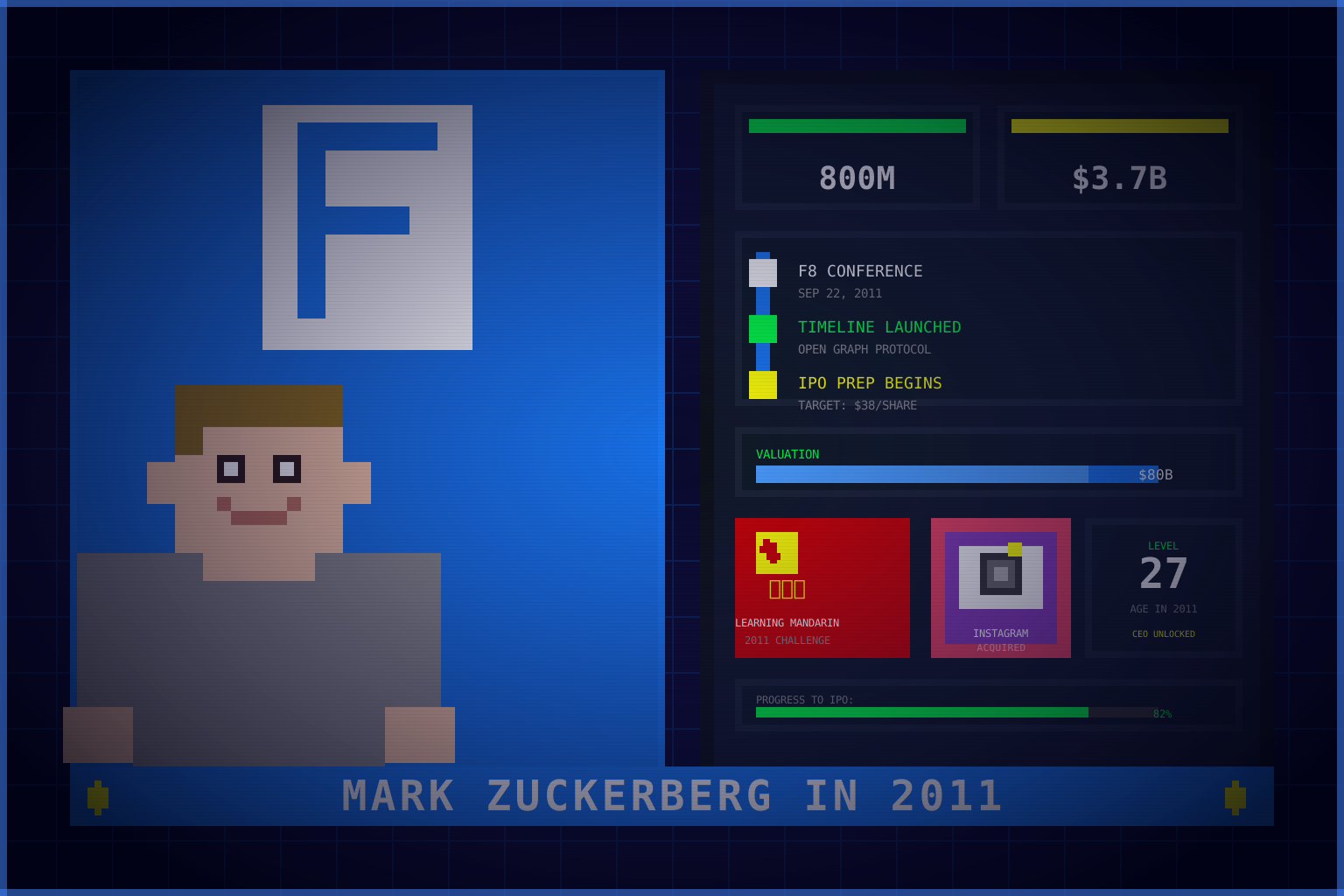
In 2011, Mark Zuckerberg, then 27 years old, directed Facebook through multiple transformative initiatives that solidified his control over the company and shaped its trajectory toward becoming the world’s dominant social media platform. The year centered on two landmark events: the September 22 f8 developer conference—where Zuckerberg announced the “Timeline” profile redesign and the Open Graph protocol—and Facebook’s quiet but accelerating preparation for what would become history’s largest consumer-internet IPO, which ultimately priced at $38 per share in May 2012.
By December 2011, Facebook had surpassed 800 million monthly active users, generated approximately $3.7 billion in annual revenue, and attracted private-market valuations between $65 and $80 billion. Zuckerberg’s strategic decisions throughout 2011—from aggressive international expansion to acquiring mobile photo-sharing infrastructure—signaled his vision of Facebook as inevitable and omnipresent in human connection. His personal annual challenge that year was learning Mandarin Chinese, a signal of his ambitions for the Chinese market.
Key Events and Timeline
| Date | Event |
|---|---|
| February 4, 2011 | Facebook’s seventh anniversary (founded February 4, 2004) |
| January 2011 | Goldman Sachs leads $1.5B secondary investment at $50B valuation |
| June 28, 2011 | Google launches Google+, threatening Facebook’s social dominance |
| September 22, 2011 | f8 developer conference: Timeline and Open Graph announced |
| October 2011 | Facebook Subscribe button launched, enabling public following |
| December 2011 | Facebook acquires Gowalla (location check-in service) |
The f8 Conference and Timeline
On September 22, 2011, Zuckerberg took the stage at The Concourse at the San Francisco Design Center for Facebook’s annual f8 developer conference—considered the year’s single most consequential moment for Facebook’s product direction. He introduced the “Timeline,” a complete overhaul of the user profile presenting one’s life as a scrollable chronological narrative rather than a static wall. The Timeline displayed not just recent posts but life events, photos, and activities stretching back years, with a visual “cover photo” banner at the top.
The same f8 keynote introduced the Open Graph protocol, which allowed third-party apps—music players, news readers, fitness trackers, recipe sites—to post automatic activity updates to a user’s timeline (“Sarah listened to Adele” or “John ran 5 miles”). This transformed Facebook from a destination site into a platform layer embedded across the internet. Within three months of f8, more than 60,000 apps had integrated with the Open Graph.
IPO Preparation and Financial Scale
Facebook did not file its S-1 registration statement until February 1, 2012, but the groundwork was laid throughout 2011. By January 2011, Goldman Sachs had led a $1.5 billion private placement valuing Facebook at $50 billion—at the time, the highest valuation ever assigned to a private U.S. technology company. Secondary-market trading platforms including SharesPost and SecondMarket saw Facebook shares change hands at implied valuations ranging from $65 billion to $80 billion by year-end 2011.
Revenue for 2011 reached approximately $3.71 billion, up from $1.97 billion in 2010—an 88% year-over-year increase driven almost entirely by targeted advertising. Net income for the year was approximately $1 billion, a figure that would prove crucial to the IPO narrative’s credibility. The company employed roughly 3,200 people at year-end, triple the 2009 headcount.
Competitive Pressure: Google+
The June 28, 2011 launch of Google+ represented the most credible competitive threat Facebook had faced since its founding. Google+ introduced “Circles”—the ability to share selectively with defined groups rather than broadcasting to all friends—addressing a persistent Facebook privacy complaint. Within 16 days of launch, Google+ had 10 million users; within 90 days, 40 million.
Zuckerberg reportedly declared an internal “lockdown” at Facebook headquarters, focusing engineering resources on the competitive response. The Subscribe button (launched October 2011), the Timeline redesign, and the Open Graph features were all accelerated partly in response to Google+. Zuckerberg privately dismissed Google+ as a “social layer bolted onto search” without genuine social utility, a view that events largely validated: Google+ stagnated while Facebook continued growing.
Mobile Strategy and Acquisition Signals
By 2011, Zuckerberg recognized that the shift to mobile was Facebook’s largest strategic risk. The company’s desktop-centric advertising model generated minimal revenue from mobile app users, yet mobile usage was growing exponentially, driven by the iPhone 4S and Siri launch and the expansion of the Android ecosystem.
Zuckerberg began building the acquisition strategy that would culminate in Facebook’s $1 billion purchase of Instagram in April 2012. In December 2011, Facebook quietly acquired Gowalla, a location-based check-in service that competed with Foursquare—less for Gowalla’s product than for its engineering team and its experience with mobile social features.
Leadership Style and Cultural Influence
Zuckerberg’s public persona in 2011 was shaped significantly by The Social Network (2010)—David Fincher’s film portraying him as driven, socially detached, and ruthless with early collaborators. Zuckerberg publicly called the film “fiction” and disputed its characterizations, but it colored investor, press, and public perception entering the IPO period. His insistence on wearing the same gray t-shirt and hoodie daily, and his famous dictum “move fast and break things,” became shorthand for a generation of entrepreneurs who equated informality with innovation.
On the philanthropic front, Zuckerberg had signed the Giving Pledge in December 2010 alongside Warren Buffett and Bill Gates, committing to donate the majority of his wealth. In September 2010, he had donated $100 million to Newark, New Jersey public schools—a gift announced on The Oprah Winfrey Show. These moves in 2010–2011 signaled an emerging public-responsibility narrative that would become increasingly central to his identity through the 2010s.
Significance
Mark Zuckerberg’s 2011 activities positioned him as more than a successful entrepreneur: he became the embodiment of a new class of technology leaders wielding unprecedented influence over human communication and attention. His decisions directly shaped the trajectory of Facebook’s evolution into a platform with over 2.9 billion users by 2021. The Timeline redesign introduced psychological principles around behavioral narrative and chronological identity that became templates for social-media design globally.
For the AI and machine learning community specifically, Facebook’s growth in 2011 accumulated the massive datasets and engagement metrics that would power recommendation algorithms, content ranking, ad targeting, and later computer vision and NLP systems that transformed Facebook into an AI-driven company. Zuckerberg’s leadership during this period also sparked the first serious debates about tech-founder accountability, platform responsibility, and the societal costs of engagement-maximizing algorithms—debates that intensified throughout the 2010s and continue today.
The parallel success of LinkedIn’s IPO in May 2011 demonstrated investor appetite for social-media companies broadly, creating favorable public-market conditions for Facebook’s own eventual offering.
Sources
- Kirkpatrick, David (2010). The Facebook Effect. Simon & Schuster.
- Facebook f8 conference keynote recording and official blog posts (September 22, 2011). https://www.facebook.com/blog/
- Securities and Exchange Commission, Facebook S-1 Registration Statement (February 1, 2012). https://www.sec.gov/
- Goldman Sachs private placement reporting — The Wall Street Journal (January 2011). https://www.wsj.com/
- The New York Times tech coverage of Google+ and Facebook competitive dynamics (June–September 2011). https://www.nytimes.com/
Related
- Google+ Launch — Google’s 2011 challenge to Facebook’s social dominance
- Instagram Founding & iOS Launch — the photo-sharing app Facebook would acquire in April 2012
- LinkedIn IPO — the 2011 social-network IPO that set the stage for Facebook’s
- Groupon IPO and the Tech Bubble — a contrasting 2011 tech IPO built on weaker fundamentals