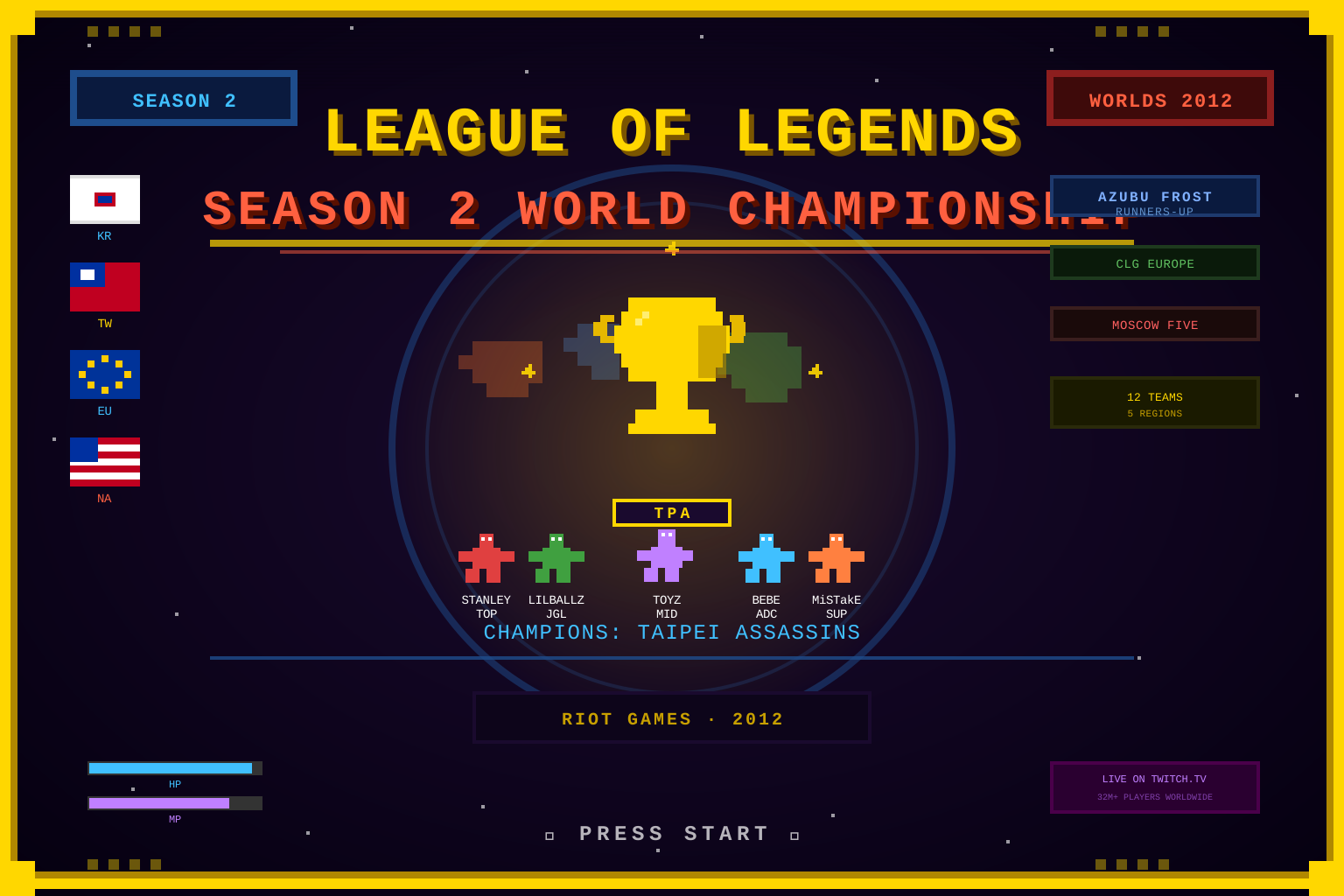
Key figures: Brandon Beck and Marc Merrill (Riot Games co-founders); Taipei Assassins (champions) — Stanley (top), Lilballz (jungle), Toyz (mid), Bebe (AD carry), and MiSTakE (support/captain); Azubu Frost (runners-up) — Shy, CloudTemplar, RapidStar, Woong, and MadLife; CLG Europe and Moscow Five (beaten semifinalists).
Background
League of Legends (LoL), developed by Riot Games and released in October 2009, is a team-based multiplayer online battle arena (MOBA) game that by 2011 had become the world’s most-played PC game by registered accounts, with over 32 million registered players globally by early 2012. The game’s success spawned professional competitive leagues across North America, Europe, South Korea, China, and Southeast Asia, with tournaments streamed live through Twitch (then still operating partly under the Justin.tv brand) and regional broadcast platforms.
The Season 2 World Championship was the culmination of League of Legends’ inaugural fully structured competitive season. Professional teams qualified through regional circuits that preceded the formal League Championship Series (which Riot launched in 2013) in North America and Europe, the OGN Champions league in South Korea, and qualifiers across China, Southeast Asia, and Taiwan. Twelve teams from five regions competed — a structure that foreshadowed the intercontinental format of all subsequent Worlds tournaments.
Tournament Structure and Venue
The Season 2 World Championship took place at the USC Galen Center in Los Angeles, California, from October 4 to October 13, 2012. The Galen Center is a 10,258-seat arena on the University of Southern California campus, the same venue that hosts major collegiate and professional sporting events in Los Angeles.
Twelve teams competed. Eight of them played a group stage — two groups of four, single round-robin in best-of-one games — from which the top two in each group advanced; four other teams were seeded directly into an eight-team, single-elimination knockout bracket. Azubu Frost and Invictus Gaming advanced from Group A and NaJin Sword and CLG Europe from Group B, joining the seeded Taipei Assassins, Moscow Five, Team WE, and Team SoloMid in the quarterfinals. The quarterfinals and semifinals were best-of-three; the final was best-of-five.
Quarterfinal results:
- Taipei Assassins defeated NaJin Sword, 2–0
- Moscow Five defeated Invictus Gaming, 2–0
- Azubu Frost defeated Team SoloMid, 2–0
- CLG Europe defeated Team WE, 2–1
Semifinal results:
- Taipei Assassins defeated Moscow Five, 2–1
- Azubu Frost defeated CLG Europe, 2–1
Championship final (October 13):
- Taipei Assassins defeated Azubu Frost, 3 wins to 1 loss
The prize pool for the Season 2 World Championship totaled $2 million USD, with $1 million awarded to the champion — at the time, the largest single esports prize in history. Runners-up Azubu Frost received $250,000; the beaten semifinalists each received $150,000.
The Champion: Taipei Assassins (TPA)
The Taipei Assassins entered the tournament as relative underdogs — a Taiwanese team less well-known to Western audiences than the Korean powerhouses and established European organizations. Their championship victory stunned the competitive scene and demonstrated that the dominant Korean competitive ecosystem could be defeated by a well-prepared team from another region.
TPA’s championship roster:
- Stanley (top lane) — known for durable, frontline champions such as Shen
- Lilballz (jungle) — aggressive early-game player who consistently disrupted opponents
- Toyz (mid lane) — the team’s playmaker, remembered for his Orianna and Anivia
- Bebe (AD carry) — the team’s primary damage dealer in teamfights
- MiSTakE (support and captain) — played utility-focused champions enabling teamfight initiation
TPA’s strategic style emphasized coordinated teamfighting and disciplined objective control. In the final against Azubu Frost, they repeatedly outmaneuvered Frost’s renowned support player MadLife — considered by many analysts the best support in the world — neutralizing Frost’s engage-oriented compositions through well-timed collapses.
The Runners-Up: Azubu Frost
Azubu Frost, sponsored by the Azubu streaming platform and representing the South Korean competitive ecosystem, had dominated the group stage and semifinals. Their roster included:
- Shy (top lane) — regarded as one of the strongest individual top laners of the season
- CloudTemplar (jungle)
- RapidStar (mid lane)
- Woong (AD carry)
- MadLife (support) — celebrated for his predictive abilities and mechanical skill
Frost’s defeat by TPA in the final was widely analyzed as a strategic upset: TPA had adapted their ban-and-pick phase to deny MadLife’s signature champions, forcing Frost to play less comfortable compositions.
The Western Challenge: CLG Europe and Team SoloMid
The furthest a Western team advanced was the semifinals, reached by CLG Europe (Counter Logic Gaming’s European roster, led by Danish mid-laner Henrik “Froggen” Hansen). CLG Europe defeated China’s Team WE in the quarterfinals before losing 2–1 to Azubu Frost — a series marked by an in-game controversy in which Frost was penalized for viewing an on-stage spectator screen. North America’s Team SoloMid was eliminated 2–0 by Azubu Frost in the quarterfinals. Notably, Season 1 world champions Fnatic failed to qualify for the tournament altogether. The event’s outcome — with East Asian teams filling the final and Western sides unable to progress past the semifinals — foreshadowed the pattern of Korean and Asian mechanical discipline outpacing Western opponents that would define the following years of international competition.
Viewership and Broadcast Scale
According to figures released by Riot Games after the event, more than 8 million viewers watched the Season 2 World Championship broadcast, with a peak of roughly 1.1 million concurrent viewers during the grand final — an extraordinary multiple of any previous esports event, placing the final in the same order of magnitude as major traditional sports broadcasts reaching young-adult demographics. The broadcast was carried in more than a dozen languages.
Distribution platforms included:
- Justin.tv / Twitch — the primary English-language streaming platform
- Own3d — a competing streaming platform with large European audiences (closed in early 2013)
- Azubu.tv — sponsored Korean and Asian broadcasts
- Regional platforms in South Korea (OGN), China, and Southeast Asia
Broadcasts were produced in multiple languages, with English-language commentary on the main stream and Korean-language coverage anchored by OGN’s established broadcast team — helping Western audiences follow the strategic depth of Korean competitive play.
Cultural and Industry Significance
Esports Reaches Mass Audiences Without Television
The S2 Worlds’ viewership figures arrived entirely through internet streaming, requiring no television infrastructure. For the first time, a live competitive gaming event proved it could aggregate an audience comparable to mid-tier American cable sports broadcasts — on-demand, globally distributed, and accessible via consumer internet. This demonstrated the viability of digital-native sports entertainment at commercial scale.
Asian Dominance Established
The tournament’s outcome — with Korean and Taiwanese teams in the final, and Korea’s dominant regional league players filling top seeds — established the pattern of East Asian competitive dominance that would define League of Legends esports for years. The 2013, 2014, 2015, and 2016 World Championships were all won by Korean teams (SKT T1, Samsung White, SKT T1 again, and SKT T1 again), cementing the institutional and training infrastructure advantages of the Korean esports system.
Riot Games as a Major Event Producer
The S2 Worlds marked Riot Games’ emergence as a global event organizer, not merely a game developer. The production values — live audience, professional stage design, broadcast-quality camera work, professional commentary — positioned Riot alongside traditional sports organizations. This set the template for a multi-year escalation in production investment: S3 Worlds at Staples Center (2013), S4 Worlds at Seoul World Cup Stadium (2014), and subsequent events with opening ceremonies rivaling major entertainment productions.
Commercial Ecosystem Validation
Teams such as Fnatic, Azubu Frost, Moscow Five, and CLG Europe were sponsored by technology companies, peripheral manufacturers, and consumer brands. Azubu itself — a streaming platform investing heavily in team sponsorships — demonstrated that platform companies would fund esports organizations to build audience loyalty. This model foreshadowed Amazon/Twitch’s 2014 acquisition of the streaming ecosystem and later investment from telecom companies, apparel brands, and sports franchises.
Prize Money and Professionalization
The $1 million winner’s prize in 2012 was unprecedented in esports and enabled the winning TPA roster — previously earning modest regional tournament prizes — to establish themselves as fully professional players. The prize pool scale set expectations for subsequent tournaments, driving a multi-year escalation: by 2019, the LoL Worlds prize pool had grown to $2.2 million with additional performance bonuses, while the broader esports industry saw prize pools exceeding $30 million for other titles.
Long-term Impact
The Season 2 World Championship is widely cited as the watershed moment when esports transitioned from a niche internet subculture to a recognized entertainment industry category. Within three years of the S2 Worlds, ESPN had launched an esports coverage section, Turner Broadcasting launched an esports television network (ELeague), and traditional sports franchise owners — including those from the NFL, NBA, and MLB — had begun acquiring or investing in esports organizations.
League of Legends Worlds became an annual tentpole event. The 2022 Worlds final in San Francisco drew 5.1 million peak concurrent English-language viewers (with total multilingual viewership estimated at 73.9 million), illustrating the exponential growth trajectory that S2 Worlds had initiated.
See Also
- The Avengers (2012 Film) — 2012’s highest-grossing film, released in May as mainstream entertainment reached peak blockbuster scale
- Gangnam Style Viral Phenomenon — another 2012 moment of internet-driven, globally distributed mass culture originating in East Asia
- YouTube and Streaming Video Adoption (2012) — the technical infrastructure enabling esports mass broadcast
- Windows 8 Release — the October 2012 OS release that shaped gaming platform dynamics
- Pro Evolution Soccer 2013 — competitive gaming across sports simulation genres in 2012
Sources
- 2012 League of Legends World Championship — Wikipedia
- Season 2 World Championship — League of Legends Esports Wiki
- Riot Games official viewership release, October 2012 (via Polygon, The Verge archives)
- Taipei Assassins — Liquipedia League of Legends
- Esports Earnings — Season 2 Worlds prize pool