Key figures: Susan Wojcicki (YouTube VP Product), Reed Hastings (Netflix CEO), Jason Kilar (Hulu CEO), Larry Page (Google CEO)
Summary
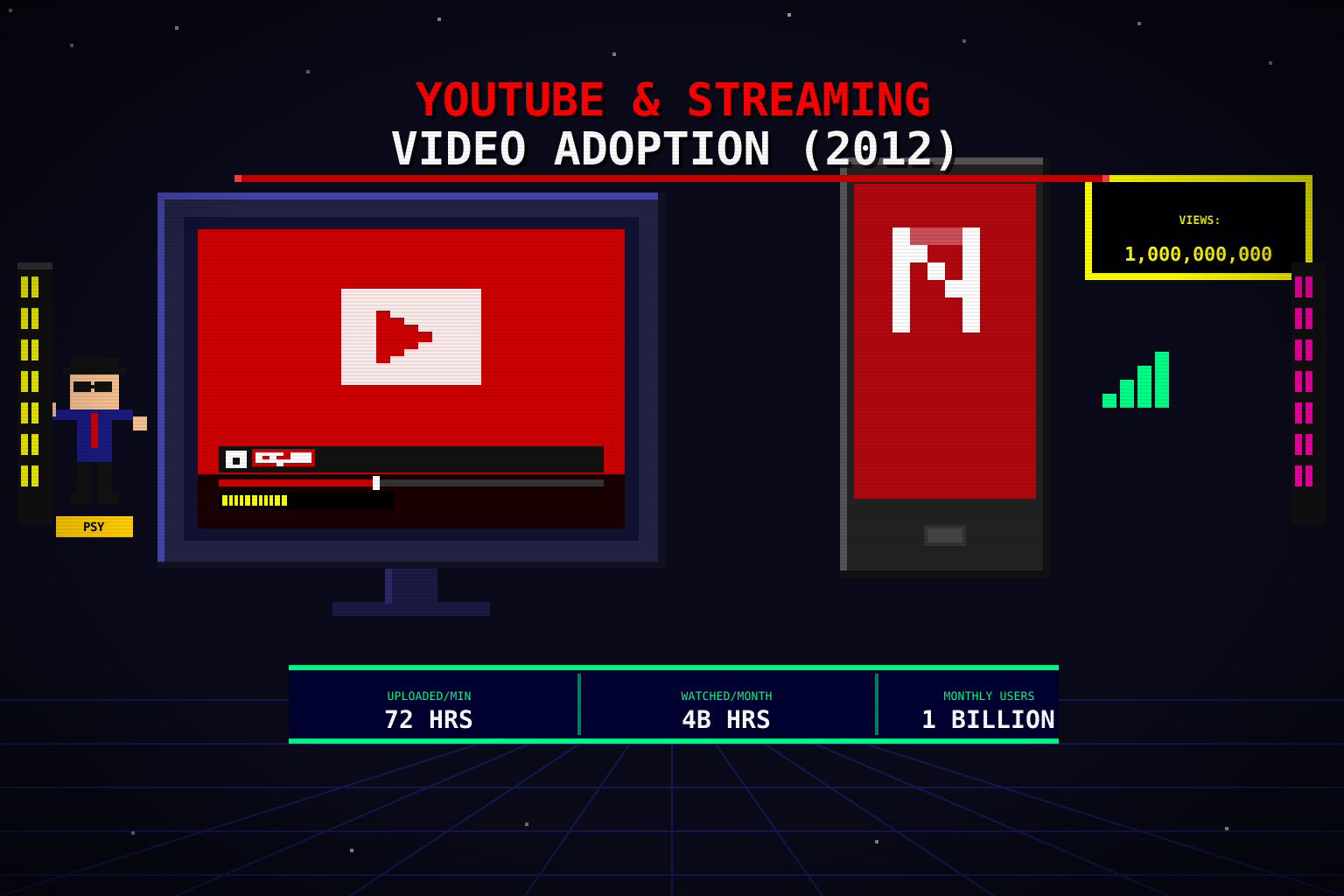
Throughout 2012, video streaming matured from a technological novelty into a mainstream media delivery platform, fundamentally altering how audiences discovered, consumed, and paid for entertainment. YouTube, owned by Google since a $1.65 billion acquisition in October 2006, approached 1 billion unique monthly users by early 2013—a figure that placed it ahead of every television network in the world in terms of reach. Four billion hours of video were watched on YouTube every month by mid-2012, and 72 hours of new video were uploaded every minute, figures that had roughly doubled from 2011.
On December 21, 2012, PSY’s “Gangnam Style” music video became the first YouTube video to surpass 1 billion total views, a milestone that required the platform’s engineers to upgrade their view counters—which had been capped at a signed 32-bit integer limit of approximately 2.1 billion—to accommodate the billions of views the video would go on to accumulate. The event became a cultural marker for the scale of global internet video consumption.
Netflix’s Streaming Transition
Netflix executed one of the most consequential business pivots in media history during 2012. The company had begun offering streaming in 2007 as an add-on to DVD subscriptions; by 2012, streaming had become its primary product:
- Netflix ended Q4 2012 with approximately 27.1 million domestic streaming subscribers, up from 21.7 million at the end of 2011—a 25% year-on-year increase.
- International streaming subscribers reached approximately 5 million across Latin America, the United Kingdom, Ireland, and the Nordic countries by year-end.
- DVD-by-mail subscribers declined to approximately 8 million by December 2012, down from a peak of more than 20 million in 2010.
- Netflix spent approximately $2 billion on content licensing in 2012, with a significant portion directed toward exclusive streaming rights.
Netflix’s push into original programming—it had committed in 2011 to House of Cards, the first major series produced exclusively for a streaming platform, which entered production during 2012 ahead of its February 2013 premiere—signaled that services like Netflix would compete directly with premium cable channels (HBO, Showtime) rather than simply licensing their content. Netflix’s stock, which had fallen sharply after the botched 2011 Qwikster spinoff announcement, recovered through 2012 as subscriber growth validated the streaming pivot.
Hulu and the Studio Response
Hulu, the joint venture of Walt Disney Company, 21st Century Fox, and NBCUniversal, pursued a different strategy: partnering with the studios that owned the content. By the end of 2012, Hulu generated approximately $695 million in revenue, more than doubling its 2010 figure of $263 million. Hulu Plus, its subscription tier launched in 2010 at $7.99 per month, reached approximately 3 million paying subscribers by late 2012, while the ad-supported free tier drew significantly larger audiences.
The contrast between Netflix and Hulu reflected a broader industry tension: technology companies (Netflix, Amazon, Google/YouTube) wanted to own the distribution relationship with consumers, while traditional media companies preferred to maintain control over content libraries and licensing terms while hedging with their own streaming operations.
Infrastructure: Mobile Broadband as Enabler
The rapid expansion of mobile broadband subscriptions—exceeding 1 billion subscriptions globally by 2012, as documented by the ITU—enabled streaming consumption on smartphones and tablets, breaking the dependency on fixed internet connections. Key infrastructure developments in 2012 included:
- 4G LTE rollout: By the end of 2012, LTE networks reached commercial availability in more than 50 countries, with the United States, South Korea, and Japan leading in coverage and subscriber adoption. Verizon’s LTE network covered approximately 470 U.S. cities by year-end.
- Tablet proliferation: Apple sold 22.9 million iPads in Q4 2012 alone, with video streaming consistently ranked among the top use cases. Amazon’s Kindle Fire HD and Google’s Nexus 7 and Nexus 10 tablets also entered the market, expanding the device ecosystem for streaming.
- Bandwidth costs: Average U.S. broadband speeds rose to approximately 7.2 Mbps by mid-2012, sufficient to support HD streaming, which required roughly 5 Mbps per Netflix’s specifications at the time.
The Advertising and Monetization Shift
YouTube’s scale created a new category of internet-native advertising. Google’s DoubleClick ad technology, integrated into YouTube, enabled targeted pre-roll, mid-roll, and display advertising at a granularity impossible in broadcast television. By 2012, YouTube’s annual revenue was estimated at approximately $3.7 billion, though the platform was not yet consistently profitable after infrastructure and content costs.
The emergence of the “YouTuber” as a professional creator category—individuals like Jenna Marbles (who surpassed 5 million subscribers in 2012), PewDiePie, and Ray William Johnson—demonstrated that the platform’s ad-sharing model (creators received approximately 55% of ad revenue on monetized videos) could sustain professional content production outside traditional studio structures.
Significance
The shift to streaming video in 2012 represented a structural transformation in media consumption. The year established several dynamics that would define the entertainment industry for the following decade:
- The subscription video-on-demand (SVOD) model, validated by Netflix’s profitable growth, became the dominant framework around which studios built their own streaming services (Disney+, HBO Max, Paramount+) beginning in 2019.
- User-generated content at scale, exemplified by YouTube’s billion-user reach and the “Gangnam Style” milestone, proved that algorithmically distributed, creator-uploaded video could command audiences comparable to legacy broadcast television.
- Mobile-first streaming decoupled video consumption from the living room, shifting audience behavior toward shorter, on-demand viewing sessions and accelerating cord-cutting trends that cable providers began to acknowledge publicly by 2013.
- The cord-cutting phenomenon—canceling cable subscriptions in favor of streaming services—remained nascent in 2012 (U.S. pay-TV subscribers still exceeded 100 million), but the structural conditions enabling mass defection were now in place.
See Also
- Global Internet Adoption and the Digital Divide (2012) — the mobile broadband infrastructure expansion that enabled global streaming growth
- Instagram Facebook Acquisition 2012 — parallel consolidation in social media platforms driven by mobile and content trends
- 2012 London Olympics Technology & Broadcasting — the largest live-streaming event to that point, foreshadowing streaming’s mainstream scale
- Gangnam Style Viral Phenomenon — the YouTube milestone whose billion-view record this article documents
- League of Legends Season 2 World Championship — the October 2012 esports event whose multi-million-viewer live broadcast depended on the streaming infrastructure described here
Sources
- YouTube Revenue and Usage Statistics (2026) - Business of Apps
- Hulu Statistics (2026) - Number of Subscribers & Revenue
- Video streaming worldwide - statistics & facts | Statista
- Online Video and Streaming Sites Statistics, Facts - Market.us
- Netflix Letter to Shareholders Q4 2012
- Gangnam Style YouTube milestone - The Guardian