Summary
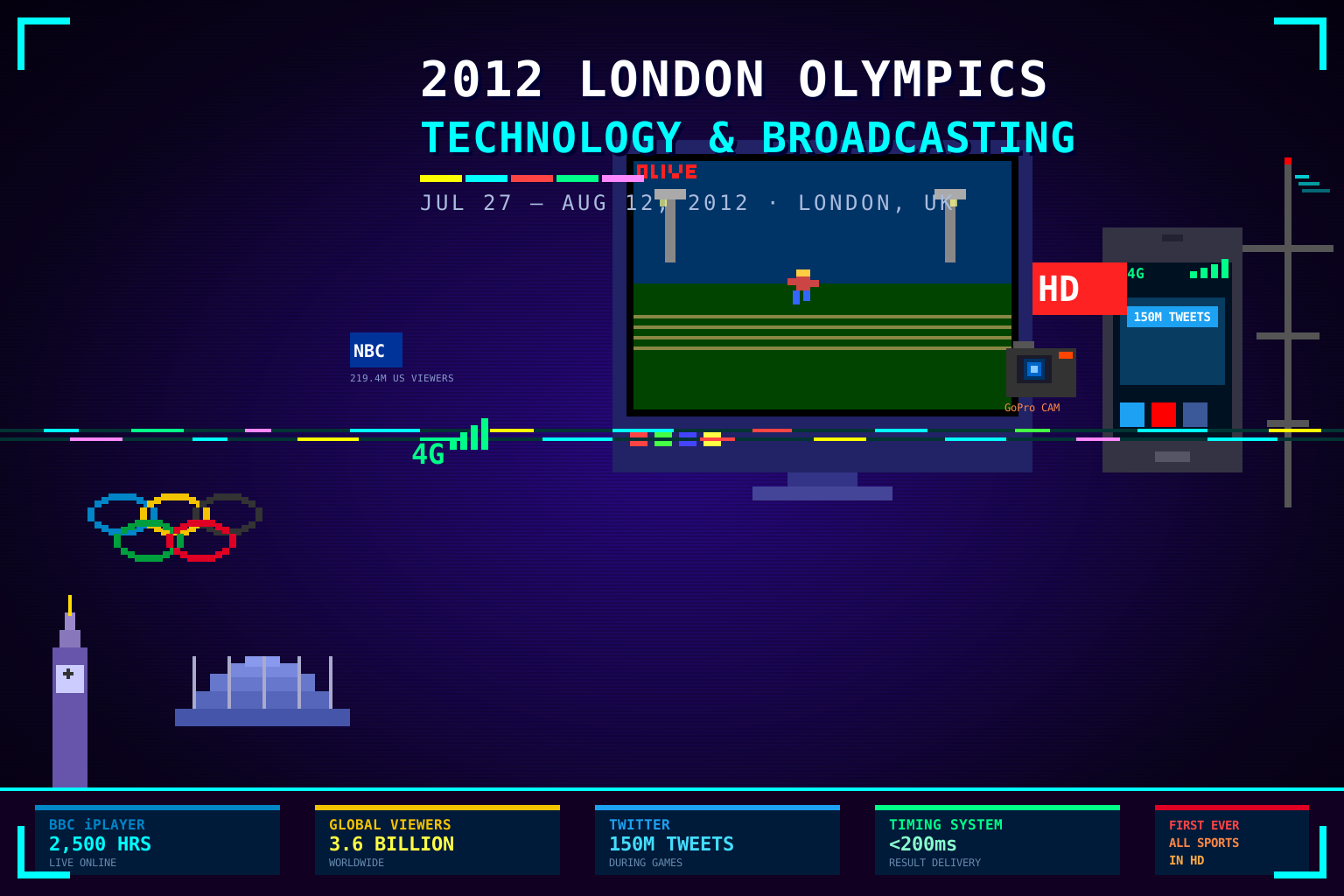
The 2012 London Olympics (July 27–August 12, 2012) marked a turning point in how the Olympic Games leveraged emerging technologies to enhance the global viewing experience and operational efficiency. For the first time in Olympic history, every sport in the Games was broadcast in high definition to domestic audiences, with the BBC transmitting 2,500 hours of live coverage online via the BBC iPlayer—a volume that would have been technically and economically impossible just four years earlier at Beijing 2008. An estimated 3.6 billion people watched some portion of the Games globally—out of a record potential audience of 4.8 billion with access to coverage—while NBC’s US coverage reached 219.4 million viewers, making London 2012 the most-watched US broadcast event up to that point.
Social media transformed spectator participation: Twitter processed over 150 million Olympic-related tweets during the Games, and the IOC’s official YouTube channel delivered live streaming in markets where broadcast rights had not been sold. Athletes communicated directly with fans, bypassing broadcast intermediaries. BT served as official technology partner, deploying a fiber network backbone across all Olympic venues. Omega’s precision timing systems transmitted results to the global press corps in under 200 milliseconds. The integration of action cameras—particularly GoPro units mounted on athletes in kayaking, BMX, and beach volleyball—into official broadcast feeds began a new era of immersive sports production. These developments collectively established London 2012 as the first “Social Olympics” and set the operational and editorial template for all subsequent mega-events.
Background: Broadcasting Before London 2012
The evolution of Olympic broadcasting from Beijing 2008 to London 2012 illustrates how rapidly the media landscape shifted:
- Beijing 2008: Partial HD coverage from some broadcasters; NBC streamed 2,200 hours online (a record at the time); Twitter had only 6 million users globally; the iPhone was one year old and had no App Store for the first two months.
- Vancouver 2010 (Winter): NBC’s online streaming reached 27 million unique visitors; HD coverage expanded but remained uneven across sports and broadcasters.
- London 2012: Full HD across all sports; the BBC iPlayer handled record simultaneous streams; Twitter had over 500 million registered users; smartphones were ubiquitous in high-income markets; the App Store had over 650,000 apps.
This four-year gap—spanning the smartphone revolution, the launch of Instagram (October 2010), the iPad (April 2010), and the broad rollout of 4G networks—meant that London faced a qualitatively different technological environment than any prior Olympics.
Significance
Broadcast Innovation: Full HD at Scale
The BBC’s complete HD coverage across all Olympic sports required coordinating with Olympic Broadcasting Services (OBS), the IOC’s dedicated production agency, to ensure HD-capable camera crews, transmission infrastructure, and editorial workflows across 34 sports at 40 venues spread across London and regional UK sites. The BBC deployed over 765 journalists and technical staff. Its iPlayer platform set a record of approximately 9 million requests in a single day during the Games—at a time when catch-up TV streaming was still a novel concept in most markets.
For the first time, the BBC offered viewers a “red button” and online choice of up to 24 simultaneous live streams, enabling audiences to watch any event live rather than waiting for primetime highlights. This multi-feed approach anticipated the on-demand streaming model that Netflix and Amazon Prime Video would mainstream within two years. ITV and Channel 4 (covering the Paralympics) also contributed to what was described by the European Broadcasting Union (EBU) as the most complex multi-platform sports broadcast in history.
4G Infrastructure and Mobile Networks
EE (a joint venture between Deutsche Telekom and Orange, subsequently acquired by BT) launched the UK’s first commercial 4G network on October 30, 2012—approximately two months after the Olympic closing ceremony. However, 4G trial networks were active in central London during the Games period, and O2 and Vodafone operated enhanced 3G (HSPA+) networks capable of delivering near-4G throughputs to meet the demands of 700,000+ daily visitors to Olympic venues. BT upgraded its backhaul infrastructure across the Olympic Park in Stratford, East London, installing over 30,000 kilometers of optical fiber in the Olympic venues and athletes’ village.
The Olympic Park in Stratford—built on a reclaimed brownfield industrial site in East London—received the most concentrated telecommunications infrastructure investment in UK history up to that point. Every venue included distributed antenna systems (DAS) to ensure indoor cellular coverage. This infrastructure investment, totaling approximately £1.5 billion across all technology partners (BT, Panasonic, Atos, Cisco, Omega), subsequently benefited Stratford’s long-term development as a technology and commercial hub.
Social Media: The First “Social Olympics”
The IOC officially designated London 2012 the first “Social Olympics,” reflecting the unprecedented scale of real-time social media engagement. Key metrics:
- Twitter: 150 million Olympic-related tweets during the Games; the opening ceremony on July 27 generated 9.66 million tweets in a single hour, a record at the time
- Facebook: 100 million interactions (likes, comments, shares) on Olympic content during the Games period
- YouTube: The IOC’s channel offered live streaming in 64 countries; over 100 million video views of Olympic content during the Games
- Instagram: Athlete and spectator images from London 2012 contributed to Instagram surpassing 80 million users by late July 2012, up from around 15 million at the start of the year
The athlete-to-fan direct communication channel represented by Twitter fundamentally altered how sports personalities managed their public personas. Gymnast Gabby Douglas and swimmer Michael Phelps became social-media phenomena in real time during competition; US swimmer Ryan Lochte’s Twitter follower count grew by over 500,000 during the Games. The IOC’s initial restrictive social-media guidelines (athletes were not permitted to livestream or provide journalist-style coverage from venues) generated controversy, foreshadowing ongoing tensions between sports governing bodies and the creator economy.
Digital Distribution & Second-Screen Experiences
NBC’s digital coverage—streaming via NBCOlympics.com and the NBC Sports app—reached 159 million total streams during London 2012, representing a 300% increase over Vancouver 2010. NBC offered live streaming of every event online (authenticated via cable/satellite TV subscription), supplementary statistics, multi-camera feeds, and a “Social Pulse” feature aggregating Twitter and Facebook reactions in real time.
The BBC’s companion app for tablets provided synchronized second-screen content: real-time athlete biographies, event schedules, historical records, and contextual statistics keyed to the live broadcast. This “companion experience” model—pioneered at London 2012—became standard practice for major broadcasters by 2014–2016. It also established the economic logic of authenticated streaming (requiring a pay-TV subscription to access online content), which was the dominant model until direct-to-consumer streaming disrupted it in the late 2010s.
Channel 4 and Paralympic Innovation
Channel 4’s coverage of the 2012 Paralympic Games (August 29–September 9, 2012) set a new international benchmark for para-sport broadcasting. The channel allocated more airtime to the Paralympics than any previous British broadcaster—116 hours of live coverage across Channel 4, Channel 4+1, and More4—and introduced several accessibility and production innovations:
- “Meet the Superhumans” campaign: A 90-second trailer featuring disabled athletes set to Public Enemy’s “Harder Than You Think,” which has since been cited in advertising industry analyses as one of the most influential sports marketing campaigns of the decade
- Live audio description and signing: Real-time audio description for visually impaired viewers and British Sign Language interpretation for key broadcasts
- Athlete-centered narration: Commentary focusing on athletic achievement rather than disability narrative, a deliberate editorial policy that influenced para-sport broadcasting globally
Channel 4’s approach, driven by its Paralympic remit and a £47 million broadcast rights fee, generated record Paralympic viewing figures: an average audience of 2.7 million for evening sessions, peaking at 11.2 million for the Opening Ceremony—figures comparable to mainstream sports broadcasting.
Event Operations: RFID, Timing, and Results Distribution
Omega’s timekeeping and scoring infrastructure represented 40 years of Olympic partnership and its most complex deployment to date. Results were transmitted from competition venues to the global press center in under 200 milliseconds, enabling live results feeds that journalists, broadcasters, and fans consumed simultaneously. Omega deployed over 400 timing specialists across all venues, using photocell sensors, false-start detectors, touchpads (swimming), photofinish cameras operating at 10,000 frames per second, and transponders.
RFID tracking systems enabled real-time location of athletes, officials, media, and accredited vehicles across the 34-venue complex. Over 10 million RFID-enabled accreditations were processed across the full Games period. Atos served as IT systems integrator, managing the results database, accreditation systems, and venue operations infrastructure across a private IP network (no public internet) to ensure security and reliability.
Infrastructure Legacy: East London Digital Hub
The Olympic Park’s technology infrastructure—fiber networks, data centers, cellular DAS systems—became the foundation for the East London “Tech City” (Silicon Roundabout) development that the UK government actively promoted from 2010 onward. The Stratford International station and Olympic Park site attracted technology firms including Google (UK headquarters), Amazon Web Services’ UK operations, and dozens of startups in the years following the Games. This technology clustering, catalyzed by the Olympic infrastructure investment, significantly shifted East London’s economic geography.
Key Figures & Organizations
- BBC: Led full-HD broadcast delivery across all Olympic sports; 2,500 hours online via iPlayer; peak of 9 million daily iPlayer requests
- EE / BT Group: Provided optical fiber backbone across Olympic venues; 4G trial network active in central London during Games
- NBC Universal (US broadcaster): 159 million total streams; first complete online streaming of all Olympic events for US pay-TV subscribers
- Channel 4 (UK): Groundbreaking Paralympic Games coverage; “Meet the Superhumans” campaign; 116 hours of live Paralympic programming
- Olympic Broadcasting Services (OBS): Coordinated global signal production in HD across all venues; provided host-broadcast feed to 220 countries
- Atos: IT systems integrator for results, accreditation, and venue management across all Olympic sites
- Omega: Official timekeeper; sub-200ms results transmission; photofinish cameras at 10,000 fps
- Danny Boyle (Opening Ceremony director): Coordinated cutting-edge LED arrays, live-feed projection, and digital visual effects for the July 27 opening spectacle
See Also
Category: Science & Technology
- GoPro and the Action Camera Rise (2012) — action cameras integrated into official Olympic coverage for first-person athlete POV footage
- Curiosity Rover Mars Landing — concurrent July–August 2012 technology milestone; similarly streamed via NASA’s web platform to record online audiences
- Instagram Facebook Acquisition 2012 — the social-media platform that crossed 80 million users during the Olympics, amplified by athlete and fan content
- 2012 London Summer Olympics — the broader Olympic event, political context, and cultural significance
- London 2012 Olympics Opening Ceremony — Danny Boyle’s technology-enhanced spectacle, watched by 900 million globally
- YouTube and Streaming Video Adoption (2012) — the same year’s shift toward streaming video that the Games’ record online audience anticipated
Sources
-
BBC Annual Report 2012–2013 (BBC, published July 2013). Primary source for iPlayer request volumes (peak 9 million daily requests), hours of live online coverage (2,500 hours), and technical deployment scale.
-
NBC Sports: “London 2012 Digital Report” (NBC Universal, September 2012). Documents 159 million total streams, 219.4 million total US viewers, and authenticated streaming model. Widely cited in trade press including Multichannel News and Broadcasting & Cable.
-
Twitter Blog: “London 2012: By the Numbers” (Twitter official blog, August 12, 2012). Confirms 150 million Olympic tweets, 9.66 million tweets during opening ceremony hour, and athlete follower growth statistics.
-
Wikipedia: “2012 Summer Olympics” — “Broadcast and media” section. Comprehensive overview of broadcasting arrangements (220 countries, rights fees, broadcaster list), digital platforms, and OBS technical infrastructure.
-
Channel 4: “Paralympic Coverage Report 2012” (Channel 4, September 2012). Documents viewing figures (2.7 million average, 11.2 million opening ceremony peak), 116 hours of live coverage, and accessibility innovation commitments.
-
Omega SA: “Olympic Timekeeping at London 2012” (Omega press release, August 2012). Confirms sub-200ms results transmission, 400+ timekeeping specialists deployed, and photofinish camera specifications (10,000 fps).
-
Atos SE: “London 2012 Technology Partnership Review” (Atos, 2012). Documents IT infrastructure scope including results management systems, accreditation volume (10 million+ RFID credentials), and private IP network architecture.