Summary
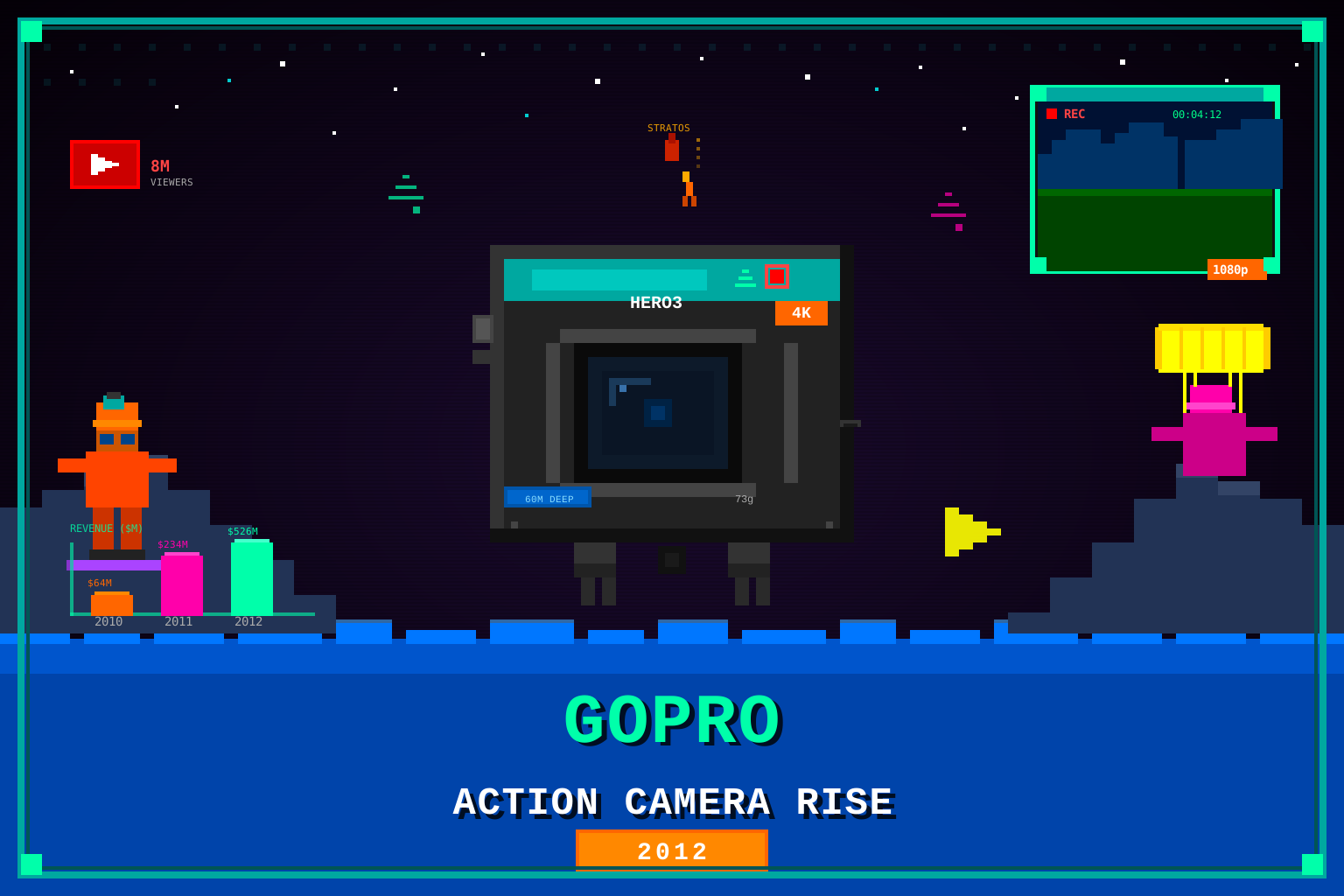
The rise of compact, waterproof, high-definition action cameras—epitomized by GoPro—became a defining consumer-electronics trend of 2012. Marketed initially to extreme athletes and adventure enthusiasts, action cameras like the GoPro Hero 3 (released October 17, 2012) captured stunning first-person HD footage in environments where traditional cameras were impractical or impossible. Priced at $199.99 (Hero 3 White), $299.99 (Silver), and $399.99 (Black Edition), the Hero 3 line dramatically undercut earlier models while adding native Wi-Fi connectivity, 4K video recording at 15 fps, and 1080p at 60 fps. By 2012, GoPro’s revenue had reached approximately $526 million—up from $234 million in 2011 and $64.6 million in 2010—as affordable action cameras entered mainstream consciousness through viral sports footage, their ubiquitous presence at the London 2012 Olympics, and growing integration with YouTube and Instagram.
GoPro’s ecosystem—built on interchangeable mounts, a rugged polycarbonate housing rated waterproof to 60 meters, and seamless social sharing via the GoPro iPhone and Android apps—transformed what consumers expected from personal recording devices. The Hero 3 Black Edition weighed just 73 grams (body only), making it lighter than a typical smartphone. Felix Baumgartner’s Red Bull Stratos stratospheric jump on October 14, 2012, broadcast live to an estimated 8 million concurrent viewers on YouTube, demonstrated action cameras’ capacity to document extreme feats previously impossible to film. This convergence of consumer demand, streaming platforms, and miniaturized HD technology created the foundation for a multibillion-dollar market that reshaped digital media production throughout the 2010s.
Background: GoPro Before 2012
Nick Woodman founded GoPro in 2002 after a surfing trip to Australia, where he wanted a way to mount a camera to his wrist. He initially funded development by selling beaded belts and shell necklaces from a van, reportedly raising $30,000 from friends and family before receiving $265,000 from his parents. The original GoPro Hero, released in 2004, used 35mm film and was sold primarily at surf shops. The company pivoted to digital video in 2006 with the Digital Hero, and by 2010 the HD Hero introduced 1080p recording.
The 2010 HD Hero—capable of 1080p at 30 fps in a waterproof housing for under $300—was GoPro’s first product to attract mainstream media attention. Revenue grew from $64.6 million in 2010 to $234.2 million in 2011, and then to $526.0 million in 2012 as the Hero 2 (released October 2011) and Hero 3 (released October 2012) drove adoption across new demographics: snowboarders, cyclists, motorsport competitors, and eventually professional filmmakers.
The Hero 3: Technical Specifications
The Hero 3 represented a major technological leap across its three tiers:
| Model | Price | Max Resolution | Key Feature |
|---|---|---|---|
| Hero 3 White | $199.99 | 1080p/30fps | Entry-level; no Wi-Fi in some markets |
| Hero 3 Silver | $299.99 | 1080p/60fps | Built-in Wi-Fi; improved low-light performance |
| Hero 3 Black | $399.99 | 4K/15fps; 1080p/60fps | First consumer camera with 4K video capability |
The Black Edition also offered 720p at 120 fps for slow-motion capture, a 12-megapixel still-image sensor capable of burst shots at 30 frames per second, and a 170-degree ultra-wide lens. The integrated Wi-Fi allowed remote control via smartphone at distances up to 180 feet (55 meters), enabling riders to mount the camera in inaccessible positions and control it from a phone in their pocket—a feature that distinguished the Hero 3 from every competitor at its price point.
The camera body measured 59.9 × 41.0 × 21.0 mm and came standard with a waterproof dive housing rated to 60 meters (197 feet), effectively making it the world’s smallest production-grade HD dive camera. The removable battery (1050 mAh) provided approximately 1.5–2 hours of continuous 1080p recording.
Significance
Consumer Electronics Market Disruption
By October 2012, GoPro had shipped over 2 million cameras cumulatively. Competitors including Contour ROAM ($149.99), Drift HD170, and Sony’s Action Cam (announced early 2012) entered the market, validating the category but failing to match GoPro’s ecosystem depth. GoPro’s mount ecosystem—comprising over 30 official mount variants including the Chest Mount Harness, Jaws Flex Clamp, and Suction Cup Mount—became a proprietary advantage that locked in users. By the time GoPro filed for its IPO in June 2014 (listing on NASDAQ under ticker GPRO at $24/share, raising $427 million), the company had established itself as the world’s largest action-camera maker by revenue.
Sports & Extreme-Event Documentation
2012 was a pivot year for first-person sports footage. The Red Bull Stratos project on October 14, 2012 carried Felix Baumgartner to about 128,100 feet (39,045 meters)—at the time the highest crewed balloon flight in history—and documented his 4-minute-19-second freefall, during which he became the first human to break the sound barrier in freefall, reaching a top speed of approximately 1,357.64 km/h (843.6 mph). Five GoPro cameras mounted on Baumgartner’s suit captured the jump alongside dedicated broadcast cameras. The YouTube livestream peaked at 8 million concurrent viewers, a record at the time, and the full jump video ultimately accumulated over 40 million views.
At the London 2012 Olympics (July 27–August 12), GoPro cameras were used by kayakers, BMX riders, and beach volleyball players to capture first-person POV footage that professional broadcast cameras could not access. This footage was licensed by NBC, BBC, and Eurosport for broadcast use, marking the first large-scale integration of consumer action-camera footage into official Olympic coverage. See 2012 London Olympics Technology & Broadcasting for the broader broadcast context.
Social Media & User-Generated Content Ecosystem
The rise of YouTube’s Partner Program and Instagram (acquired by Facebook in April 2012 for $1 billion) created financial incentives for individual action-camera content creators. GoPro launched its own YouTube channel in 2012, which by year’s end had accumulated over 100,000 subscribers—it would eventually reach 10+ million. The company formalized its content strategy by republishing user-submitted footage and building a library of aspirational content that served dual purposes: entertainment and product demonstration.
This ecosystem created a flywheel: compelling footage drove camera sales, which drove more footage, which drove more subscribers, which provided GoPro with a media property valued independently of hardware. By 2013, GoPro’s YouTube channel was generating enough ad revenue to be treated as a standalone media business. See Instagram Facebook Acquisition 2012 for the platform context that amplified this distribution model.
Documentary & Journalism Innovation
War correspondents embedded with combat units began adopting GoPros in 2012 for their small form factor, durability under harsh conditions, and ability to capture footage without conspicuously handling a large camera. Investigative journalists and citizen reporters in conflict zones—including Syria and Egypt during the Arab Spring’s aftermath—used action cameras to document events where traditional camera equipment would have been dangerous or conspicuous.
Environmental documentarians working in extreme conditions (deep-sea dives, high-altitude expeditions, wildfire coverage) adopted the Hero 3’s 60-meter waterproof rating and −20°C operating temperature range. The BBC’s Natural History Unit began integrating GoPro footage into nature documentary production, recognizing that the cameras could be positioned inside burrows, on bird wings, and in locations impossible for a traditional camera operator.
Wearable Technology Precedent
Action cameras were among the earliest mainstream wearable recording devices, establishing design patterns—small form factor, mount ecosystem, wireless remote control, cloud backup—that would be replicated in body cameras (law enforcement adoption surged after 2012), automotive dash cams (a multi-billion-dollar market by 2015), and eventually head-mounted devices. The GoPro mount ecosystem directly informed the modular attachment systems used in later wearable tech including fitness trackers, military-grade helmet cameras, and the HoloLens developer accessory ecosystem. See Apple iPhone 5 Launch for the concurrent smartphone trends that shaped mobile video ecosystems.
Intellectual Property & Creator Economics
As user-generated action-camera footage proliferated on YouTube, content ownership disputes emerged. GoPro’s terms of service when users submitted footage for the company’s YouTube channel required a license grant; some creators contested this arrangement. YouTube’s Content ID system, deployed at scale by 2012, allowed rights holders to claim ad revenue from videos containing their footage—creating cases where athletes who filmed themselves were subject to music copyright claims or platform restrictions. These tensions foreshadowed the creator-economy IP debates that would intensify through the 2010s.
Key Figures & Organizations
- Nick Woodman (GoPro founder, b. 1975): Founded GoPro in 2002 in San Mateo, California; named Forbes’ “World’s Richest New Billionaire” in 2014 after the company’s IPO. His personal net worth peaked at approximately $3.9 billion in late 2014.
- GoPro Inc. (San Mateo, CA): Launched the Hero 3 on October 17, 2012; grew to approximately 1,500 employees by the time of its 2014 IPO. Ticker: GPRO (NASDAQ, listed June 26, 2014).
- Felix Baumgartner (Red Bull Stratos, October 14, 2012): Austrian skydiver whose stratospheric jump—documented with five GoPro cameras—set records for highest manned balloon flight, highest freefall, and first supersonic freefall.
- Red Bull Media House: Produced and distributed the Stratos jump footage, demonstrating how a non-media brand could use action-camera technology to create globally viral premium content.
- YouTube / Google: Platform that provided both distribution for GoPro content and financial incentives (via the Partner Program) for individual creators, creating the economic foundation for the action-camera content ecosystem.
- Contour, Drift, Sony (competitors): Contour’s ROAM, Drift’s HD170, and Sony’s HDR-AS15 Action Cam (announced January 2012 at CES) validated the category but struggled to match GoPro’s mount ecosystem and brand positioning.
See Also
Category: Science & Technology
- 2012 London Olympics Technology & Broadcasting — mainstream use of action cameras in Olympic sports coverage, including first-person footage integrated into official broadcasts
- Felix Baumgartner Red Bull Stratos (October 2012) — the stratospheric jump documented with five GoPro cameras, showcasing action cameras’ capacity to film extreme feats
- Apple iPhone 5 Launch — concurrent smartphone innovations that enabled mobile video editing, Wi-Fi remote control, and cloud backup for action footage
- Instagram Facebook Acquisition 2012 — social-platform acquisition that accelerated action-camera adoption and content distribution economics
- Gangnam Style Viral Phenomenon — concurrent viral-video trend demonstrating YouTube’s power as a global distribution platform
Sources
-
GoPro Inc. Form S-1 Registration Statement (filed June 2014, SEC EDGAR). Primary source for revenue figures ($526.0M in 2012, up from $234.2M in 2011 and $64.6M in 2010), employee count, and product history. Confirms Hero 3 launch date of October 17, 2012.
-
Wikipedia: “GoPro” — comprehensive history of product evolution, market timeline, and founder biography. Confirms Hero 3 pricing tiers and technical specifications.
-
Red Bull Stratos Mission Documentation (October 2012; redbullstratos.com and Red Bull Media House official records). Confirms altitude of 128,100 feet, freefall speed of 1,357.64 km/h, and use of five GoPro cameras. YouTube livestream peak of 8 million concurrent viewers documented by YouTube official blog post (October 2012).
-
YouTube Official Blog: “Red Bull Stratos: A Record-Breaking Livestream” (October 14, 2012). Confirms concurrent viewer peak of 8 million, a YouTube live-streaming record at the time.
-
Wired: “The Action Camera Revolution” (2012–2013). Analysis of how action cameras transformed consumer video production, extreme-sports industry dynamics, and the journalism use cases that emerged during 2012–2013.
-
Forbes: “The World’s Richest New Billionaire: GoPro’s Nick Woodman” (March 2014). Confirms Woodman’s founding story, early funding from family, and net worth at IPO.