Summary
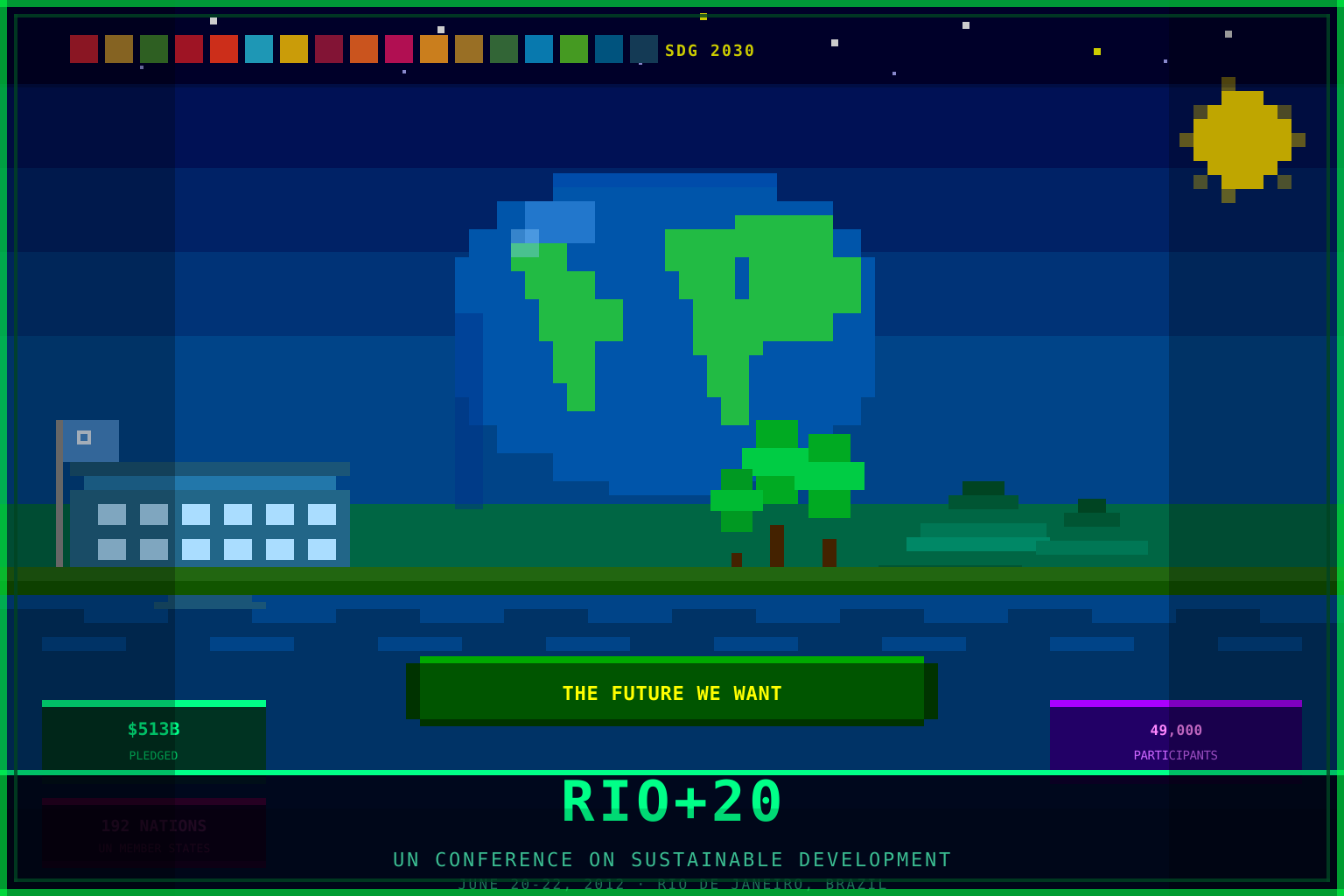
The UN Conference on Sustainable Development, commonly known as Rio+20 (marking the 20th anniversary of the 1992 Rio Earth Summit), took place June 20–22, 2012 in Rio de Janeiro, Brazil. It was one of the largest inter-governmental conferences in UN history, with approximately 49,000 registered participants including delegations from 192 member states, over 100 heads of state or government, and representatives from civil society, the private sector, and international organizations. A parallel People’s Summit drew an additional 15,000 civil society representatives who produced a more forceful, binding-language alternative declaration.
The centerpiece outcome was a non-binding political declaration, “The Future We Want”, adopted unanimously on the final day. The conference also established the mandate that led directly to the Sustainable Development Goals (SDGs), a framework of 17 goals and 169 targets adopted by the UN General Assembly in September 2015 and intended to govern global development through 2030. Voluntary commitments pledged at Rio+20 — by governments, cities, businesses, and NGOs — totaled more than $513 billion in financing for sustainable development, though few carried binding enforcement mechanisms.
The Rio+20 outcomes reflected the difficult geopolitical and economic climate of mid-2012: the European debt crisis was intensifying (Spain had just received a €100 billion bank bailout package on June 9, 2012), the lingering effects of the 2008 financial collapse continued to constrain government budgets, and growing disputes between developed and developing nations over the costs and responsibilities of environmental stewardship defined the negotiating atmosphere. The final agreement was criticized by environmentalists as weak and non-binding — Greenpeace’s Kumi Naidoo described it as “a failure of historic proportions” — yet it represented a historic consensus that sustainable development balancing economic growth, social inclusion, and environmental protection was a legitimate global policy framework for the decades ahead.
Significance
Bridging the Post-Kyoto Vacuum
Rio+20 took place at a critical juncture in climate and environmental diplomacy. The Kyoto Protocol’s first commitment period (2008–2012) was expiring, and the 2009 Copenhagen Accord — which had established the aspirational $100 billion per year in climate finance from developed to developing nations by 2020 — had not produced a legally binding successor treaty. The 2011 Durban COP17 had agreed to draft a new legal instrument by 2015, but the negotiating atmosphere remained fractious. Rio+20’s deliberate focus on “sustainable development” rather than climate alone allowed broader participation and consensus: by decoupling development finance from emissions commitments, the conference enabled developing nations to engage constructively rather than defensively.
By establishing a mandate for the Sustainable Development Goals, Rio+20 provided a conceptual bridge: moving from an emissions-focused (Kyoto) framework toward a broader, more inclusive model of sustainable development that encompassed poverty reduction, health, education, and environmental stewardship equally. The SDG process formally began when the UN General Assembly established an Open Working Group of 70 member states in January 2013, directly implementing the Rio+20 mandate.
The “Green Economy” Controversy
One of Rio+20’s sharpest pre-conference debates concerned the European Union’s push to adopt a “green economy” framework — essentially enshrining market-based environmental mechanisms (carbon pricing, ecosystem services payments, biodiversity offsets) as the primary policy tools. Developing nations, led by Brazil, India, and Bolivia, resisted strongly, arguing that the “green economy” label would impose Northern environmental standards on Southern development pathways and restrict policy space for poverty reduction strategies. Bolivia’s negotiators called the framing “the financialization of nature.”
The final “Future We Want” text included green economy language but explicitly reaffirmed national sovereignty over development pathways: “We recognize that green economy policies in the context of sustainable development and poverty eradication should … respect each country’s national sovereignty.” This compromise language preserved consensus but weakened the operational content, a pattern critics noted had characterized UN environmental diplomacy since Rio 1992.
Seeding the Sustainable Development Goals
The most consequential outcome of Rio+20 was the decision to launch a process that became the 2030 Sustainable Development Agenda and the 17 SDGs adopted in September 2015. The SDGs went on to become the primary metric for assessing global progress on sustainability, adopted by governments, NGOs, and corporations worldwide. Nearly every major environmental and development initiative from 2015 onward was framed in relation to the SDGs.
Reaffirming Consensus on “Sustainable Development”
Rio+20 legitimized the term “sustainable development” as the organizing principle for global policy, offsetting the polarization between “development” (favored by the Global South) and “environment” (prioritized by wealthy nations). This framing proved durable: by 2012, corporations began adopting environmental, social, and governance (ESG) reporting frameworks; governments committed to “green” recovery strategies following the recession; and the concept became embedded in higher education, urban planning, and international finance.
Global South Assertiveness
Rio+20 demonstrated the rising voice of the Global South in international negotiations. Brazil, as the host and a BRICS leader, positioned the conference as an alternative to the stalled UN Framework Convention on Climate Change (UNFCCC) process, emphasizing that climate action must be paired with development opportunity. India, South Africa, and other emerging economies resisted language that would impose strict emissions limits without corresponding aid and technology transfer for adaptation and renewable energy. This coalition-building at Rio+20 prefigured the more assertive negotiating stance of developing nations in the 2015 Paris Agreement.
The Role of Cities and Sub-National Actors
Rio+20 was notable for the unprecedented visibility of sub-national actors — cities, states, and provinces — in the negotiations and voluntary commitment process. The C40 Cities Climate Leadership Group (representing 40+ major metropolises including New York, London, São Paulo, and Seoul) made public commitments to reduce emissions and improve urban sustainability independent of national government pledges. New York City Mayor Michael Bloomberg announced a $19 million grant to the C40 network at Rio+20. This dynamic — cities acting where national governments stalled — prefigured the subnational climate leadership movement that became central to post-2016 climate diplomacy.
Private Sector Engagement
For the first time at a UN sustainable development conference, the private sector played a formalized role. The UN Global Compact’s Business for Rio platform brought over 500 corporate signatories to Rio+20, making voluntary commitments on sustainability, transparency, and responsible business practice. The World Business Council for Sustainable Development presented 2050 visions from major corporations. Critics noted that voluntary corporate commitments at UN conferences had a mixed record of follow-through, but the institutional integration of business voices into the Rio+20 process reflected the growing recognition that public policy alone could not drive the investment scale required for sustainable development.
Limited Immediate Impact, Durable Framework
While the “Future We Want” declaration was not binding and included few specific, quantified commitments, its symbolic and structural importance proved enormous. Rio+20 established the working groups and timelines that led to the SDGs. It reinforced the principle of Common but Differentiated Responsibilities (CBDR), recognizing that wealthy nations and developing economies must take different pathways to sustainability. And it set the stage for the 2015 Paris Climate Agreement, which succeeded in binding commitments where Rio+20 had not. By 2022, the SDGs — Rio+20’s most durable legacy — were embedded in national development plans for over 190 countries and referenced in more than $20 trillion in ESG-labeled financial assets globally.
Key Figures at Rio+20
| Country / Organization | Representative | Role |
|---|---|---|
| Brazil (host) | Dilma Rousseff | Conference chair; advocate for Southern development rights |
| United States | Hillary Clinton (Secretary of State) | Led U.S. delegation; Obama did not attend |
| United Nations | Ban Ki-moon (Secretary-General) | Presided over plenary; pushed for stronger commitments |
| EU | José Manuel Barroso (Commission President) | Led green economy push; pressed for binding timelines |
| Bolivia | Pablo Solón | Led opposition to “green economy” market-mechanism language |
| Greenpeace | Kumi Naidoo | Publicly declared outcome “a failure of historic proportions” |
Sources
-
UN Department of Economic and Social Affairs (DESA). “Rio+20 — Sustainable Development Conference.” United Nations, 2012. https://www.un.org/en/rio20/ — Official conference site; agenda, outcomes, and delegations.
-
Biswas, Asit K. “Rio+20: A Watershed Moment or More Hot Air?” The Guardian, June 22, 2012. Assesses the conference’s outcomes as weak on binding commitments but significant for establishing the SDG mandate.
-
Worldwatch Institute. “After Rio+20: Progress Toward Sustainable Development.” Worldwatch Report, 2012. Documents the relationship between Rio+20 and the later SDG framework development.
See Also
- European Debt Crisis — 2012 Escalation — Contemporaneous economic turmoil shaping Rio+20 negotiating positions; Spain’s €100 billion bank bailout announced 11 days before Rio+20
- Spain’s 2012 Banking and Property Crisis — Specific context for the austerity pressures that constrained European climate finance pledges at Rio+20
- Hurricane Sandy — 2012 Atlantic Disaster — Natural disaster four months after Rio+20 that validated the conference’s climate-adaptation urgency
- 2012 Arctic Sea Ice Minimum — Climate sentinel event recorded in September 2012 that gave retroactive empirical weight to Rio+20’s warnings
- 2012 Amazon Basin Record Flood — Regional climate impacts in the conference’s host country reinforcing Rio+20 urgency
- Fukushima Daiichi and Japan’s 2012 Nuclear Restart — Ongoing nuclear emergency that influenced Rio+20 discussions on clean energy alternatives and energy security
- Occupy Wall Street — 2012 Momentum — Parallel civil society critique of economic inequality echoing the People’s Summit at Rio+20
- The LIBOR Scandal and the Barclays Fine (June 2012) — Financial system integrity crisis undermining confidence in market-based green economy mechanisms