Overview
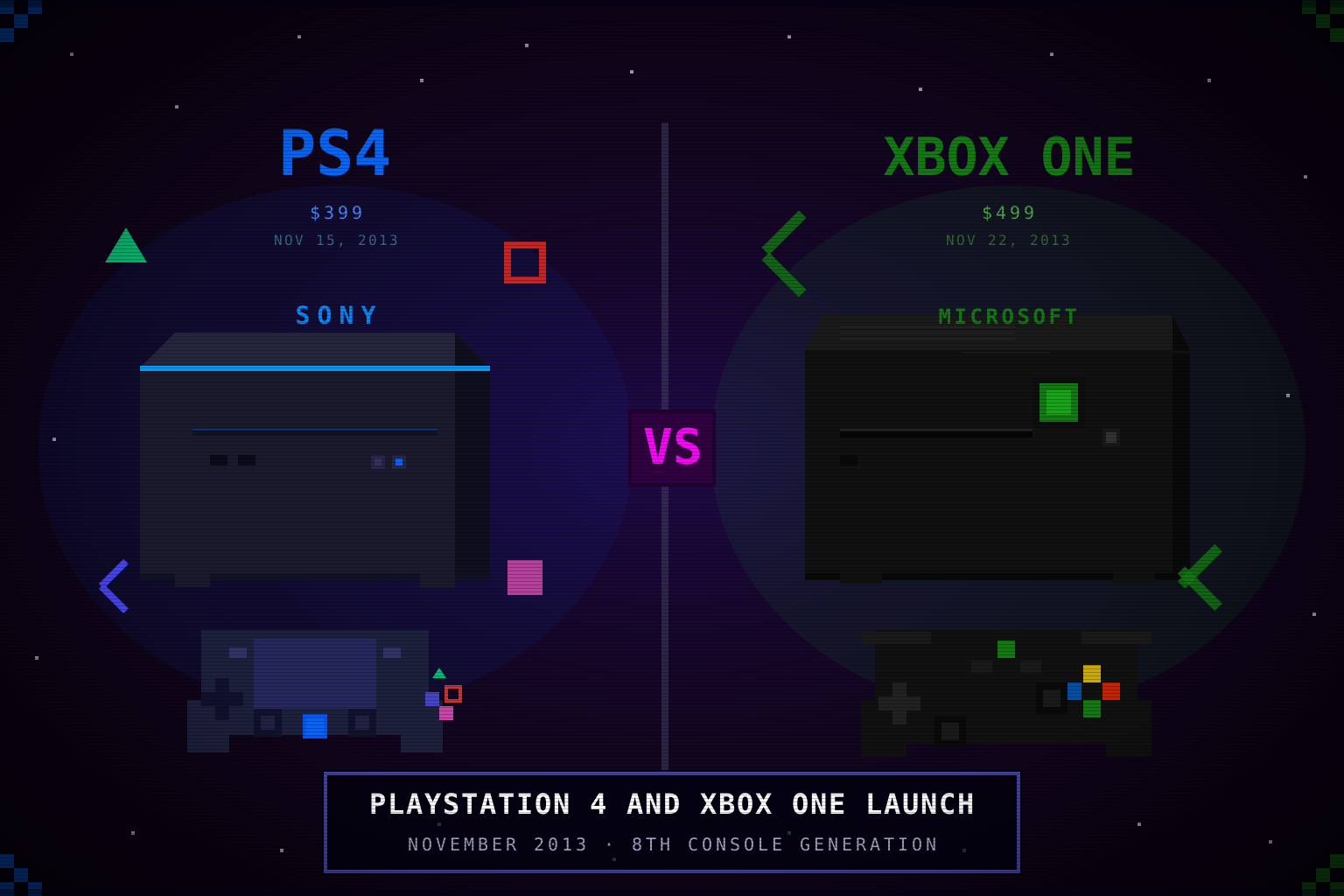
In November 2013, two gaming consoles launched within a week of each other, ushering in the eighth console generation. Sony released the PlayStation 4 on November 15, 2013, in North America (with a November 29 release in Europe, Australia, and New Zealand), while Microsoft followed with the Xbox One on November 22, 2013. Priced at $399 and $499 respectively, the two systems competed fiercely for early adopters and dominated gaming hardware discussions for the next seven years.
Pre-Launch Controversy
The lead-up to both launches was unusually turbulent. Microsoft’s Xbox One reveal on May 21, 2013 generated immediate backlash when company representatives described policies requiring an always-online internet connection and imposing restrictions on the resale of used games. The console’s mandatory bundling with the Kinect motion sensor added $100 to its retail price compared to the PlayStation 4.
Sony capitalized on the controversy at the Electronic Entertainment Expo (E3) in June 2013, when PlayStation executives staged a brief video demonstration showing a PS4 game disc being handed from one person to another—pointedly mocking Microsoft’s proposed used-game restrictions. The audience response was immediate and decisive. Within weeks, Microsoft reversed both the always-online requirement and the used-game restrictions, but the reputational damage shaped perceptions heading into launch.
Hardware Specifications
Both consoles featured custom AMD processors and graphics architectures, reflecting a departure from the architecturally distinct approaches of previous generations. Each console contained:
- Processor: Custom AMD Jaguar eight-core x86-64 CPU running at 1.6 GHz (PS4) and 1.75 GHz (Xbox One)
- RAM: 8 GB total system memory
- Storage: 500 GB hard drive
The critical difference lay in memory configuration and GPU performance. The PlayStation 4 used 8 GB of unified GDDR5 memory, offering approximately 176 GB/s of bandwidth, while the Xbox One employed DDR3 RAM at around 68 GB/s, supplemented by 32 MB of embedded high-bandwidth ESRAM. The PS4’s GPU delivered approximately 1.84 teraflops with 18 compute units; the Xbox One’s GPU provided 1.31 teraflops with 12 compute units—a roughly 40% performance advantage that became a focal point of early-generation comparisons and had visible consequences in third-party game releases.
The Xbox One’s mandatory Kinect peripheral—a second-generation motion-sensing camera bundled with the hardware—justified part of the price difference but also drew criticism for the console’s overall bulk and Microsoft’s initial insistence that Kinect remain always connected.
Launch Titles and Pricing
The PlayStation 4 launched at $399 with a library of 23 titles available at launch, including first-party exclusives Killzone: Shadow Fall and Knack, the indie hit Resogun, and third-party titles like Battlefield 4, Call of Duty: Ghosts, and Assassin’s Creed IV: Black Flag. Sony offered the console without a camera, positioning it as a pure gaming device.
The Xbox One launched at $499—$100 more—with exclusives including Forza Motorsport 5, Ryse: Son of Rome, and Dead Rising 3. Microsoft positioned the Xbox One as an all-in-one entertainment device, featuring an HDMI passthrough port designed to route a cable television signal through the console and integrate with live TV via voice commands.
Market Launch and Reception
Initial sales strongly favored Sony. The PS4 sold 2.1 million units in its first two weeks in North America, while Microsoft reported 2 million Xbox One units sold worldwide in the first 18 days. By year-end 2013, Sony announced the PS4 had sold more than 4.2 million units globally; Microsoft did not release a comparable full-year figure.
The performance gap between the two systems became publicly visible almost immediately. Several multiplatform games, including Call of Duty: Ghosts and Battlefield 4, rendered at 1080p resolution on the PlayStation 4 but only 720p or 900p on the Xbox One—a disparity that gaming journalists documented in detail and that reinforced the PS4’s reputation for superior specifications.
Mid-Generation Revisions
Both companies released upgraded hardware mid-generation. Sony released the PlayStation 4 Pro in November 2016 at $399, offering enhanced GPU performance targeting 4K resolution and High Dynamic Range (HDR) output. Microsoft followed with the Xbox One X in November 2017 at $499, featuring 6 teraflops of GPU performance—the most powerful console released to that point—along with native 4K support for many titles.
Microsoft also reversed the Kinect requirement in June 2014, releasing a Kinect-free Xbox One bundle for $399 to match the PS4’s price point.
Long-Term Generation Outcomes
The eighth generation lasted until November 2020, when Sony released the PlayStation 5 and Microsoft released the Xbox Series X and Xbox Series S. Over the full generation, the PlayStation 4 sold approximately 117.2 million units globally by September 2022, making it the second best-selling home console in history behind the PlayStation 2 (155 million units). Xbox One lifetime sales were estimated at approximately 58 million units.
Significance
The PlayStation 4 and Xbox One launches signaled both companies’ commitment to unified x86-based hardware architectures—departing from the Cell processor of the PS3 and the PowerPC architecture of the Xbox 360—and established digital game distribution as a mainstream pathway alongside physical media.
The eighth generation coincided with major shifts in gaming culture. The PS4’s “Share” button, which enabled one-press video capture and broadcasting, helped normalize game streaming on platforms like Twitch and YouTube. The Xbox One’s streaming and cloud gaming ambitions, though ahead of their time at launch, anticipated the later rise of services like Xbox Game Pass and xCloud.
The launches occurred during a broader 2013 technology surge. The preceding September had seen Apple release the iPhone 5S and 5C with Touch ID and the first mobile 64-bit processor, while Google Glass was reshaping expectations around wearable computing. The selfie became Oxford Dictionaries’ word of the year in November 2013, the same month both consoles launched—a convergence reflecting the broader digitization of leisure and social life. Meanwhile, Bitcoin’s dramatic price surge in late 2013 signaled the growing commercial significance of digital economies that gaming was helping to pioneer.
Sources
- Engadget: PlayStation 4 vs. Xbox One Release Dates and Sales (November 2013)
- GeekWire: Xbox One Release Date November 22, One Week After PS4
- New Atlas: Xbox One vs PS4 Specs Comparison
- Game Rant: PS4 Release Date November 15, 2013
- Engadget: Xbox One Hardware and Specifications
- VGChartz: PS4 Lifetime Sales