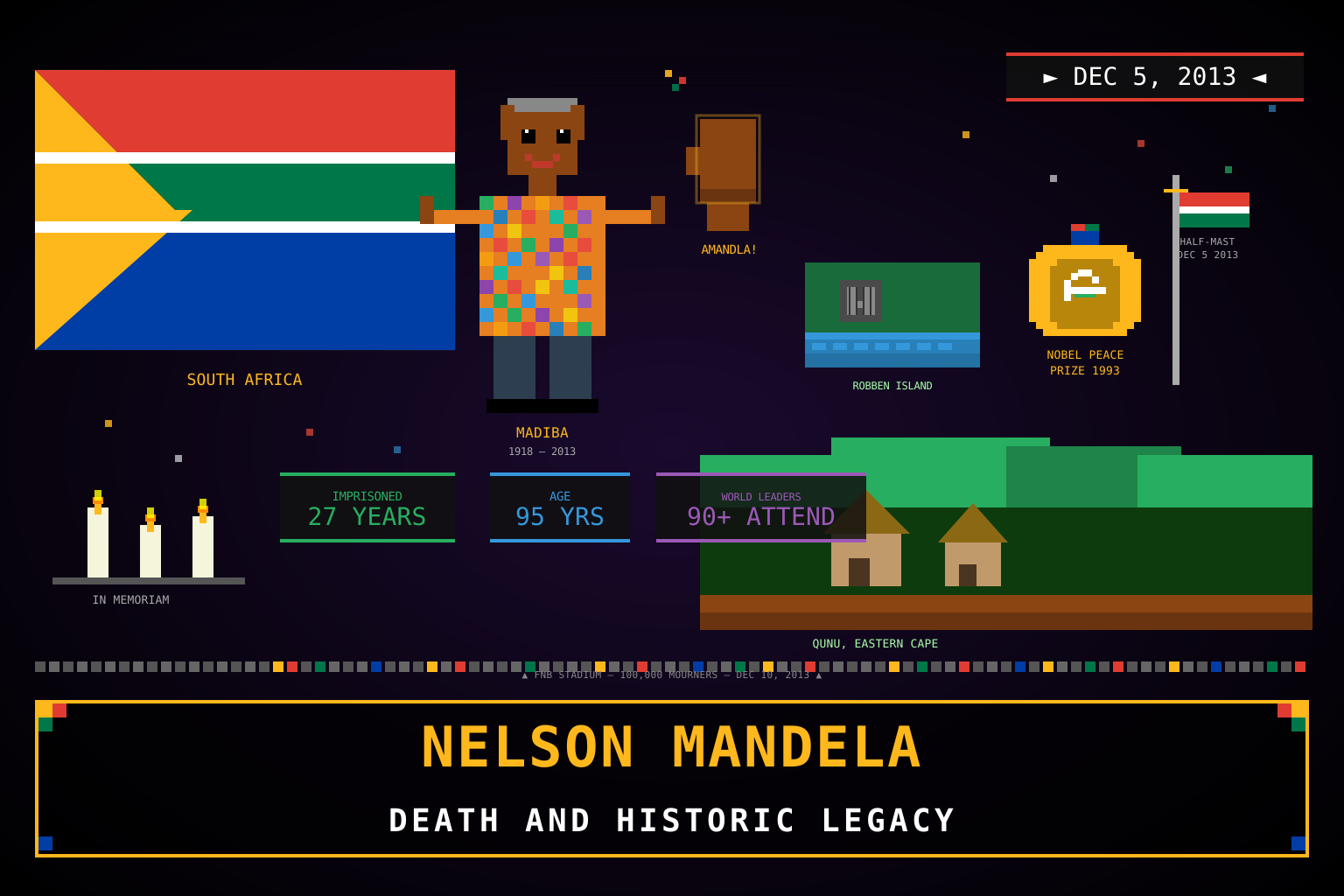
Key figures: Nelson Mandela, Jacob Zuma (South African President), Thabo Mbeki (former president), Desmond Tutu (Archbishop), Graça Machel (spouse), Barack Obama (US President), F.W. de Klerk (former National Party leader, co-Nobel laureate)
Summary
On December 5, 2013, Nelson Rolihlahla Mandela, the first Black president of South Africa and a defining figure of the twentieth century, died at his home in Houghton, Johannesburg, at the age of 95. He died after a prolonged respiratory illness — recurring complications from tuberculosis he had contracted during his years of imprisonment on Robben Island — ending a life of extraordinary public consequence and a final decade characterized by intentional withdrawal from the global spotlight.
Mandela’s death precipitated a 10-day period of national mourning across South Africa and spontaneous memorials in cities worldwide. The South African government ordered all national flags to fly at half-mast. An official memorial service was held at FNB Stadium in Johannesburg on December 10, 2013, attended by roughly 100,000 people and more than 90 heads of state — the largest gathering of world leaders since Winston Churchill’s 1965 funeral. Mandela’s body lay in state at the Union Buildings in Pretoria from December 11 to 13, 2013, allowing the public to pay their respects. His state funeral and burial took place on December 15, 2013, in Qunu in the Eastern Cape Province — his birthplace and lifelong spiritual home.
A 30-foot bronze statue of Mandela was unveiled in Pretoria on December 16, 2013 — one day after his burial and on the Day of Reconciliation, South Africa’s national holiday — as a permanent public monument to his leadership.
Early Life and Political Formation (1918–1944)
Nelson Rolihlahla Mandela was born July 18, 1918, in Mvezo, a small village in the Transkei region of the Eastern Cape. His clan name, Madiba, came from the Thembu royal house from which he descended. He was the first in his family to attend school, where a teacher gave him the English name “Nelson.” He studied law at the University of Fort Hare and the University of Witwatersrand, where he encountered the emerging African nationalist politics that would define his life.
Mandela’s entry into organized politics began in 1944 when he joined the African National Congress (ANC) at age 25. Along with Oliver Tambo and Walter Sisulu, he co-founded the ANC Youth League the same year, pushing the broader organization toward mass action and direct confrontation with apartheid policies codified in law after the 1948 National Party election victory.
Anti-Apartheid Struggle and Imprisonment (1948–1990)
For 45 years, Mandela remained the ANC’s most visible and uncompromising face against South African apartheid. When peaceful tactics yielded little result, he co-founded Umkhonto we Sizwe (“Spear of the Nation,” known as MK) in 1961, serving as its first commander-in-chief. MK conducted sabotage against government infrastructure rather than civilian targets, a strategic choice Mandela later described as a deliberate effort to avoid casualties.
Arrested in August 1962 on charges of incitement and leaving the country without a permit, Mandela was tried again the following year in the Rivonia Trial (1963–1964), charged with sabotage and conspiracy to overthrow the government. At the trial, he famously concluded his four-hour statement from the dock:
“I have cherished the ideal of a democratic and free society in which all persons live together in harmony and with equal opportunities. It is an ideal which I hope to live for and to achieve. But if needs be, it is an ideal for which I am prepared to die.”
Convicted on June 12, 1964, Mandela was sentenced to life imprisonment. He served 27 years — 18 of them on Robben Island in the Atlantic Ocean, where he wore a prison number 466/64 (prisoner 466 of 1964), performed hard labor in a limestone quarry, and lived in a 2.4-meter cell. The number 46664 later became the name of his HIV/AIDS awareness campaign, launched in 2003.
During his incarceration, Mandela became a symbol of resistance globally. The “Free Nelson Mandela” campaign, which the Specials’ song of the same name (1984) brought to mainstream Western audiences, gained momentum throughout the 1980s as international anti-apartheid sentiment intensified.
Negotiations and Release (1990)
The ANC was unbanned and Mandela was released on February 11, 1990, after then-President F.W. de Klerk, concluding that apartheid was politically and economically unsustainable, authorized his unconditional release. The image of Mandela walking free from Victor Verster Prison, fist raised, was broadcast live around the world. In 1993, Mandela and de Klerk were jointly awarded the Nobel Peace Prize for their negotiated dismantling of apartheid — one of the most consequential political transformations of the twentieth century.
The negotiations between the ANC and the National Party from 1990 to 1994 navigated extreme violence from both right-wing white extremists and Inkatha Freedom Party militias, as well as internal divisions within the liberation movement. Mandela’s personal credibility and willingness to engage directly with de Klerk were credited with keeping the negotiations from collapsing at multiple critical moments.
Presidency and Democratic Transition (1994–1999)
On April 27, 1994, South Africa held the first fully democratic election in its history, with millions of Black South Africans voting for the first time. The ANC won 62.65% of the national vote, and on May 9, 1994, the newly elected National Assembly chose Mandela — standing unopposed — as the country’s first Black president. He was inaugurated May 10, 1994, at the Union Buildings in Pretoria, in a ceremony attended by representatives of 140 countries.
He served a single five-year term, voluntarily stepping down in 1999 to establish the precedent of term limits and democratic succession. His presidency oversaw the drafting of the Constitution of 1996, adopted May 8, 1996, and widely regarded as one of the most progressive constitutions in the world: it abolished apartheid law, enshrined universal suffrage, and included an extensive bill of rights protecting freedoms of speech, religion, and sexuality — the latter making South Africa one of the first nations to constitutionally prohibit discrimination on grounds of sexual orientation.
Rather than pursuing retribution against apartheid’s architects, Mandela established the Truth and Reconciliation Commission (TRC) in 1995, chaired by Archbishop Desmond Tutu. Over nearly three years, the TRC heard testimony from more than 21,000 victims and, of over 7,000 amnesty applications, granted amnesty in 849 cases where perpetrators provided full public disclosure of politically motivated crimes. The model, controversial for prioritizing reconciliation over prosecution, became a widely studied framework for post-conflict societies from Rwanda to Northern Ireland.
Mandela also focused international attention on HIV/AIDS in sub-Saharan Africa — a commitment that deepened after he left office, and that acquired personal dimension after his son Makgatho died of AIDS-related illness in January 2005.
Post-Presidential Years (1999–2013)
After leaving office, Mandela founded the Nelson Mandela Foundation in 1999, dedicated to fostering dialogue on issues of social justice and global peace. He largely retired from public life but remained symbolically powerful. Key post-presidential appearances included the 2010 FIFA World Cup closing ceremony in Johannesburg and his 90th birthday celebration at London’s Hyde Park in 2008, which drew 46,000 people.
His marriage to Graça Machel — a Mozambican educator, former cabinet minister, and human rights advocate whom he married on his 80th birthday, July 18, 1998 — endured throughout his final years. He had three surviving children from prior marriages to Evelyn Mase (divorced 1958) and Winnie Madikizela-Mandela (divorced 1996).
By 2012, Mandela’s recurring lung infections required multiple hospitalizations. He was admitted to a Pretoria hospital on June 8, 2013, in critical condition, and spent nearly three months hospitalized before returning home in September 2013 for end-of-life care.
Global Significance and Reception
Mandela’s death was observed globally as the passing of a twentieth-century giant. World leaders and citizens issued statements emphasizing his role in ending apartheid, his advocacy for human rights, and his embodiment of reconciliation. Barack Obama, speaking from the White House on December 5, 2013, called him “the last great liberator of the 20th century” and “a man who took history in his hands, and bent the arc of the moral universe toward justice.” Obama traveled to Johannesburg to speak at the December 10 memorial, where he memorably shook hands with Cuban President Raúl Castro — itself a diplomatic moment captured worldwide.
The reception was nearly universal in its reverence — a striking contrast to the polarization often surrounding other political figures. Among those who delivered tributes at the December 10 memorial: former US presidents Clinton and Carter, UK Prime Minister David Cameron, Brazilian President Dilma Rousseff, and UN Secretary-General Ban Ki-moon. Of the 90+ heads of state present, it was among the most significant concentrations of global leadership since World War II.
Awards and Honors
Mandela received more than 250 awards over his lifetime. Among the most significant:
- Nobel Peace Prize (1993, shared with F.W. de Klerk)
- US Presidential Medal of Freedom (2002, awarded by President George W. Bush)
- US Congressional Gold Medal (1998)
- Order of the Companions of O.R. Tambo (South Africa’s highest civilian honor)
- Honorary degrees from over 50 universities, including Oxford, Harvard, and the University of Cape Town
- The United Nations declared July 18 — Mandela Day — a global day of action in 2009, while he was still alive; an extremely rare distinction
Legacy and Global Impact
Mandela’s life bookended a century of colonial, apartheid, and post-apartheid South Africa. His presidency established democracy in a country where racial hierarchies had been enshrined in law for over a century. His reconciliation framework influenced post-conflict societies across the world.
Yet his 2013 death also marked the end of an era. South Africa by 2013 faced substantial new challenges: an unemployment rate of approximately 25%, ongoing economic inequality (a Gini coefficient of approximately 0.65, among the world’s highest), and a governing ANC increasingly associated with corruption rather than liberation. His death prompted reflection not only on his achievements but on the ongoing work required to fulfill the promises of South Africa’s democratic transition.
Like Malala Yousafzai — another human rights figure who came to global prominence in 2013 (see Malala Yousafzai: Education Advocate) — Mandela demonstrated that individual moral courage in confronting institutional power could reshape global norms. His legacy connected the liberation movements of the mid-twentieth century to the human rights discourse of the twenty-first.
Mandela was memorialized most often through the lens of reconciliation and moral leadership. His most widely cited quotation — “It always seems impossible until it’s done” — captured the spirit that defined his approach to the transformation of South Africa: patient, determined, and ultimately historic.
Sources
- Death and state funeral of Nelson Mandela — Wikipedia
- Nelson Mandela — Wikipedia
- Nelson Mandela Foundation
- South Africa: Nelson Mandela’s Death a Tremendous Loss — Human Rights Watch
- Nelson Mandela (1918–2013) — History.com
- Nobel Peace Prize 1993 — NobelPrize.org
- Rivonia Trial — South African History Archive