Key figures: Satoshi Nakamoto (pseudonymous Bitcoin creator), Mark Karpelès (Mt. Gox CEO), Ross Ulbricht (Silk Road founder), Ben Bernanke (Federal Reserve Chair), Jennifer Shasky Calvery (FinCEN Director)
Summary
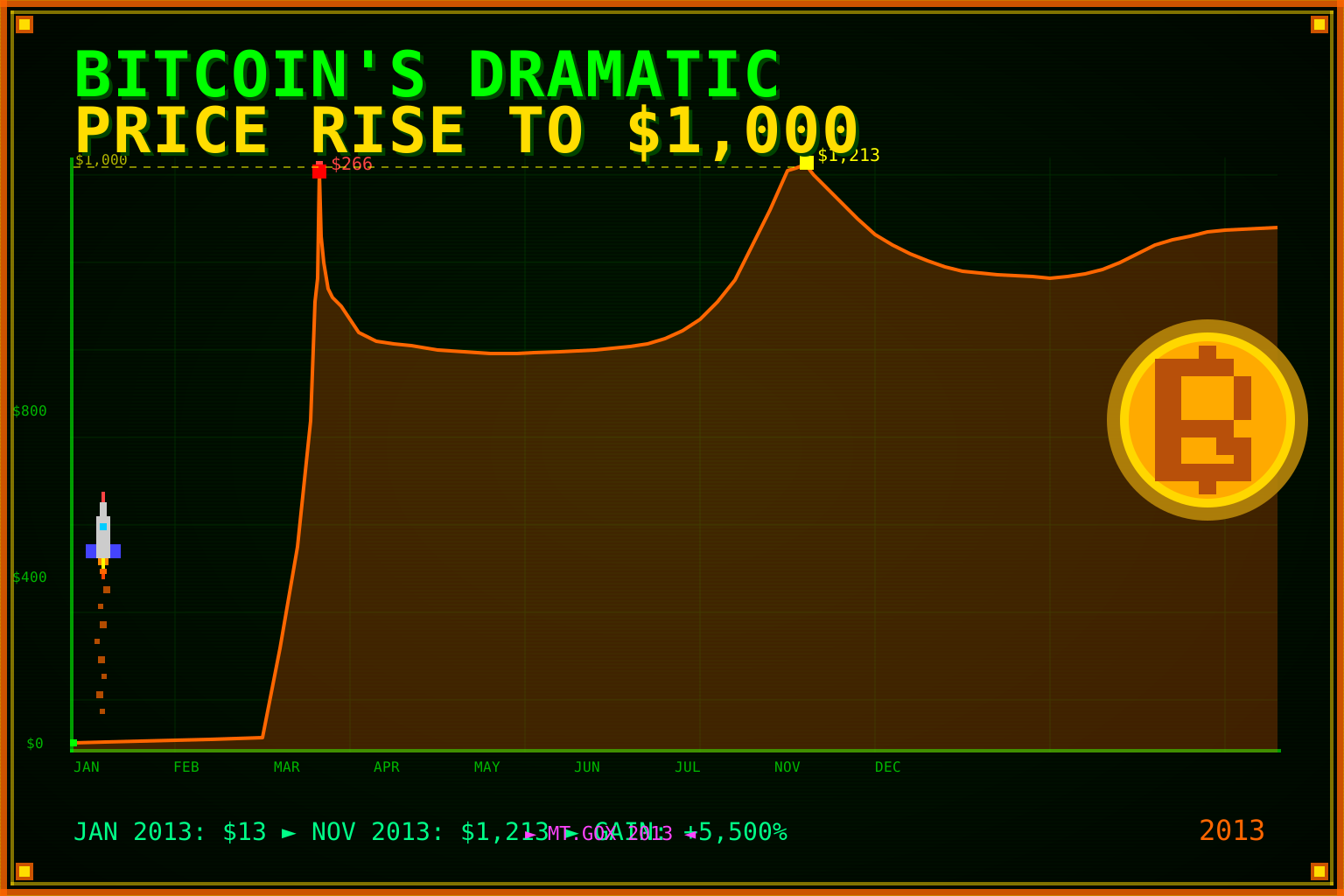
Bitcoin experienced a spectacular price increase of more than 90-fold at its peak over the course of 2013, transforming from a niche digital experiment valued at roughly $13 per coin in January to a phenomenon that briefly exceeded $1,200 per coin in late November, capturing mainstream financial attention for the first time in the currency’s four-year history. Measured against its year-end close of about $754, the gain for the full year was still roughly 5,500%.
The year’s price action was punctuated by multiple sharp peaks and crashes. A first bubble in April 2013 drove Bitcoin from $48 on March 25 to $266 on April 10—a rise of more than 450% in 15 days—followed by a crash to $50 within 24 hours as the Mt. Gox exchange buckled under trading volume. Bitcoin then recovered steadily through the summer, trading near $100–$140 through September and October, before accelerating sharply in November. On November 28, 2013, Bitcoin crossed $1,000 for the first time at Mt. Gox, reaching $1,044, and peaked at approximately $1,213 on November 29–30—the same days that many U.S. consumers were engaged in Black Friday and Cyber Monday retail activity, producing an ironic cultural juxtaposition.
Price Timeline
| Date | Price (USD) | Event |
|---|---|---|
| January 1, 2013 | ~$13 | Year opens |
| March 25, 2013 | ~$48 | Pre-bubble run begins |
| April 10, 2013 | $266 | First 2013 peak |
| April 11, 2013 | $50 | Mt. Gox crash |
| October 1, 2013 | ~$140 | Silk Road seized |
| October 2, 2013 | ~$110 | Post-Silk Road dip |
| November 3, 2013 | ~$200 | November bull run begins |
| November 18, 2013 | ~$900 | Senate hearing day |
| November 28–29, 2013 | $1,044–$1,213 | All-time high (2013) |
| December 18, 2013 | ~$550 | Post-peak correction |
Drivers of the 2013 Surge
The Cyprus Banking Crisis
The most significant early catalyst was the Cypriot financial crisis of March 2013. On March 16, the Eurogroup announced a one-time tax (“bail-in”) on Cypriot bank deposits as a condition of a €10 billion bailout—the first time European depositors faced direct confiscation to fund a bank rescue. The proposal to impose a 6.75% levy on deposits under €100,000 (later amended to protect small depositors) triggered a bank run and an immediate surge in Bitcoin purchases as investors worldwide sought assets outside the traditional banking system. Bitcoin’s price approximately doubled between March 16 and April 10, 2013, a correlation widely observed by financial analysts at the time.
Silk Road and Its Seizure
The Silk Road, an anonymous online marketplace operating on the Tor network and accepting only Bitcoin, had served as both a major source of Bitcoin demand and a persistent regulatory concern since its 2011 founding. FBI agents arrested founder Ross Ulbricht—operating under the alias “Dread Pirate Roberts”—on October 1, 2013, in a San Francisco public library, seizing the marketplace and approximately 144,000 Bitcoin (worth roughly $28 million at the time, later auctioned by the U.S. Marshals Service in December 2013). Rather than crashing Bitcoin’s price, the Silk Road closure provided an unexpected boost: it demonstrated that Bitcoin as an asset could survive the closure of its most notorious use case, increasing investor confidence in the network’s resilience.
Congressional Hearings and Regulatory Legitimacy
On November 18–19, 2013, the U.S. Senate Committee on Homeland Security and Governmental Affairs held hearings titled “Beyond Silk Road: Potential Risks, Threats, and Promises of Virtual Currencies.” Federal agencies including the Department of Justice, the Drug Enforcement Administration, the Secret Service, and FinCEN testified. Federal Reserve Chairman Ben Bernanke sent a letter to the committee stating that virtual currencies “may hold long-term promise, particularly if the innovations promote a faster, more secure and more efficient payment system.” The hearing, widely interpreted as indicating Bitcoin would be regulated rather than banned outright in the United States, catalyzed the November price surge. Bitcoin rose from approximately $350 on November 17 to over $900 within 24 hours of the hearing’s conclusion.
FinCEN Guidance
In March 2013, FinCEN issued interpretive guidance clarifying how existing Bank Secrecy Act regulations applied to virtual currency businesses. The guidance established that Bitcoin exchanges and administrators were “money services businesses” subject to registration, anti-money-laundering programs, and reporting requirements—but importantly affirmed that individual users of Bitcoin were not subject to the same regulatory requirements. This guidance, while imposing compliance costs on exchanges, was broadly interpreted as legitimizing Bitcoin within the existing U.S. regulatory framework rather than prohibiting it.
Chinese Demand
A frequently underappreciated driver of the late-2013 surge was buying from China. Baidu, China’s largest search engine, announced in October 2013 that it would accept Bitcoin as payment for its Jiasule security services. Chinese retail investors, restricted from many international financial markets, became significant Bitcoin purchasers. At peak, BTCC (formerly BTC China) briefly surpassed Mt. Gox as the highest-volume Bitcoin exchange globally in October 2013. Chinese demand abruptly reversed on December 5, 2013, when the People’s Bank of China banned financial institutions from handling Bitcoin transactions, triggering a 35% price drop from approximately $1,150 to $750 within 24 hours.
The Role of Mt. Gox
Mt. Gox—originally a trading card exchange platform repurposed as a Bitcoin exchange in 2010 and acquired by Mark Karpelès in 2011—handled an estimated 70–80% of all global Bitcoin trading at its peak in 2013. The exchange’s dominance meant that its technical problems became systemic Bitcoin problems. During the April 2013 bubble, a distributed denial-of-service attack on Mt. Gox, combined with trading volume that overwhelmed its servers, caused the exchange to halt trading for 12 hours on April 11—a pause widely blamed for the crash from $266 to $50.
Throughout 2013, Bitcoin users experienced extended withdrawal delays from Mt. Gox, which the exchange blamed on banking partner difficulties and anti-money-laundering compliance reviews. In May 2013, the U.S. Department of Homeland Security seized approximately $5 million from a Mt. Gox subsidiary account at Wells Fargo for operating as an unlicensed money transmitter. Unknown to traders and regulators during 2013’s price surge, Mt. Gox had been systematically losing Bitcoin to a theft vulnerability since 2011; the exchange would file for bankruptcy on February 28, 2014, revealing that 850,000 Bitcoin (then worth approximately $473 million) had vanished. The collapse became one of the largest financial fraud cases in cryptocurrency history.
Institutional and Media Response
The 2013 Bitcoin surge generated the first sustained mainstream financial media coverage of cryptocurrency. The Wall Street Journal, Financial Times, Bloomberg, Forbes, and major television networks including CNBC ran extended coverage of Bitcoin’s price movements. In August 2013, a U.S. federal judge in Texas ruled that Bitcoin was a currency that could be regulated under existing financial laws—the first U.S. judicial ruling on Bitcoin’s legal status. In October 2013, the first regulated Bitcoin ATM in North America opened at a Vancouver, Canada coffee shop, dispensing and accepting Canadian dollars.
The venture capital community began serious investment in Bitcoin-related infrastructure during 2013. Coinbase, founded in June 2012, raised a $5 million Series A in May 2013, followed by a $25 million Series B in December 2013, with Union Square Ventures and Andreessen Horowitz among the investors. Circle Internet Financial, another Bitcoin startup, raised $9 million in May 2013. By year-end, Bitcoin-related startups had collectively raised over $100 million in venture capital.
Aftermath and Market Correction
Following the November 2013 peak, Bitcoin entered a sustained bear market. The Chinese central bank’s December 2013 prohibition was the first major shock; the Mt. Gox collapse in February 2014 was the decisive blow. Bitcoin’s price declined from the $1,213 peak to approximately $315 by early February 2014, and continued declining to a multi-year low of approximately $177 in January 2015—a 85% drawdown from peak. This pattern—dramatic rise, peak, extended decline—would repeat in subsequent Bitcoin cycles in 2017–2018 and 2020–2022.
The 2013 event catalyzed regulatory action worldwide. In 2014, the New York Department of Financial Services (NYDFS) proposed the “BitLicense,” a comprehensive regulatory framework for virtual currency businesses that took effect in 2015. European regulators issued warnings about Bitcoin’s volatility and the risks to retail investors. The IRS issued guidance in March 2014 declaring that Bitcoin was property for U.S. tax purposes, meaning capital gains tax applied to Bitcoin transactions.
Significance
The 2013 price surge established Bitcoin as a serious phenomenon in global finance, moving cryptocurrency from the fringes of tech culture into the awareness of regulators, investors, and the general public. The boom demonstrated both the appeal and the risk profile of an unregulated, decentralized asset: its price could increase by orders of magnitude in months, driven by a combination of genuine technological interest, speculative momentum, and geopolitical distrust of conventional financial systems.
The year’s events also established several durable themes in cryptocurrency markets: the price’s sensitivity to regulatory news; the risks of exchange concentration; the role of Chinese retail demand; and the recurring pattern of rapid appreciation followed by extended bear markets. The distrust of centralized institutions that fueled both Bitcoin adoption and the backlash against government surveillance—illustrated by the Snowden NSA revelations of June 2013—formed a coherent cultural moment. Simultaneously, the technology sector was grappling with the limits of consumer hardware innovation, illustrated by the Google Glass Explorer launch, which positioned 2013 as a year in which both the promise and the contradictions of digital technology were unusually visible.
Sources
- History of Bitcoin — Wikipedia
- Bitcoin — Wikipedia
- Mt. Gox — Wikipedia
- Silk Road (marketplace) — Wikipedia
- Bitcoin prices top $1,000 as the virtual currency craze accelerates — CNN Money (November 27, 2013)
- Bitcoin soars above $1,000 on popular exchange — Washington Post (November 27, 2013)
- FinCEN Guidance FIN-2013-G001 (March 18, 2013)