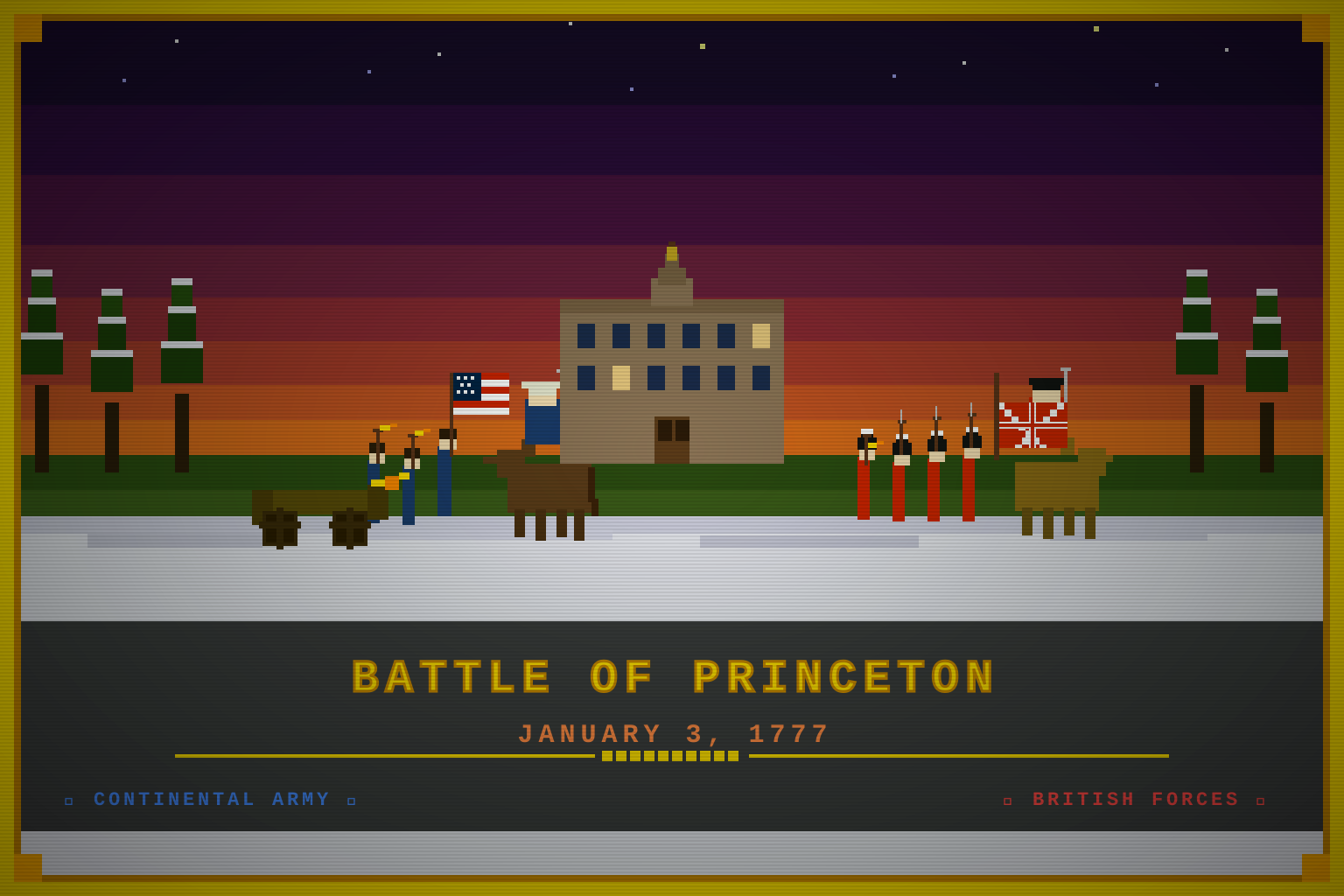
Key figures: General George Washington (American Commander-in-Chief), Brigadier General Hugh Mercer (American, mortally wounded), Lieutenant Colonel Charles Mawhood (British), Major General Nathanael Greene (American), Brigadier General Henry Knox (American artillery), Lieutenant General Charles Cornwallis (British)
Summary
The Battle of Princeton, fought on the morning of January 3, 1777, was the culminating action of Washington’s “ten crucial days” campaign and the last major engagement of the New Jersey theater’s winter offensive. Following the Continental Army’s crossing of the Delaware River and victory at the first Battle of Trenton (December 26, 1776), Washington’s army had re-crossed into New Jersey and, on January 2, 1777, fought a sharp delaying action against Lord Cornwallis’s advancing British force at the Battle of the Assunpink Creek (Second Trenton). Rather than risk his outnumbered and exhausted army in a set-piece battle the following morning, Washington ordered his men to slip away from their campfires overnight and march by a little-used back road around Cornwallis’s flank toward Princeton, where a smaller British garrison remained.
At dawn, Washington’s advance column under Brigadier General Hugh Mercer collided unexpectedly with two British regiments — the 17th and 55th Regiments of Foot — under Lieutenant Colonel Charles Mawhood, who were themselves marching to reinforce Cornwallis at Trenton. In the initial exchange, Mercer’s brigade was driven back and Mercer himself was surrounded and bayoneted repeatedly after refusing to surrender; he died of his wounds on January 12, 1777. As the American line wavered, Washington personally rode forward between the two armies to rally the retreating militia and Continentals, reportedly calling out, “It’s a fine fox chase, my boys!” His exposure to close-range volley fire became one of the war’s most recounted moments of personal battlefield leadership.
With the line restored, Continental forces — reinforced by Greene’s division and supported by Knox’s artillery — routed Mawhood’s regiments, driving many British troops into a final stand at Nassau Hall on the College of New Jersey (Princeton University) campus before that garrison, too, surrendered. American forces then withdrew north to winter quarters at Morristown, New Jersey, having inflicted the action before Cornwallis’s main army could arrive from Trenton.
The Ten Crucial Days
Princeton was the third and final battle of the “ten crucial days,” a sequence beginning with Washington’s Christmas-night crossing of the Delaware (December 25–26, 1776) and the surprise capture of the Hessian garrison at Trenton, continuing through the January 2 stand at Assunpink Creek, and closing with the January 3 victory at Princeton. Coming after a year of near-continuous American defeats — the loss of New York, the retreat across New Jersey, and the expiration of many enlistments due at year’s end — the campaign reversed the psychological momentum of the war at its lowest ebb for the American cause.
Aftermath
Princeton’s tactical result — American casualties of roughly 40 killed and wounded against British losses of some 275 killed, wounded, and captured — was modest in scale compared to later campaigns, but its strategic and morale effects were disproportionate. Alarmed that his supply and communication lines in New Jersey were no longer secure, General William Howe withdrew most British garrisons to a handful of posts near New York City, ceding the bulk of New Jersey to American control and militia raiding through the subsequent “Forage War” of early 1777. The victories at Trenton and Princeton also encouraged reenlistments and new recruiting at a moment when the Continental Army had been on the verge of dissolution, and they cemented Washington’s reputation — both in Congress and among European observers — as a capable field commander rather than merely a defensive general.
Significance
The Battle of Princeton, together with Trenton, is widely regarded by historians as the turning point that preserved the Continental Army and the cause of independence through the winter of 1776–1777. It demonstrated Washington’s willingness to take tactical risks — the night march around a superior force was a maneuver that could have ended in disaster — and his personal courage under fire, both of which shaped his standing with Congress and the army for the remainder of the war. The campaign’s success also set the strategic pattern that would culminate later in 1777 in the twin crises of the Philadelphia campaign and the American victory at Saratoga.
Sources
- Battle of Princeton — Wikipedia
- Battle of Princeton — American Battlefield Trust
- Princeton Battlefield — George Washington’s Mount Vernon
Related
- General George Washington — commanded the night march and rallied the American line at Princeton
- Nathanael Greene — led the division committed to break Mawhood’s counterattack
- Henry Knox — his artillery supported the Continental assault at Princeton
- Battles of Saratoga — the later 1777 campaign that built on the momentum Trenton and Princeton restored
- Valley Forge Encampment — the winter encampment that closed out the year’s campaigning after Princeton reshaped it