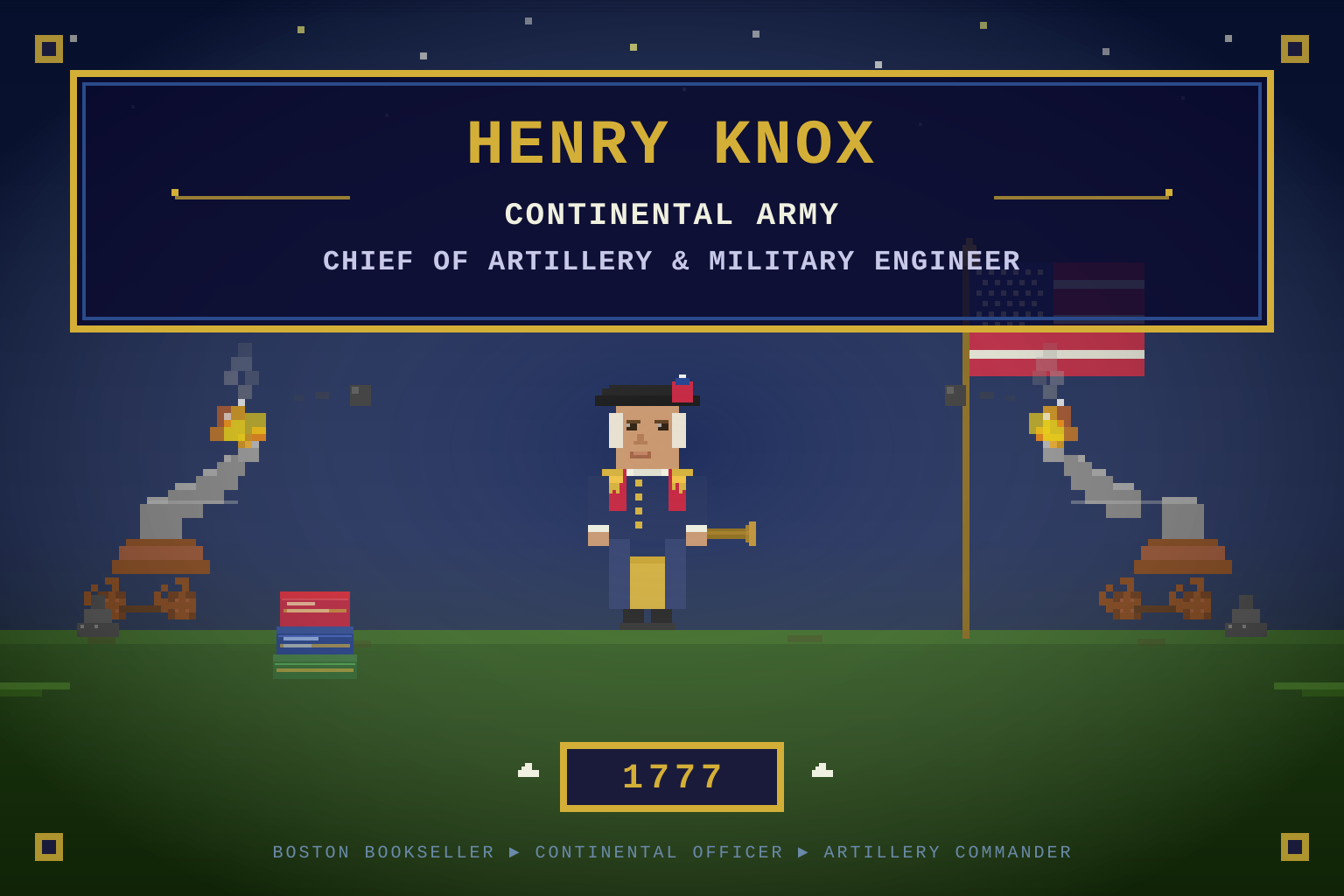
Key figures: Henry Knox (1750–1806), George Washington (Commander-in-Chief), Baron Friedrich Wilhelm von Steuben (Valley Forge drill master), Nathanael Greene (quartermaster), British General William Howe (opposing commander)
Summary
Henry Knox stands as one of the most remarkable figures of the American Revolution—a self-taught military engineer and artillery expert who rose from Boston bookseller to become George Washington’s most trusted subordinate and the chief of the Continental Army’s artillery. In 1777, at age twenty-seven, Knox was already proving himself indispensable to the Continental Army’s survival and effectiveness. Though he lacked formal military academy training—indeed, he had no military background whatsoever before the Revolution—Knox’s study of military texts, his practical experience, and his native genius for organization and tactics made him the equal of any European officer. Washington’s confidence in Knox was absolute, a relationship that would last through the remainder of the war and into the founding of the American republic.
Knox’s role in 1777 was transformative. He organized the Continental Army’s artillery into an effective fighting force, participated in strategic planning for major operations, and began the systematic training that would establish American artillery as a discipline rivaling that of European powers.
From Boston Bookseller to Continental Officer
Henry Knox was born in Boston in 1750 to a merchant family of modest means. He had little formal education but possessed an extraordinary intellectual hunger. As a young man, he worked as a bookseller in Boston and spent his leisure time studying military science, mathematics, and engineering from books in his shop and in libraries. When the Revolution began, Knox was already a trained militia officer, having served in the Boston militia and developed a reputation for military knowledge.
In 1775, Knox joined the Continental Army and impressed Washington with his knowledge of artillery and fortifications. He rose rapidly from colonel to brigadier general—an extraordinary advancement that reflected Washington’s confidence and Knox’s demonstrated competence (he would not be promoted to major general until 1782). By 1777, he was the chief of artillery of the Continental Army and one of Washington’s closest advisors.
The Ticonderoga Expedition: Proving Ground for a Self-Made Officer
Knox’s reputation rested principally on one extraordinary feat: the “Noble Train of Artillery” expedition of winter 1775–1776. In November 1775, Washington sent the 25-year-old Knox—then a colonel with no prior combat experience—to Fort Ticonderoga in northern New York to retrieve the cannon captured there from the British in May 1775. Knox’s mission was to bring approximately 59 heavy artillery pieces, weighing a total of nearly 60 tons, across 300 miles of frozen wilderness to Boston.
Knox accomplished this seemingly impossible task over 56 days, transporting the guns across Lake George on improvised sleds and flatboats, then hauling them through the Berkshire Mountains in the depths of winter. The convoy arrived outside Boston in late January 1776. When the guns were emplaced on Dorchester Heights overlooking the harbor on the night of March 4–5, 1776, British General William Howe recognized that his fleet lay under direct fire and evacuated Boston on March 17, 1776—a pivotal early American victory. This feat transformed Knox from an untested bookseller-soldier into one of the Continental Army’s most celebrated officers, and firmly established Washington’s confidence in him.
By 1777, Knox held the rank of brigadier general (promoted December 27, 1776) and commanded the Continental Artillery, which comprised approximately 500 men organized into four regiments. His artillery at Trenton and Princeton in December 1776–January 1777 had demonstrated that disciplined American gunnery could be decisive in battle, setting the stage for his role in the 1777 Philadelphia campaign.
Artillery Command in the Philadelphia Campaign
The year 1777 saw the Continental Army engaged in the desperate Philadelphia campaign—a series of battles culminating in British occupation of Philadelphia and American retreat to Valley Forge. Throughout this campaign, Knox’s artillery was crucial to American operations.
At the Battle of Brandywine (September 11, 1777), Knox’s artillery was positioned to support the American defensive line along Brandywine Creek. The Continental Army fielded approximately 22 guns at Brandywine; Knox’s batteries engaged British columns throughout the fighting and covered the retreat when British forces under Cornwallis flanked the American right. Though the British outmaneuvered Washington and forced a retreat, Knox’s gun placements inflicted significant casualties and slowed the British advance. American artillery proved that even when outnumbered and outmaneuvered tactically, superior American gunnery could impose costs on the enemy.
At the Battle of Germantown (October 4, 1777), Washington’s ambitious multi-column assault on the British encampment was ultimately unsuccessful, but Knox’s artillery again demonstrated effectiveness. Knox directed the artillery bombardment of Cliveden (the Chew House), a stone mansion into which British infantry had retreated; Washington and Knox debated whether to bypass the strongpoint or reduce it—Knox’s advice to reduce it formally before advancing proved controversial, as the artillery bombardment consumed precious time and allowed British forces to reinforce. The guns supported the American advance and covered the retreat when the attack collapsed in fog and friendly-fire confusion.
Throughout the campaign, Knox worked closely with Washington on positioning and strategy, proving that he had mastered not merely the technical aspects of artillery (gunnery, ammunition supply, gun placement) but also the strategic integration of artillery into overall battle plans. European officers of the era often treated artillery as a support arm; Knox understood it as a potentially decisive element in warfare.
Valley Forge and the Professionalization of Artillery
When the Continental Army retreated to Valley Forge in December 1777, the organization faced its darkest hour. Supplies were short, discipline was breaking down, and troops were dying of disease and exposure. In this crisis, both Knox and Baron Friedrich Wilhelm von Steuben arrived—Knox already established as chief of artillery, and Steuben newly arrived from Europe to serve as the army’s drill master.
During the Valley Forge winter, Knox worked with Steuben to institute systematic training in artillery handling, gunnery discipline, and the maintenance and deployment of field guns. Steuben’s legendary contributions focused on infantry drill and general discipline; Knox’s contributions focused specifically on making the Continental Army’s artillery a professional force.
Knox organized the artillery units into coherent regiments with standardized procedures for gun handling, ammunition supply, and tactical coordination. He established schools for artillery officers and established standards that would outlast the Revolution itself. The result was that when the Continental Army emerged from Valley Forge in the spring of 1778, its artillery arm was dramatically more professional and effective than it had been at the valley’s gates.
Washington’s confidence in Knox never wavered. The general consulted him on strategic matters beyond artillery, recognizing that Knox’s intellect and judgment extended to broader questions of warfare and strategy. By the end of 1777, Knox had become not merely the chief of artillery but one of Washington’s most trusted aides and advisors.
Military Innovation and Strategic Thinking
What distinguished Knox from merely competent officers was his capacity for innovation and strategic thinking. He understood that American artillery, though fewer in guns than British artillery, could be made more effective through superior training, better use of terrain, and more aggressive tactical doctrine.
Knox pioneered the use of massed artillery—concentrating multiple guns to deliver devastating firepower at crucial moments in battle. This was not entirely novel in European warfare, but American implementation of massed artillery was distinctly effective. Knox trained his gunners to achieve high rates of fire and to coordinate their efforts across multiple gun batteries. The result was that American artillery, despite numerical disadvantages, often fought effectively against larger British artillery.
Knox also understood the importance of artillery in siege warfare and fortification—skills he would apply in later campaigns, particularly in the Southern theater where siege warfare was more prevalent.
Significance and Legacy
Henry Knox’s role in 1777 and beyond had several profound consequences:
-
American military professionalism: Knox proved that American officers could master the technical and strategic dimensions of warfare without European military academy training. This was not obvious in 1777; many observers doubted whether Americans could field a professional army at all. Knox’s success demonstrated otherwise.
-
Artillery as a discipline: Knox’s innovations in training and organization established American artillery as a distinct discipline with standardized procedures. The artillery corps that emerged from the Revolution carried Knox’s imprint for generations.
-
Relationship with Washington: Knox’s rise was possible because of Washington’s recognition of talent and his willingness to trust his judgment. The Knox-Washington relationship became a model for how military hierarchies could function effectively—based on merit and confidence rather than formal rank or social status.
-
Post-war military establishment: Knox’s wartime experience led directly to his appointment as the first Secretary of War under the Constitution (1789–1794). In that role, he shaped the early American military establishment according to principles he had learned through the Revolution: emphasis on professionalism, training, and technical expertise.
-
Military education: Knox’s own self-education through study of military texts inspired the creation of the United States Military Academy at West Point, established in 1802 after Knox had left office. The Academy institutionalized the kind of systematic military training that Knox had pioneered during the Revolution.
Sources
- Callahan, North. Henry Knox: General Washington’s General. Rinehart, 1958.
- Brooks, Noah. Henry Knox: A Soldier of the Revolution. G. P. Putnam’s Sons, 1900.
- Drake, Francis S. Life and Correspondence of Henry Knox, Major-General in the American Revolutionary Army. Boston: Samuel G. Drake, 1873.
- Henry Knox Papers (Massachusetts Historical Society and the Gilder Lehrman Collection, New-York Historical Society).
Related
- Battle of Brandywine — Knox’s artillery support at this September 1777 battle
- Battle of Germantown — Knox’s artillery operations during the October 1777 attack
- Valley Forge Encampment — Where Knox professionalized Continental Artillery training in winter 1777–1778
- Baron Friedrich Wilhelm von Steuben — Fellow reformer of Continental Army discipline at Valley Forge
- General George Washington — Knox’s commander and closest professional relationship
- Robert Morris and Continental Army Finance — Morris’s merchant credit arrangements supplied the ordnance and provisions that Knox’s artillery units required
- King George III and British War Policy — British strategy in 1777, which Knox’s artillery countered at Brandywine and Germantown, was directed by the king personally