Key figures: Admiral Samuel Barrington, Marquis de Bouillé (Governor of Martinique), Comte d’Estaing, Lord George Germain, Commodore William Hotham
Summary
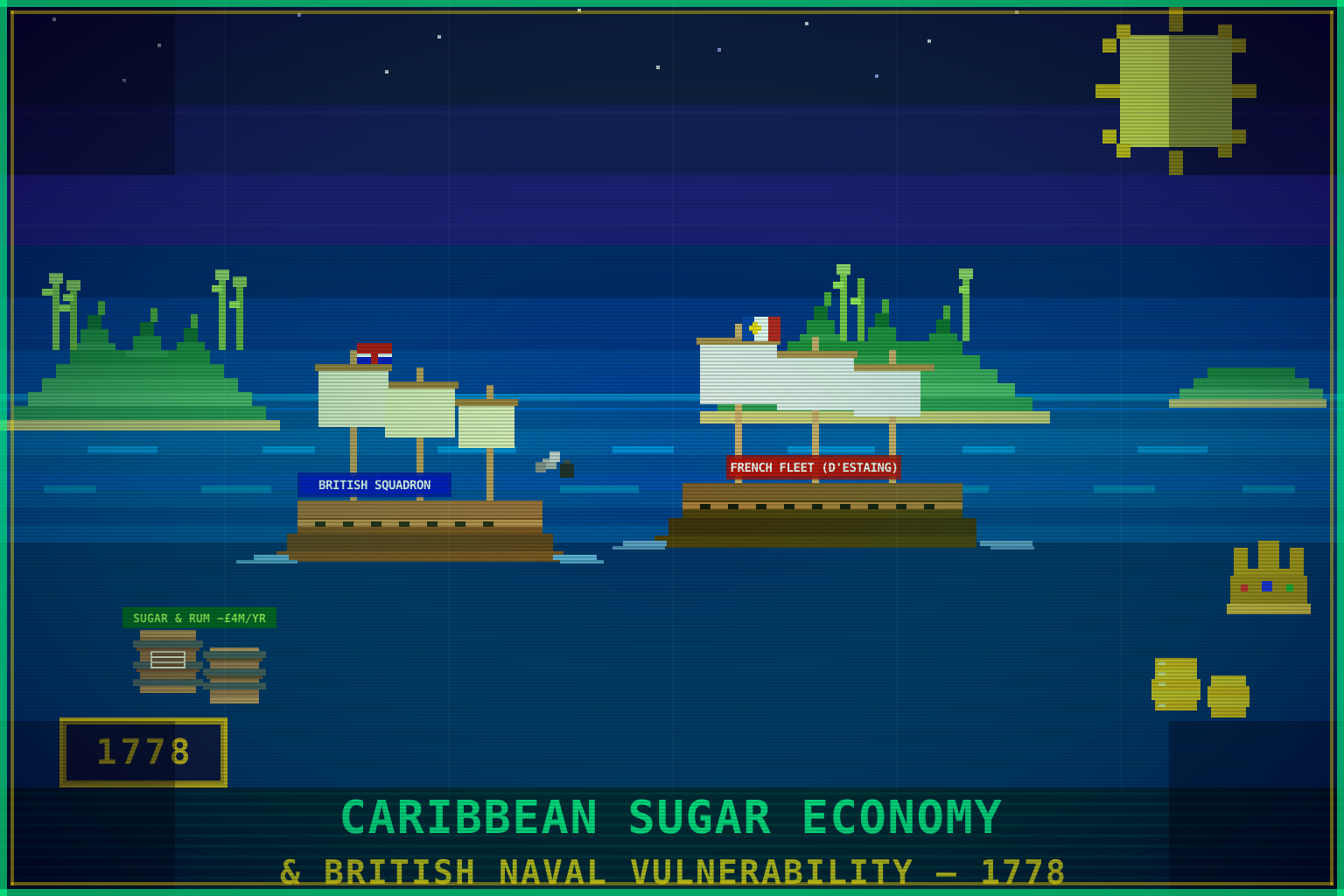
By the 1770s, Britain’s Caribbean sugar islands were, by export value, the empire’s most valuable colonial possessions — more valuable than the thirteen mainland colonies combined. Sugar, rum, and molasses from Barbados, Jamaica, and the Leeward Islands were worth nearly £4 million annually, against just over £1 million from the Chesapeake, the most productive mainland region. This economic weight made the islands’ defense a strategic imperative the moment France entered the Revolutionary War: the Franco-American Alliance of February 6, 1778 and Britain’s subsequent declaration of war on France that March converted the sugar islands from secure rear-area assets into front-line targets.
Britain’s Caribbean garrisons, however, were dangerously thin — scattered across dozens of islands, they totaled roughly a thousand troops in 1778, a fraction of the eight thousand French troops already stationed in the region. The vulnerability was demonstrated immediately: on September 7, 1778, the Marquis de Bouillé, governor of Martinique, landed some 1,800 regular troops and 1,000 volunteers on Dominica, defended by a British garrison of fewer than fifty soldiers fit for duty. The island surrendered within hours — two British soldiers killed, the rest taken prisoner — becoming the first British territorial loss of the war. Contemporary and later assessments held that “a single ship of the line might have prevented the attack,” but Admiral Samuel Barrington’s fleet remained at Barbados under restrictive Admiralty orders rather than reinforcing the threatened island.
Britain’s response revealed the depth of the dilemma. In December 1778, the government diverted 5,000 troops from the New York garrison — reducing forces available against Washington’s Continental Army — to seize and hold St. Lucia, whose harbor at Gros Islet offered a base from which to watch French naval movements out of Martinique. The gamble paid off narrowly: British troops repelled the Comte d’Estaing’s attempted counter-landing in the Battle of St. Lucia that December, but only after committing forces sorely needed on the American mainland. Historian Andrew O’Shaughnessy has documented that British ministers seriously discussed withdrawing altogether from the North American war in order to concentrate resources on defending the sugar islands — a measure of how the Caribbean’s economic value outweighed, in London’s calculations, the strategic importance many placed on the rebellious colonies themselves.
The Economics of Sugar Production
The scale of Caribbean sugar output in 1778 rested on an economy of coerced labor. Jamaica alone — Britain’s largest and most productive sugar island — held approximately 200,000 enslaved people by 1778, producing around 50,000 hogsheads of sugar per year valued at roughly £1.8 million. The island required importation of approximately 8,000–10,000 enslaved Africans annually simply to maintain population in the face of brutal working conditions. Barbados, smaller but intensively cultivated, added another 70,000–80,000 enslaved laborers producing an additional £700,000–£800,000 of sugar annually.
These figures meant that losing even one major sugar island to France was not a tolerable outcome in British strategic thinking. When the French captured Tobago (which fell in 1781) and threatened Barbados and Jamaica, the Treasury calculated that each island lost represented a permanent annual revenue loss comparable to a medium-sized English county. Lord North’s ministry funded the war partly through loans underwritten by London merchant-bankers whose portfolios were heavily weighted toward Caribbean trade; any serious threat to the islands accordingly threatened the credit mechanism financing the entire war effort. This interconnection between sugar, credit, and military capacity is explored in Revolutionary War Financing in 1778, where Robert Morris faced an analogous problem on the American side — without reliable revenue, armies could not be maintained.
Naval Competition in the Caribbean, 1778
The French Admiralty’s decision to send the Comte d’Estaing with twelve ships of the line to American waters in April 1778 was designed precisely to threaten both the Chesapeake and the Caribbean simultaneously, forcing the Royal Navy to split its limited forces between two theaters. D’Estaing’s fleet arrived off Sandy Hook, New Jersey, on July 8, 1778 — too large-drafted to enter the harbor and attack the British fleet inside — then turned south toward the Caribbean after a failed attempt against Newport, Rhode Island in August. By December, his twelve sail of the line confronted Admiral Barrington’s five ships in the waters off St. Lucia, a disparity of force only partially offset by Barrington’s choice of a tight defensive anchorage.
The Battle of Ushant on July 27, 1778 — the major fleet engagement in European waters — directly affected Caribbean naval balance: the indecisive outcome meant that neither side achieved the decisive margin of superiority that might have allowed the winner to send additional reinforcements to the Caribbean. The result was a grinding war of naval attrition across multiple theaters, which historian N.A.M. Rodger identified as Britain’s fundamental strategic problem from 1778 onward.
Strategic Consequences and the “Southern Strategy”
The government’s December 1778 decision to prioritize St. Lucia had immediate consequences on the American mainland. The 5,000 troops detached from New York reduced General Henry Clinton’s effective field strength and contributed to the British decision to pursue a “Southern Strategy” focusing on the Carolinas and Georgia — a theater where Loyalist support was believed stronger and the proximity to the Caribbean made supply and reinforcement more feasible. The fall of Savannah, Georgia in December 1778 is directly connected to this reorientation: Clinton dispatched Lieutenant Colonel Archibald Campbell with 3,500 troops to Georgia partly because troops could be more economically shared between the Caribbean and the southern coastal theater than between the Caribbean and the New York–Philadelphia axis.
Britain’s war financing also felt the strain. The government raised a loan of £6 million in early 1778, of which a significant portion was earmarked for Caribbean naval operations; the Continental Dollar’s collapse in the same period illustrates how both sides struggled to finance a suddenly multi-theater war. The British advantage in credit was real but not unlimited, and the obligation to garrison both the Caribbean and North America stretched it severely.
Significance
1778 marks the year the Revolutionary War’s center of gravity partially shifted south into the Caribbean, as France’s entry forced Britain to defend two widely separated theaters with insufficient naval and military resources for either. The loss of Dominica and the costly defense of St. Lucia exposed a strategic vulnerability that persisted through the war’s end, diverting troops, ships, and attention from the American mainland at critical moments and validating France’s decision to press the fight in the sugar islands. The economic logic that made the Caribbean worth defending at any cost — sugar’s outsized value to the British economy — thus directly shaped military decisions on the North American continent, tying the fate of Washington’s army to the defense of islands thousands of miles away. Britain’s failure to reconcile these competing demands contributed to the conditions that led to the eventual defeat at Yorktown in 1781.
See Also
- Battle of St. Lucia (December 1778) — the successful British defense enabled by troops diverted from New York
- Battle of Ushant (1778) — the European naval clash that opened alongside the Caribbean theater once France entered the war
- Britain Declares War on France — the declaration that turned the sugar islands into active war targets
- Comte d’Estaing — the French admiral whose Caribbean-and-American fleet operations defined 1778’s naval war
- Revolutionary War Financing in 1778 — the credit and revenue pressures on both sides intensified by two-theater war
- Continental Dollar Crisis — the American financing struggle parallel to Britain’s Caribbean defense burden
- Wartime Trade & Commerce in 1778 — the broader disruption of Atlantic commerce that the Caribbean campaigns intensified
- Industrialization & Innovation in 1778 — the domestic British economy straining to fund a two-theater war
Sources
- Invasion of Dominica (1778) — Wikipedia
- What Role Did the Caribbean Play in the Revolutionary War? — HISTORY
- The West Indies and the Sugar Trade — Colonial Williamsburg Foundation
- O’Shaughnessy, Andrew Jackson. The Men Who Lost America: British Leadership, the American Revolution, and the Fate of the Empire. Yale University Press, 2013.
- Rodger, N.A.M. The Command of the Ocean: A Naval History of Britain, 1649–1815. W.W. Norton, 2004.