Summary
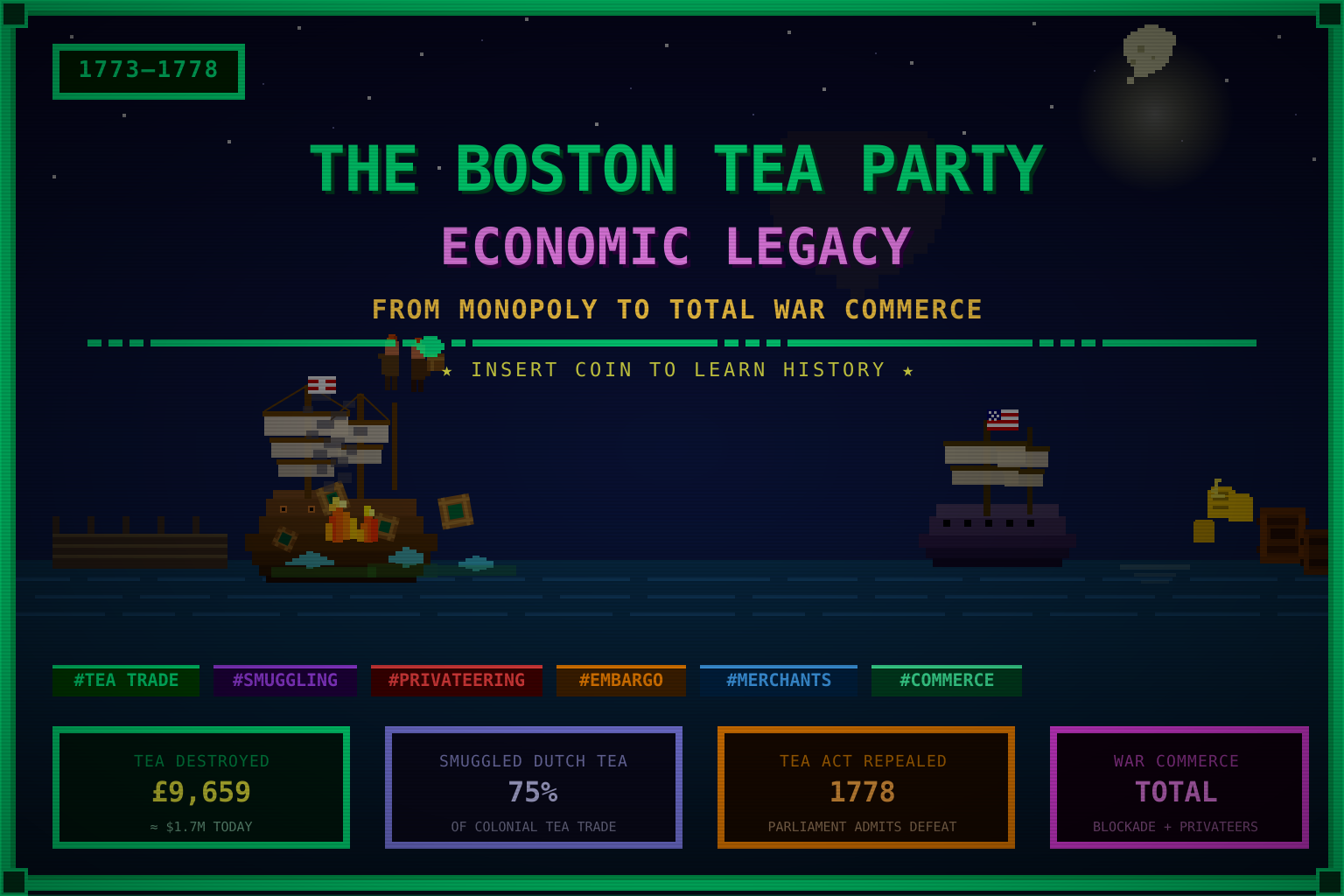
The Boston Tea Party (December 16, 1773) was an economic act as much as a political one: colonists destroyed cargo valued at approximately £9,659 sterling (the British East India Company’s own damage estimate, equivalent to roughly $1.7 million in today’s dollars) to resist the Tea Act’s monopoly, which threatened the livelihoods of colonial merchants and smugglers. By 1778, five years of escalating trade warfare—non-importation agreements, port closures, naval blockades, and privateering—had transformed the North American economy utterly. Colonial commerce with Britain had vanished, traditional smuggling networks had evolved into state-sanctioned privateering, and American merchants sailed under French and Dutch flags to survive. In a remarkable admission that the tea monopoly had become unsustainable, Parliament itself repealed the Tea Act in 1778—even as the war it had sparked raged on.
The Economic Roots of the Boston Tea Party (1773)
Colonial Tea Smuggling and the East India Company Monopoly
Before 1773, the colonial tea trade existed in a state of organized evasion. Smuggling was so prevalent and commercially entrenched that:
- Dutch tea dominance: By 1760, approximately 1 million pounds of tea entered the colonies annually; roughly three-quarters (750,000 pounds) was smuggled Dutch tea, often through Rhode Island ports where magistrates routinely sided with smugglers or returned seized vessels.
- Merchant wealth: Colonial merchants including John Hancock (Massachusetts) and Samuel Adams (Massachusetts) built their fortunes on the Dutch tea trade. Hancock allegedly earned 70% of his wealth from smuggling operations.
- Commercial network: Smuggled tea moved through an interlocking network of colonial merchants, ship captains, dock workers, innkeepers, and retailers—a significant portion of the colonial economy depended on this contraband.
The Tea Act (May 1773) — A Monopoly Threat
The British Parliament passed the Tea Act of 1773 with the intention of saving the nearly-bankrupt British East India Company. The act:
- Eliminated the import tax on tea shipped directly from Britain to America, making East India Company tea cheaper than smuggled Dutch tea.
- Granted the East India Company a monopoly on tea sales in the American colonies—only the Company could export tea directly to colonial agents.
- Undercut colonial merchants: The combination of lower prices and monopoly control meant Dutch tea smugglers could no longer compete. Merchants who had profited from contraband tea faced economic ruin.
Colonial Opposition:
Colonial merchants, traders, and the political interests aligned with them (including Hancock and Adams) understood the Tea Act as an existential threat. They organized resistance through:
- Public meetings and newspaper campaigns denouncing the monopoly
- Pressure on consignees (the colonial agents appointed to distribute East India tea) to resign
- Organizing the December 1773 destruction of three shipments of tea in Boston Harbor
The Boston Tea Party was not spontaneous mob action but coordinated economic resistance by merchants defending their market share and livelihoods.
The Escalation: From Monopoly Protest to Total Commercial War (1774–1775)
The Coercive Acts (1774) — Parliamentary Retaliation
Britain responded to the Boston Tea Party with four punitive laws collectively called the Coercive Acts (known as the Intolerable Acts in America):
- Boston Port Act (March 31, 1774): Closed Boston Harbor until the destroyed tea was paid for, cutting off the city from maritime trade—its lifeblood.
- Massachusetts Government Act (May 20, 1774): Stripped Massachusetts of self-governance and canceled town meetings.
- Quartering Act (June 2, 1774): Required colonists to house British soldiers.
- Quebec Act (June 22, 1774): Extended Quebec’s territory over western lands colonial investors and settlers claimed.
The economic impact was devastating: Boston’s merchant class—which depended on the port—faced bankruptcy. Maritime workers lost employment. Trade networks that had operated for decades were severed overnight.
The Continental Association (October 20, 1774) — Collective Non-Importation
The First Continental Congress responded to the Coercive Acts by creating the Continental Association, a continent-wide non-importation, non-consumption, and non-exportation agreement signed by 53 delegates from 12 colonies. Its terms:
- No imports from Britain or Ireland (effective December 1, 1774)
- No consumption of British goods — enforcement through public opinion and citizen committees
- Termination of the slave trade (an economic provision often overlooked)
- Conditional non-exportation: If Britain did not repeal the Coercive Acts by September 10, 1775, colonists would ban exports to Britain and the British West Indies
Economic Significance:
The Continental Association represented the most radical collective economic action the colonies had yet undertaken. It was not merely a protest; it was an attempt to weaponize commerce—to inflict economic pain on Britain through coordinated trade denial. Colonial merchants who had competed fiercely with each other now accepted collective sacrifice for political goals.
For Britain, the stakes were immediate: the American colonies provided 25-30% of British overseas trade, access to raw materials (timber, naval stores, tobacco, rice), and a captive market for British manufactures. Trade denial threatened British prosperity and naval power.
Total War and Commerce: 1775–1778
Privatization of War — Merchants Become Privateers
When the Revolutionary War began in April 1775, official colonial trade with Britain ended completely. But American merchants did not disappear; they transformed into privateers—licensed merchants authorized by Congress to raid British merchant shipping.
Privateering in 1778:
By 1778, American privateers had become a major economic and military force:
- Authorized by Congress: Congress issued Letters of Marque authorizing privateers to attack British merchant vessels and keep a portion of captured cargo and ships.
- Profitable and numerous: More than 100 privateering expeditions operated in 1778 alone, striking British merchant ships in American waters, the Atlantic, and even British coastal waters.
- Economic benefit: Privateering enriched American investors, ship captains, and crews while disrupting British commerce. Captured cargoes (sugar, tobacco, manufactured goods) supplied the continental economy.
- Naval capacity: The ships and combat experience gained through privateering bolstered American naval capabilities against the British fleet.
Key Privateers in 1778:
- John Paul Jones (USS Ranger) — Conducted raids on British soil (Whitehaven, St. Mary’s Isle) in April 1778, capturing HMS Drake in the first American naval victory in European waters.
- Emerging privateering captains — Hundreds of smaller privateers operated under congressional authorization, turning mercantile warfare into state policy.
Legitimate Trade Routes Collapse; New Networks Emerge
As Britain’s blockade tightened and American trade networks collapsed, colonial merchants developed new commercial relationships:
- French trade: Following the February 1778 Franco-American alliance, French ports opened to American commerce. American merchants shipped naval stores, tobacco, and agricultural products to France in exchange for weapons, uniforms, and manufactured goods.
- Caribbean smuggling: American merchants ran blockades to trade with French and Spanish Caribbean colonies, exchanging colonial goods for sugar, molasses, and other tropical products.
- Spanish and Dutch connections: Neutral (or nominally neutral) traders from Spain and Holland became crucial intermediaries, purchasing American goods and selling British wares through indirect routes.
Commerce Never Recovered: Despite these workarounds, American commerce in 1778 was a fraction of pre-war levels. Ships that had once carried thriving merchant cargoes now carried military supplies. Trade routes established over a century of colonial expansion lay dormant.
Parliament’s Admission of Failure: The Tea Act Repeal (1778)
The Political Reversal
Remarkably, in 1778 Parliament repealed the Tea Act that had sparked revolution five years earlier. This repeal represented a stunning admission: the monopoly policy had failed politically and economically.
Why the Repeal in 1778?
- Failure to reconcile: The Coercive Acts and parliamentary intransigence had driven colonists toward independence rather than compliance.
- Economic pressure: British merchants hurt by trade disruption lobbied Parliament for reconciliation measures.
- Military necessity: With France now officially at war with Britain, Parliament sought any path to end American resistance.
- Too late: The repeal, intended as a reconciliation gesture, came five years too late. American independence was already declared (July 4, 1776), the Franco-American alliance was signed (February 6, 1778), and the war was embedded in the continent’s political economy.
The Paradox:
The Tea Act repeal of 1778 solved nothing. American commerce remained oriented toward France, not Britain. American merchants had adapted to war conditions and privateering. The destruction of the East India Company monopoly—the Boston Tea Party’s direct goal—had been accomplished not by repealing the act but by dismantling all British trade through war.
The Long Economic Consequence: New Commercial Architecture (1778 and Beyond)
Trade Reorientation
By 1778, the Boston Tea Party’s economic logic had been realized in the harshest possible way. Colonial merchants could no longer trade with Britain. Instead, they:
- Oriented toward France: The Franco-American alliance embedded trade provisions (neither nation could place duties on exports between them), making France the primary market for American commerce.
- Caribbean redirection: American commerce flowed to French and Spanish Caribbean colonies, creating new mercantile networks that would persist for decades.
- Dutch and Spanish intermediaries: Neutral traders became crucial middlemen, creating indirect trading routes that avoided British interdiction.
Privateer Fortunes
Merchants who had lost their smuggling markets found new wealth in privateering. The fortunes accumulated through privateering in 1778 created a class of wealthy naval-commercial entrepreneurs who would shape American foreign policy into the 19th century.
The Tea Trade Itself
The East India Company’s monopoly on tea, once the flashpoint of revolution, never recovered in America. After independence, American commerce was free to trade for tea with anyone—France, China, India—without the monopoly constraint. This freedom eventually made tea one of America’s most important trade commodities and spurred the early China trade.
Significance
The Boston Tea Party (1773) was an economic rebellion against monopoly and trade restriction. By 1778, that rebellion had been transformed by war into a complete restructuring of transatlantic commerce. The East India Company monopoly was destroyed—not repealed (repeal came too late), but destroyed by military necessity.
The broader significance lay in how the colonial economic grievance of 1773 had evolved into a complete alternative commercial system by 1778. American merchants, denied access to British trade and driven to privateering and French commerce, developed relationships and networks that would define American commerce for the next century. The Boston Tea Party protested a monopoly; the Revolutionary War created a new commercial empire oriented toward France and the Atlantic world, with American privateers and merchants as central figures.
The Continental Dollar and Commercial Collapse (1778)
The war’s economic destruction was compounded by a currency catastrophe that amplified commercial paralysis. By 1778, the Continental Congress had issued over $100 million in paper money — Continental dollars backed by nothing but good faith and the promise of future tax revenue. Inflation was devastating:
- Purchasing power decline: By 1778, a Continental dollar was worth roughly 25 cents in specie (gold or silver). By 1780, it would fall to nearly nothing, giving rise to the phrase “not worth a Continental.”
- Price controls failed: Congress imposed price controls in 1777–1778 to combat inflation; merchants evaded them by withdrawing goods from markets, creating artificial scarcity.
- Specie hoarding: Hard money—gold and silver coin—disappeared from circulation as citizens hoarded specie and refused paper currency, forcing merchants to barter. The Boston merchant economy, already devastated by the port closure, could not recover without reliable currency.
This monetary crisis intersected with the Tea Act’s legacy: colonial merchants who had financed their trade on credit could no longer obtain financing, could not rely on stable currency, and faced a commercial environment nothing like the pre-Revolution era. The Continental Dollar’s collapse demonstrated how thoroughly Britain’s retaliatory measures — the Coercive Acts, blockade, and war — had disrupted not just trade but the financial architecture that supported commerce. See also: The Continental Dollar Crisis of 1778.
The Carlisle Peace Commission (June–November 1778) and the Tea Act Repeal
Parliament’s 1778 repeal of the Tea Act accompanied a broader peace offensive. The Carlisle Peace Commission (named for Frederick Howard, 5th Earl of Carlisle) arrived in Philadelphia in June 1778 authorized to offer sweeping concessions:
- Repeal of the Tea Act and Townshend duties — Parliament offered to undo the legislation that had caused the Revolution.
- American parliamentary representation — Britain offered seats in the British Parliament to American representatives.
- Virtual home rule — Americans would govern their internal affairs without parliamentary interference; only external trade and foreign policy would remain British.
Congress rejected the commission entirely, citing three conditions: either Britain must first acknowledge American independence, or withdraw all troops, or both. The Franco-American alliance (February 6, 1778) had changed American calculations — with France now an ally, independence seemed achievable, and reconciliation with Britain was no longer attractive at any price.
Economic Irony:
The commission’s authority included repealing every commercial measure — tea taxes, navigation acts, trade restrictions — that had sparked the Revolution. Offered in 1770 or even 1774, such concessions might have ended the conflict. In 1778, they were too late. The Boston Tea Party had been a protest against monopoly; five years of war had transformed it into a revolution against British sovereignty itself. See also: The Carlisle Peace Commission.
See Also
- Naval Privateering in 1778 — the merchant-privateer transformation in detail
- Revolutionary War Financing in 1778 — how Congress funded the war
- Continental Dollar Crisis — currency collapse and commercial paralysis
- Caribbean Sugar Economy in 1778 — new trade routes through Caribbean markets
- Franco-American Alliance — the February 6, 1778 treaty that opened French ports to American commerce
- Wartime Trade & Commerce in 1778 — broad overview of wartime commerce
- John Hancock — the Massachusetts merchant whose smuggling wealth helped fund colonial resistance
- John Paul Jones — American naval commander and privateer who raided British coasts in 1778
Sources
- The Boston Tea Party, Boston Tea Party Facts
- The Tea Act, Bill of Rights Institute
- The Continental Association (1774), Encyclopedia.com
- Articles of Association, 1774, US History.org
- Nonimportation Agreements, Encyclopedia.com
- Tea: Brewing a Revolution, American Battlefield Trust
- The Carlisle Commission, American Battlefield Trust
- Continental Currency Inflation, Federal Reserve History