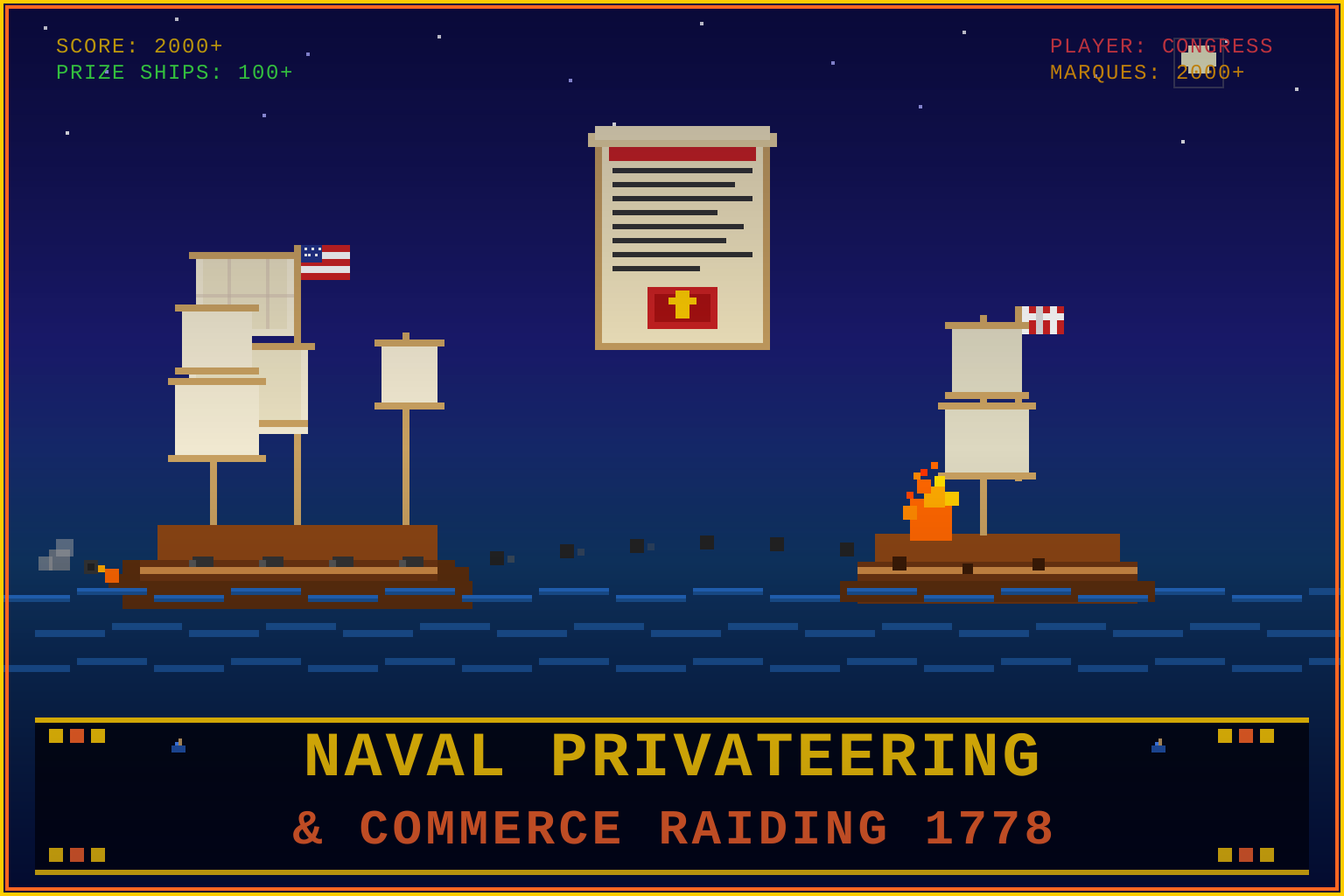
Key figures: Benjamin Franklin, John Paul Jones, Congress delegates issuing letters of marque
Summary
Naval privateering emerged as one of the most effective American weapons in 1778. Authorized by Congress through letters of marque—official commissions that distinguished privateering from piracy—more than 2,000 private merchant vessels received legal authorization to attack enemy shipping on behalf of the United States. In 1778 alone, privateers conducted over 100 recorded strikes against British merchant and supply vessels, with even greater numbers in 1779. These raids inflicted an estimated tens of millions of pounds in losses on British commerce, far exceeding the damage dealt by the nascent Continental Navy.
The privateering system worked through a carefully regulated process. A merchant owner would petition Congress or a state legislature for a letter of marque, posting a bond guaranteeing lawful conduct. Once authorized, the ship was outfitted with cannon, muskets, and crews trained in naval combat. Upon capturing an enemy vessel (called a “prize”), the privateer brought it into port where an admiralty court validated the seizure. The prize and its cargo were then sold, with proceeds divided among the ship owner, investors, and crew according to pre-arranged contracts. This legal framework transformed potentially criminal activity into a patriotic business venture, attracting private capital and entrepreneurship to the American war effort without draining public treasuries.
The timing of privateering operations shifted dramatically with the Franco-American Alliance signed February 6, 1778. Before the alliance, privateers operated in limited waters and faced severe British naval countermeasures. After France entered the war as America’s formal ally, French and French colonial ports opened as legal havens where American privateers could sell captured prizes without risk of seizure. This access to French markets multiplied privateering profitability and attracted massive new investment. The Treaty of Amity and Commerce that accompanied the Alliance explicitly authorized American merchant vessels and privateers to sell cargoes in French ports, creating a protected economic corridor for plunder.
In April 1778, John Paul Jones commanding the USS Ranger—technically a Continental Navy vessel but operating with privateer-like autonomy—conducted the audacious Whitehaven Raid (April 23, 1778) on the English coast. Jones’s force struck the shallow port at Whitehaven, where an estimated 400 British merchant ships lay anchored, disabled its fortifications, and set fires that spread through the town. Weeks later, the Ranger captured HMS Drake in the first American naval victory in European waters (April 24, 1778). Though Jones operated under Continental Navy command rather than as a pure privateer, his raids demonstrated the vulnerability of British home waters and the economic damage privateers could inflict.
The distinction between privateering and naval warfare blurred strategically: privateers harried British merchant ships while the Continental Navy and French naval squadrons engaged British warships. Together, they forced Britain to devote scarce resources to merchant-fleet protection. The British Admiralty was forced to convoy merchant vessels, reducing trading frequency and increasing shipping costs. Insurance premiums for British merchants skyrocketed. The cumulative effect of privateering and formal naval warfare created an economic siege that eroded British ability to sustain the war effort and British public support for the conflict.
Benjamin Franklin, operating from Paris as American minister, actively encouraged privateering and issued letters of marque to American and Irish crews operating in British waters, calculating that the economic pressure and diplomatic tensions privateering created between Britain and France would advance American interests. Franklin viewed privateering as both economic warfare and statecraft—a way to inflict material damage on Britain while demonstrating American resolve to France and other potential allies.
By 1778–1781, privateers had captured or destroyed an estimated 600 or more British vessels. However, the economic gains were unevenly distributed. Owners of successful privateer vessels accumulated substantial wealth, but Congress received only nominal shares from prize sales—insufficient to fund army operations. Privateering enriched a merchant class whose commercial interests sometimes conflicted with the Revolutionary cause. The Carlisle Peace Commission’s 1778 peace overtures were partly designed to appeal to this merchant interest, offering trade concessions that might separate wealthy merchants from the Patriot cause.
The Prize Court System and Economic Structure
The legal and financial architecture of privateering was as important as the ships themselves. When a privateer captured a vessel, it could not simply sell the prize — admiralty courts had to adjudicate whether the seizure was lawful under the letter of marque and the law of nations. The Continental Congress established a nationwide prize court system through its 1776 Admiralty Ordinance, and individual states maintained parallel courts. This dual structure sometimes created jurisdictional friction: Congress and state admiralty courts occasionally disputed proceeds, complicating distribution to investors. Massachusetts, Connecticut, and Pennsylvania — states with the largest merchant fleets — hosted the most active prize courts, processing hundreds of adjudications between 1776 and 1783.
The investment model that underwrote privateering was distinctly entrepreneurial. A typical privateer voyage involved a consortium of merchants who contributed shares of the vessel’s value and fitting-out costs; the letter of marque was obtained either directly from Congress or from a state authority. Prize proceeds were then divided according to strict contract terms: usually one-third to the ship’s owner, one-third shared among officers, and one-third distributed to the crew. This transparent profit-sharing attracted capital from Boston, Salem, Philadelphia, and Newport — cities whose merchants had the seafaring infrastructure and risk tolerance to finance multiple simultaneous voyages. Robert Morris, the financier of the Revolution, participated in multiple privateering ventures through his firm Willing, Morris & Co., blending patriotism with profit in a manner that epitomized the privateering ethos.
British insurance premiums for vessels trading in Atlantic waters spiked sharply as privateering intensified. London underwriters at Lloyd’s Coffee House, where marine insurance had been organized since 1688, raised rates for vessels in American waters from roughly 5–10% in peacetime to 20–30% by 1778–1779 on the most vulnerable routes. Convoys reduced individual vessel risk but added weeks to voyage times and required warship escorts, increasing operational costs. The British Board of Trade estimated that privateering losses between 1776 and 1783 exceeded £18 million sterling in captured vessels and cargoes alone — a figure that dwarfed the entire Continental Congress’s military budget in any single year.
Salem, Massachusetts emerged as the republic’s leading privateering port. Between 1776 and 1783, Salem fitted out at least 158 privateer vessels, capturing an estimated 445 British prizes worth millions of pounds. The fortunes accumulated by Salem’s privateer merchants — including the Derbys and Peabodys — helped capitalize New England commerce in the decades after the Revolution. Philadelphia and Baltimore also mounted significant privateer fleets, operating in the Caribbean and Atlantic where British sugar and tobacco convoys offered the richest prizes.
Privateering vs. Public Naval Power
Privateering was demonstrably more effective than the Continental Navy in 1778–1783. The Continental Navy, starved of funds and suffering from chronic crew shortages, operated only a handful of major combat vessels. The USS Ranger, USS Providence, USS Congress, and a few others fought valiantly but could not match British naval strength. In contrast, the decentralized privateer fleet—coordinated through no single authority but motivated by profit—harassed enemy commerce with greater reach and persistence. Privateers sustained American maritime presence and economic pressure without requiring Congress to build and maintain warships.
This efficiency came at a cost: privateer captains prioritized vulnerable merchant vessels over British warships. They avoided combat with well-armed naval vessels, preferring defenseless or lightly-armed cargo ships. This meant privateers did not directly engage British naval power, leaving naval dominance to France and its squadrons. But the economic effect was cumulative: British merchants demanded protection, British insurance costs soared, and the Crown’s trading revenues declined—precisely the wearing-down strategy that aligned with Washington’s attrition warfare approach.
The Sartine-led French naval expansion mirrored and amplified American privateering strategy. France’s Minister of Marine, Antoine de Sartine, undertook a systematic program of naval reconstruction after 1774, commissioning new warships, overhauling dockyards, and training naval officers. By 1778, France had 52 ships-of-the-line in commission — enough to contest British naval supremacy. The Franco-American Alliance of February 6, 1778 coordinated these national naval efforts, with France engaging British warships while American privateers bled British commerce. The strategy culminated in the Battle of Ushant (July 27, 1778), France’s first major fleet engagement with Britain since the Seven Years’ War, which demonstrated the combined Franco-American threat to British maritime dominance.
Significance
Naval privateering in 1778 demonstrates how asymmetric economic warfare can complement conventional military conflict. Privateers inflicted material damage on Britain’s trading economy that the Continental Navy could never achieve alone. They attracted private capital to the war effort without requiring Congressional spending, sustained American maritime presence across multiple ocean theaters, and contributed to the economic erosion of British public support for the war. Privateering proved that innovation in finance and business organization could substitute for conventional military superiority, a lesson that resonated through later American conflicts and contributed to the early republic’s reliance on merchant shipping and private enterprise as extensions of state power.
See Also
- American Revolutionary War Financing in 1778
- Wartime Trade & Commerce in 1778
- Continental Dollar Crisis and War Finance
- Sartine and French Naval Reforms
- Battle of Ushant (July 1778)
- St. Lucia Campaign (December 1778)
- John Paul Jones
- Benjamin Franklin
- Robert Morris — Financier of the Revolution
- Franco-American Alliance (1778)
- Carlisle Peace Commission
Sources
- Privateers as Diplomatic Agents of the American Revolution 1776-1778 — University of Colorado Scholar
- Piracy Became Patriotism During the American Revolution — The Mob Museum
- Privateers in the American Revolution — U.S. National Park Service
- How a Rogue Navy of Private Ships Helped Win the American Revolution — HISTORY
- John Paul Jones Leads American Raid on Whitehaven, England — HISTORY
- Letters of Marque and Reprisal — Congress.gov / Library of Congress