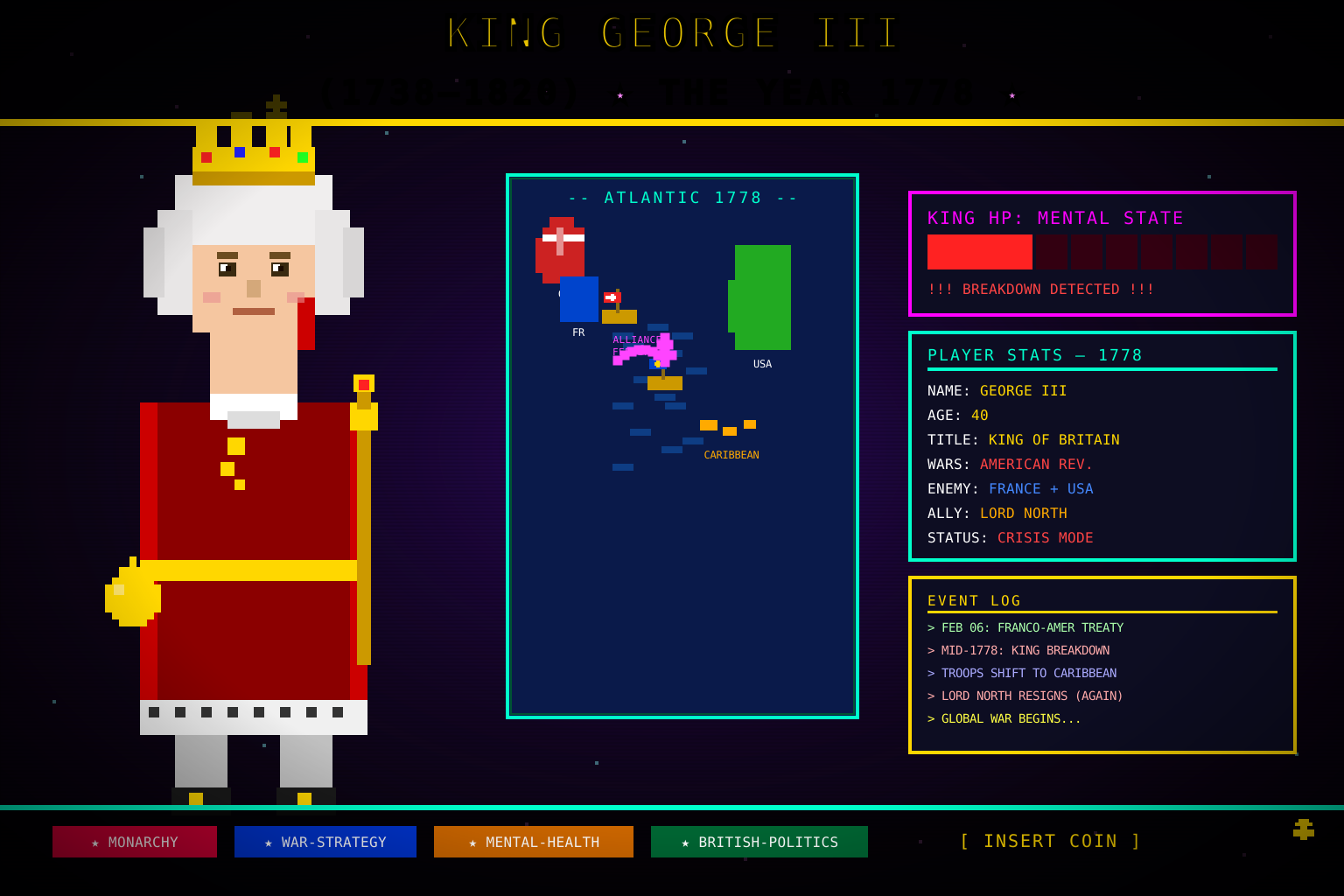
King George III, Britain’s 40-year-old sovereign, confronted 1778 as a transformative crisis year — one that combined France’s formal entry into the American Revolutionary War (via the Franco-American alliance of February 6), a fundamental strategic reorientation of British military priorities, severe government instability, and a mysterious months-long mental breakdown that temporarily incapacitated the monarch.
The Franco-American Alliance and Strategic Reorientation
When the Treaty of Alliance between France and the United States was signed on February 6, 1778, it transformed the colonial insurrection into a multi-theater global conflict. George III’s response was to double down on his position: he refused to acknowledge American independence and resolved to punish the colonists through indefinite prolongation of the war. However, the entry of France — Britain’s ancient rival — forced a strategic recalculation. By late 1778, Britain had withdrawn troops and ships from North America to defend what George III considered more essential theaters: the Caribbean sugar islands and the home islands against potential invasion. George himself declared in 1779 that the Caribbean “must be defended, even at the risk of an invasion of [the British Isles],” revealing the existential pressure France’s naval power exerted on British strategy.
Government Crisis and the Question of Succession
Throughout 1778, Lord North, Britain’s Prime Minister since 1770, submitted repeated tentative letters of resignation to the King, complaining of exhaustion and national disgrace. Yet George III, despite his ultimate accountability to Parliament, exercised his prerogative to refuse North’s departure. This reluctance to release his minister, combined with the broader strategic strain of a now-global war fought without major European allies (Spain had not yet entered; the Dutch Republic was still neutral), left Britain’s government in a state of anxiety and instability. The King’s sustained interventionism—his insistence on imperial authority, his choice and retention of ministers, and his public framing of the conflict as a matter of principle—materially shaped Britain’s trajectory toward escalation and prolonged war.
Personal Health Crisis
In 1778, George III experienced what contemporaries and later historians described as a months-long episode of “violent insanity.” The exact nature and duration of this crisis remain subjects of historical debate—later diagnoses have suggested porphyria (an inherited metabolic disorder) or bipolar disorder—but the immediate impact was profound. The King’s incapacity, even temporary, created a constitutional crisis and raised urgent questions about succession and regency. This personal collapse coincided with the nation’s strategic nadir: France had entered the war, Britain’s naval supremacy was contested, and the government itself was paralyzed by its reluctance to acknowledge the shifting realities of the conflict. The convergence of George’s private affliction with the nation’s public ordeal made 1778 a year of accumulated stress on both monarch and state.
The Carlisle Peace Commission: A Failed Diplomatic Gambit
Confronted with France’s entry and aware of Parliament’s restlessness, George III sanctioned one significant peace-seeking initiative in 1778: the Carlisle Peace Commission, which departed for Philadelphia in April and arrived in June. The Commission — led by Frederick Howard, Earl of Carlisle — was authorized to offer the Americans nearly everything they had demanded before 1776, short of independence: repeal of the Intolerable Acts, American representation in Parliament, full legislative autonomy, and guaranteed protection of colonial property. George III approved these concessions not from changed principles but from tactical calculation: if independence could be forestalled, he would accept constitutional novelty. The Commission failed completely. The Continental Congress refused to treat with any commission that did not first acknowledge American independence, and the Commission returned to Britain empty-handed by October 1778. The episode illustrates the fundamental intransigence on both sides — George III would not grant independence; the Americans would accept nothing less.
Troop Redeployment: The Arithmetic of Empire
By mid-1778 Britain had approximately 32,000 regular troops in North America. The strategic shift that George III authorized following France’s entry redistributed this force dramatically. In June 1778, the British abandoned Philadelphia — the city they had captured with fanfare in September 1777 — and consolidated their presence in New York City, releasing forces for Caribbean deployment. By the end of 1778, approximately 5,000 troops had been redeployed to the Caribbean to defend Jamaica, Barbados, and other sugar islands, while additional forces were earmarked for Gibraltar, Minorca, and India as France’s global reach became clear. The arithmetic of empire was cruel: Britain’s army was large enough to hold a few colonies or defend the Caribbean, but not to do both simultaneously against a major European power with a global navy.
Legacy and the Longer War
George III’s determination not to acknowledge American independence—a position rooted in his understanding of sovereignty and Parliament’s authority—meant that 1778 did not bring negotiation but only deeper commitment to victory. Though France’s intervention eventually exposed the limits of British power and contributed to the final American victory at Yorktown (1781) and the Treaty of Paris (1783), George III’s resolve in 1778 ensured the war would persist for five more grueling years. His refusal to accept the colonists’ political autonomy, combined with his strategic shift to defend imperial holdings worldwide, transformed what might have been a contained civil war into a prolonged global conflict that would strain Britain’s finances, navy, and social fabric through the end of the decade. The cumulative financial burden was staggering: the national debt, already substantial from the Seven Years’ War, grew by approximately £100 million over the American war’s course, and the land tax had to be raised to four shillings in the pound to fund the conflict’s expanding scope.
See Also
- King Louis XVI of France in 1778
- Women’s Agency and Influence in 1778
- Treaty of Alliance (France–United States)
- Britain Declares War on France
- Carlisle Peace Commission
- Comte de Vergennes
- The Global Crisis of 1778
Sources
- King George III Role in The American Revolutionary War Summary — Total History (encyclopedic overview)
- George III (r. 1760-1820) — The Royal Family (official biography)
- George III’s Official Correspondence 1772-1780 — Georgian Papers Programme (primary source archive)
- Franco-American Alliance — Wikipedia (historical overview)
- Britannica: Franco-American Alliance — Britannica (encyclopedic reference)