Key figures: King Charles III, José de Gálvez, Marqués de Sonora, Bernardo de Gálvez, France’s Comte de Vergennes
Summary
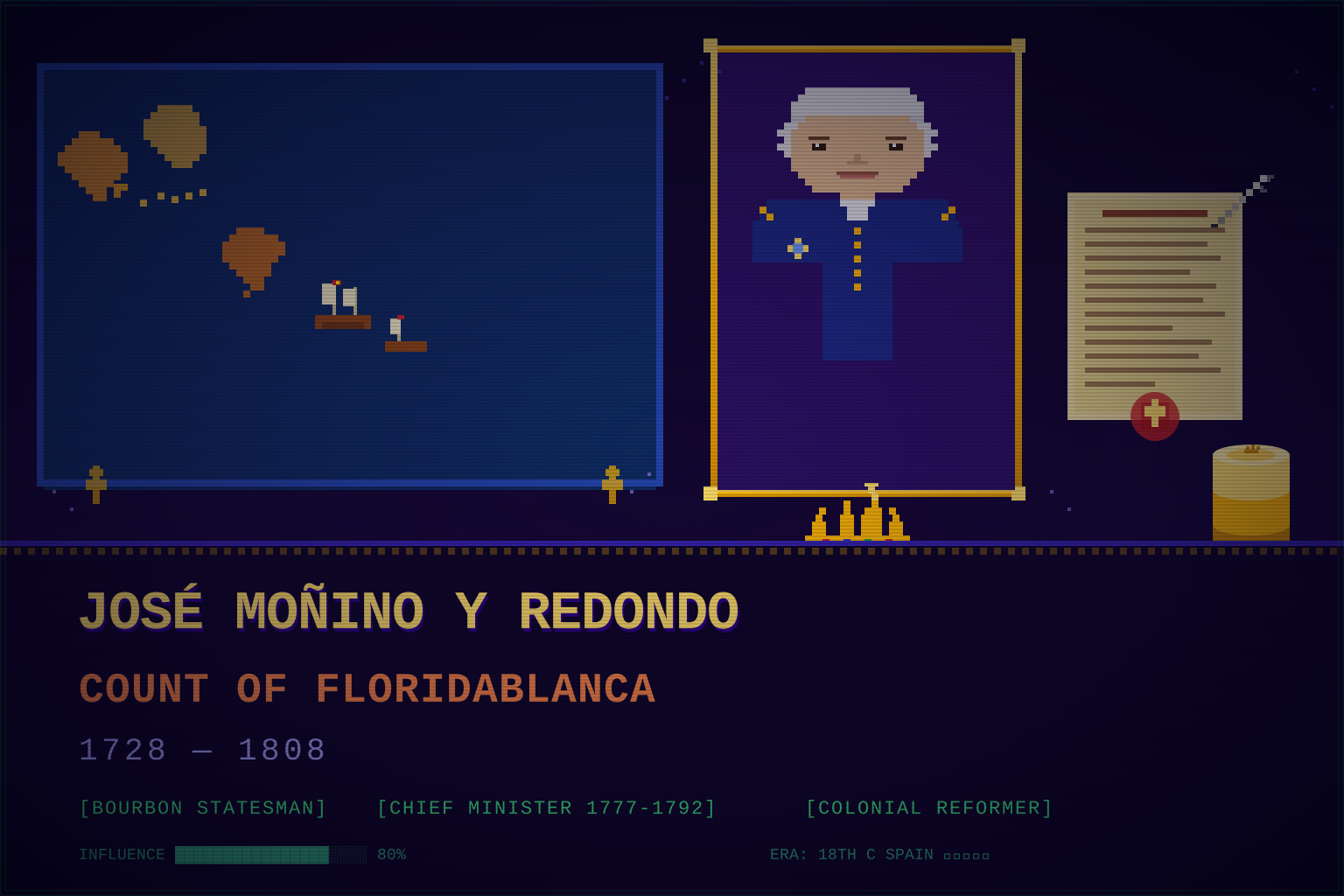
José Moñino y Redondo, Count of Floridablanca (1728–1808), was the Bourbon statesman who emerged as Spain’s chief minister in 1777 and set the course for Spanish policy throughout the American Revolutionary War and beyond. By 1778, at age 50, Floridablanca had consolidated control over Spanish government and embarked on a sweeping modernization agenda that transformed Spain’s colonial system, administrative structures, and international strategy. His 1778 commercial reforms — particularly the “Commercial Freedom Decree” that opened Spanish colonial ports to direct trade — marked a revolutionary departure from three centuries of Spanish mercantilism and signaled Spain’s determination to strengthen its empire through economic rationalization rather than military conquest alone. Floridablanca’s tenure as chief minister (1777–1792) would prove to be the era of Spain’s most effective eighteenth-century statecraft; he was subsequently characterized by historians as “arguably Spain’s most effective statesman in the eighteenth century.”
Rise to Power and Bourbon Reformism
Floridablanca’s ascent to power must be understood within the context of Bourbon Spain’s eighteenth-century transformation. The Bourbons, who had replaced the Habsburgs in 1700, had inherited an empire that was economically moribund and administratively fractured: Spain’s once-formidable colonial system had been gutted by centuries of wars, the Spanish fleet was outdated compared to Britain’s, and the Spanish economy was locked into patterns of regional fragmentation and aristocratic privilege that stifled commerce and innovation. The early Bourbons — particularly Philip V and Ferdinand VI — had begun the work of administrative modernization, but it fell to Charles III (who ruled Spain from 1759 to 1788) to push these reforms to their fullest extent.
Floridablanca had built his reputation as a jurist and diplomat during the 1760s and 1770s. The son of a Murcia notary, he trained in law at Salamanca and was appointed a fiscal (crown attorney) of the Council of Castile in the 1760s, where he argued for legal codification and the centralization of royal authority. In 1772 Charles III sent him as ambassador to Rome, charged with pressing the papacy to dissolve the Society of Jesus; his success in securing the 1773 papal suppression of the Jesuits earned him the title Count of Floridablanca. His diplomatic and administrative work argued that Spanish power could be recovered only through systematic reform rather than the fitful military adventures that had characterized earlier Bourbon policy. His career trajectory embodied the broader intellectual movement of Enlightened Absolutism that was reshaping Spain’s intellectual elite: like other Enlightenment reformers such as José de Gálvez (who served as Minister of the Indies) and the Marqués de Esquilache before him, Floridablanca believed that a modern state required rational bureaucratic structures, commercial liberalism, and the subordination of aristocratic privilege to the crown’s larger strategic interests.
When Charles III elevated Floridablanca to First Secretary of State — Spain’s chief minister — on February 19, 1777, he was signaling his commitment to accelerating the pace of reform. Floridablanca’s first year in office (1778) proved to be the most transformative: he immediately began the administrative and commercial overhauls that would define his entire tenure.
The 1778 Commercial Freedom Decree
Floridablanca’s most consequential 1778 initiative was the Reglamento y aranceles reales para el comercio libre de España e Indias (Regulation and Royal Tariffs for Free Trade between Spain and the Indies), issued on October 12, 1778. The decree fundamentally restructured Spain’s colonial commerce. Under the previous system, Spanish colonial trade had been tightly controlled through a monopoly centered on Cádiz and Seville, with a convoy system designed to protect ships from privateers but which also strangled commerce through inefficiency and high costs. The mercantile monopoly enriched a narrow class of merchants in Seville and Cádiz but impoverished Spanish colonists (who paid inflated prices for European goods) and colonial economies (which had no direct access to world markets).
Floridablanca’s decree abolished these restrictions, opening the ports of Spanish America directly to Spanish merchants from thirteen peninsular Spanish ports (not solely Cádiz) and to a much broader range of colonial ports. The decree was partly motivated by economic theory — Floridablanca and his advisors were familiar with the physiocratic arguments of the French Économistes and the free-market reasoning spreading through Enlightened Europe — and partly by practical necessity. The American Revolutionary War had made Spain’s entry into the conflict likely (Spain would formally declare war on Britain in June 1779, months after Floridablanca’s decree), and Floridablanca recognized that Spain’s ability to support its colonial possessions militarily depended on maximizing the wealth those colonies could generate.
The October 12 decree opened twenty-four Spanish colonial ports to liberalized trade within the Spanish empire — a significant expansion from what had existed before. The list included Havana, San Juan de Puerto Rico, Santo Domingo, Veracruz (in New Spain), Cartagena (in New Granada), and Callao (in Peru), among others. The effect was to transform the commercial geography of the Spanish empire: merchant networks that had previously funneled all trade through Cádiz could now operate regionally, capital accumulated in the colonies could be reinvested locally rather than extracted to Seville, and the economic vitality of Spanish America began to recover. The decree did not extend free trade to foreign merchants outside the Spanish empire (Britain and the United States remained excluded), but it was nevertheless a revolutionary departure from three centuries of closed Spanish mercantilism.
The Consulado of Cádiz and the Politics of Opposition
The Commercial Freedom Decree provoked immediate and fierce opposition from the Consulado of Cádiz — the merchant guild that had monopolized Spanish-American trade since 1717 (and effectively since the late seventeenth century) and whose members stood to lose their privileged position. The Cádiz Consulado petitioned Charles III repeatedly during 1778 and 1779, arguing that the liberalization of colonial commerce would flood Spanish markets with inferior goods, undercut established merchant houses, and reduce rather than increase colonial revenues by eliminating the coordination mechanisms of the convoy system. These arguments were not without merit: the convoy system, for all its inefficiencies, had provided systematic protection against maritime piracy and enemy naval raiders that individual merchant voyages could not easily replicate.
Floridablanca was aware of these objections and his response was characteristic of his broader administrative style: he did not suppress the Consulado’s complaints but instead ordered a structured review, soliciting technical memoranda from colonial treasury officials, naval officers, and commercial experts. The review took approximately six months and produced evidence that the old monopoly system had generated enormous price distortions in colonial markets — in some colonial ports, European manufactured goods commanded prices four to five times higher than in Spain itself, enriching Cádiz middlemen while suppressing colonial purchasing power. These data helped Floridablanca deflect political opposition: armed with documented evidence of monopoly abuse, he could frame the decree not as an ideological experiment in free trade but as a practical correction of documented mercantile exploitation. The Consulado’s formal objections were overruled; Charles III signed the October 12 decree. Within five years (by 1783), the annual value of legal colonial trade through non-Cádiz Spanish ports had increased by an estimated forty percent — a figure that vindicated Floridablanca’s commercial theory against his critics’ predictions of collapse.
Strategic Context: Spain and the American War
Floridablanca’s commercial reforms cannot be separated from his broader strategic calculation regarding Spain’s role in the emerging conflict between Britain and its American colonies. In 1777–1778, when Floridablanca was consolidating power, Spain remained technically neutral in the American war, even as France had moved toward the Franco-American alliance (signed February 6, 1778). Floridablanca’s position was more cautious than Comte de Vergennes’s; he worried that premature Spanish entry into the war against Britain would expose Spain’s scattered colonial possessions in the Caribbean and the Americas to British retaliation. Spain could not afford the kind of total commitment of resources that France had undertaken: Spain’s economy was weaker than France’s, and Spain’s colonial empire — vast in territorial extent but scattered and vulnerable — could be devastated if Britain chose to focus naval power against Spanish holdings.
The commercial freedom decree served multiple strategic purposes: it would accelerate the economic growth of Spanish America (making the colonies more defensible and more valuable), it would signal to France that Spain was preparing for potential war alongside the French alliance, and it would encourage Spanish colonial merchants to invest in shipping and naval infrastructure (which could be converted to military purposes if needed). In other words, the economic modernization of the Spanish empire was simultaneously a military modernization, preparing Spain’s colonies for the possibility of warfare.
By mid-1778, when Spain had decided to enter the war on the Franco-American side (formal declaration: June 21, 1779), Floridablanca’s commercial reforms had already begun to bear fruit. Colonial merchants, now able to trade directly with Spanish ports, were investing in ships and commerce; colonial treasuries, enriched by the expansion of trade, were able to contribute more resources to the war effort. When Spain’s war with Britain did commence in 1779, Spanish colonies played a more active military role than they would have under the old monopoly system.
Bernardo de Gálvez and Military-Commercial Coordination
Floridablanca’s commercial reforms did not operate in isolation from military planning. A key figure coordinating Spain’s military preparations in 1778 was Bernardo de Gálvez — nephew of José de Gálvez, the Minister of the Indies — who had been appointed Governor of Louisiana in 1777 at age 31. In 1778 Bernardo de Gálvez was conducting a covert supply operation from New Orleans that funneled money, weapons, and provisions to American forces fighting the British in the Ohio and Mississippi valleys. This operation, authorized by Floridablanca and José de Gálvez, predated Spain’s formal entry into the war by more than a year: as early as 1776, Spain had begun channeling funds through a fictitious trading company (Gardoqui & Sons) and through New Orleans to sustain American military pressure on Britain, reasoning that a weakened Britain in North America served Spanish strategic interests regardless of whether Spain formally declared war.
In 1778, Bernardo de Gálvez received authorization to intercept British merchant vessels on the Mississippi — in effect commencing an undeclared war several months before Spain’s formal declaration in June 1779. His seizure of eleven British merchant ships at New Orleans in August 1778 was a practical application of Floridablanca’s broader strategic logic: Spain would bleed British resources in North America covertly while preparing its colonial economy (through the Commercial Freedom Decree) for the costs of open war. The coordination between Floridablanca’s economic reforms and Bernardo de Gálvez’s military operations demonstrated a level of strategic integration unusual for eighteenth-century empires, and it laid the groundwork for the astonishing military success Spain would achieve in the Gulf region between 1779 and 1781.
Administrative and Intellectual Reform
Beyond commercial policy, Floridablanca’s 1778 agenda encompassed broader administrative and intellectual modernization. He commissioned reforms to Madrid itself — the city had fallen into physical and administrative decay during the earlier eighteenth century, and Floridablanca sponsored rebuilding, police regulation, and the construction of public buildings that would modernize the capital. He also championed educational reform, recognizing that Spain’s technological and administrative lag behind Britain and France was partly attributable to the decline of Spanish universities and intellectual culture. Though these broader reforms would continue throughout his tenure (he would found the National Bank of San Carlos in 1782 and establish more formal cabinet structures in 1787), the intellectual direction was established in 1778: Spain would modernize or fall further behind.
In parallel with domestic reforms, Floridablanca oversaw the expansion of Spain’s naval capacity. He coordinated with French minister of the marine Antoine de Sartine on combined Franco-Spanish naval strategy — a coordination that became essential after Spain formally entered the war in June 1779. Spain’s naval contribution would prove significant: the combined Franco-Spanish fleet that contested British control of the Channel in 1779 numbered sixty-six ships of the line against Britain’s thirty-nine. This naval buildup had been in preparation since at least 1776, with Floridablanca allocating treasury resources to ship construction programs in Ferrol, Cádiz, and Cartagena (Spain). The commercial revenues that began to flow from the 1778 trade liberalization thus fed directly into the naval appropriations that made Spain a credible belligerent.
Floridablanca’s Diplomatic Strategy: Independence from France
One crucial dimension of Floridablanca’s strategy was his determination to avoid Spain becoming a satellite of France within the Franco-American alliance. Though Spain and France were allies, and though Spain would eventually declare war on Britain in support of American independence, Floridablanca insisted on maintaining Spanish strategic autonomy. This became manifest in Floridablanca’s pursuit of Spanish territorial interests — during the American war, Spain would recover Menorca from Britain, recover Florida (both east and west), and secure the Mississippi frontier for Spanish North America (future Louisiana).
Floridablanca’s diplomatic skill lay in navigating between three competing interests: Spanish material interests (territorial recovery from Britain, the maximization of colonial wealth), French strategic interests (the defeat of Britain and the preservation of French power), and the emerging American interest in North American territorial expansion (which conflicted with Spain’s ambitions in the Mississippi valley). By managing Spain’s military participation in the war without subordinating Spanish diplomacy entirely to French direction, Floridablanca positioned Spain to extract the maximum benefit from the conflict.
Significance
Floridablanca’s 1778 commercial freedom decree and his broader program of administrative modernization marked the transformation of Spain from a sclerotic ancien régime empire into an enlightened monarchy attempting to reclaim great-power status through rational economic and administrative reform. The commercial freedom decree was instrumental in the Spanish colonies’ economic recovery during the late eighteenth century; it set the template for Latin American economic development well into the independence era, when the concept of free trade (though now between Spain and independent republics rather than within the empire) remained dominant.
Floridablanca’s tenure also demonstrated that eighteenth-century Bourbon absolutism, when wielded by capable hands, could be a vehicle for economic and administrative modernization. Unlike the worn-out autocracies of earlier centuries, Floridablanca’s Spain actively studied economic theory, conducted policy experiments, and attempted to modernize institutions. The American Revolutionary War, for Floridablanca, was not primarily a contest between monarchy and republicanism (he opposed American republicanism on principle) but rather an opportunity to weaken Britain and strengthen Spain’s strategic position.
Floridablanca’s influence would extend far beyond 1778: his commercial reforms remained in effect and expanded throughout his tenure, his administrative innovations (the national bank, the formal cabinet structure) became permanent features of Spanish government, and his foreign policy framework — independent Spanish strategy rather than French subordination — set the pattern for Spanish diplomacy through the Napoleonic era. Though his career would end in disgrace (he would be dismissed in 1792 and imprisoned during the French Revolutionary Wars), his achievements in 1778–1779 marked the high point of Bourbon Spain’s eighteenth-century recovery.
Sources
- José Moñino y Redondo (Wikipedia) — Biographical entry on Floridablanca’s career, ministerial achievements, and administrative reforms
- History of Spain (Wikipedia) — Context on Bourbon reforms and the administrative modernization of Spain in the eighteenth century
- Spanish Empire (Wikipedia) — Overview of Spanish colonial policy and the Bourbon commercial restructuring of the empire
- Britannica - Floridablanca — Biographical and historical context on Floridablanca’s reformist agenda
See Also
- War of the Bavarian Succession
- Comte de Vergennes (1717–1787)
- Franco-American Alliance (February 6, 1778)
- Global Crisis of 1778
- Wartime Trade & Commerce in 1778
- Caribbean Sugar Economy in 1778 — The colonial commercial system Floridablanca’s decree was designed to revitalize
- Sartine Naval Reforms — French naval buildup coordinated with Floridablanca’s Spanish preparations
- St. Lucia Campaign (December 1778) — British offensive directly threatening the colonial ports Floridablanca’s decree had opened