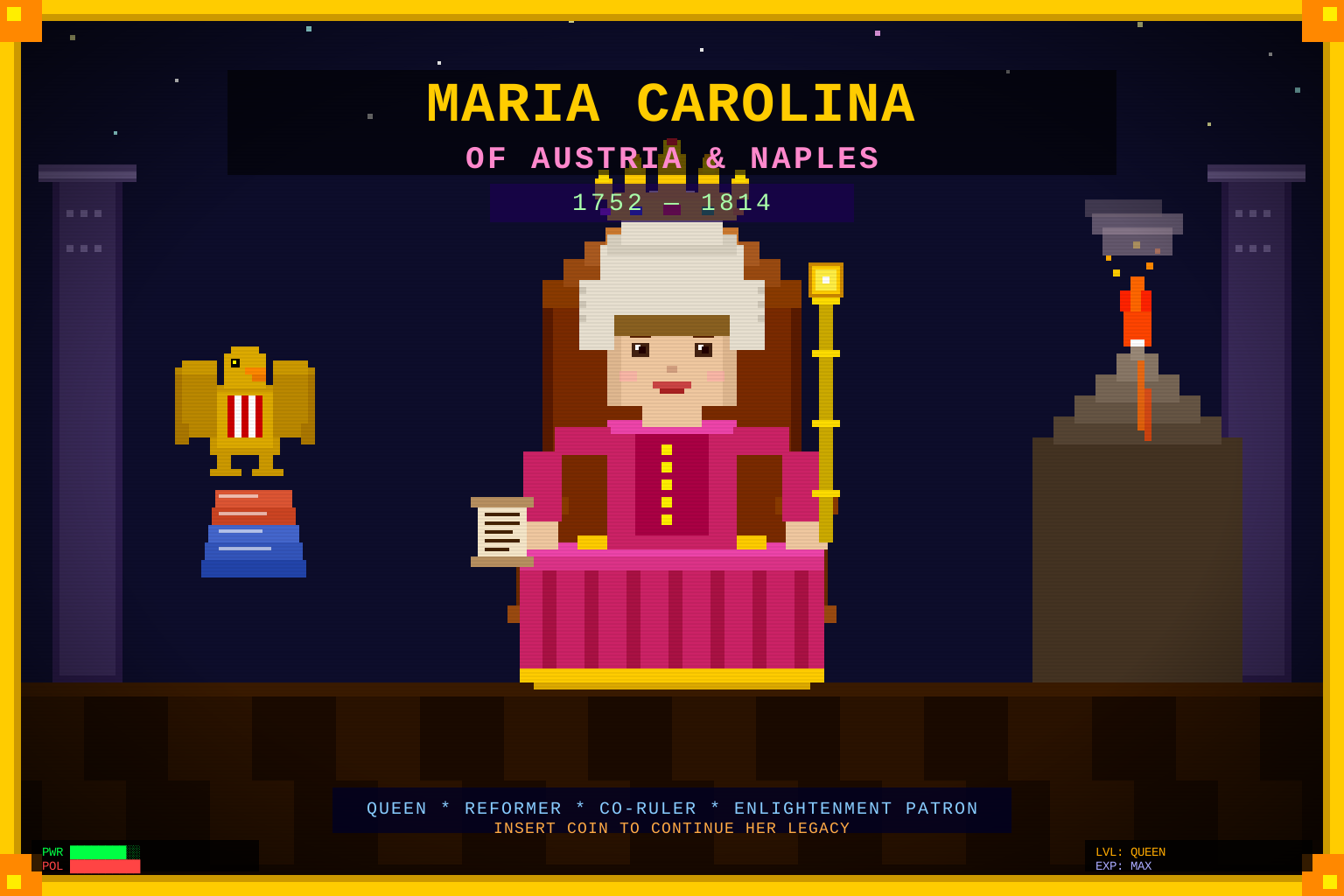
Full name: Maria Carolina Luisa di Asburgo-Lorena
Lived: 1752–1814
Key roles: Queen of Naples and Sicily (1768–1814), co-ruler and effective chief minister (1778–1814), reformer, patron of the arts and Enlightenment
Summary
Maria Carolina of Austria stands as one of the most powerful women of the late eighteenth century, wielding influence rivaling that of her contemporary Catherine the Great. Born in Vienna as the sixteenth child of Empress Maria Theresa and Emperor Francis I, Maria Carolina married King Ferdinand IV of Naples at age sixteen in 1768, a dynastic union designed to strengthen Bourbon ties and extend Habsburg influence into southern Italy. For nearly a decade, she remained largely confined to ceremonial roles as Fernando pursued his pleasures and hunting. The pivotal moment came in 1777–1778 when Maria Carolina bore Ferdinand a male heir—Prince Francis. A clause in her marriage contract granted her a seat in the kingdom’s ruling council upon producing a male successor. This constitutional provision, presumably intended as a ceremonial honor, became the foundation for unprecedented female political authority in Naples.
From 1778 onward, Maria Carolina transformed from consort to de facto ruler. Her ascension to power coincided with the Revolutionary era, the American conflict, and Europe’s political realignment. While her husband retained the titles and formal authority of kingship, Maria Carolina directed policy, appointed ministers, orchestrated diplomacy, and implemented sweeping reforms. Unlike the absolutist model of Louis XVI or the enlightened despotism of Joseph II, Maria Carolina’s rule combined Bourbon absolutism with Enlightenment rationality—she was simultaneously the dutiful queen consort deferential to her husband and the commanding intellect directing the kingdom.
The intellectual formation Maria Carolina received from her mother prepared her exceptionally for power. Maria Theresa, though staunchly Catholic and conservative on religious matters, was an enlightened reformer who modernized Austrian governance and instilled in her children the conviction that monarchs had responsibility to improve their subjects’ welfare. Maria Theresa’s letters to Maria Carolina throughout her early years in Naples counseled her daughter to advance rationality over superstition, to support worthy artists and intellectuals, and to position herself as indispensable to Ferdinand’s rule. These maternal lessons proved prescient. Upon gaining political influence, Maria Carolina became Naples’ most vigorous patron of Enlightenment thought. She first displaced the entrenched old-guard minister Bernardo Tanucci—the Tuscan-born statesman who had governed Naples under her father-in-law Charles III—and gathered around herself advisors of her own choosing, most notably the Englishman Sir John Acton, whom she elevated to become her closest confidant and, by many contemporary accounts, her lover—a political partnership unprecedented in its openness.
In 1778, Maria Carolina embarked on the first of her comprehensive reform programs. She revoked the ban on Freemasonry that had shadowed the kingdom since clerical opposition to the Enlightenment, signaling her determination to align Naples with European modernity. She patronized the archaeological excavations at Pompeii and Herculaneum, transforming these buried cities into showcases of classical knowledge accessible to enlightened minds. The Royal Academy of Sciences and Fine Arts became a focal point of her patronage, attracting scholars and artists whose work celebrated Enlightenment values. She expanded educational opportunities, funded hospitals, and reformed judicial procedures—all consistent with enlightened despotism’s promise that rational authority would improve human welfare.
Most significantly for 1778 and beyond, Maria Carolina undertook the expansion and modernization of the Neapolitan navy. Under her influence, Ferdinand’s government committed extraordinary resources to naval shipbuilding and recruitment. Sir John Acton, whom she appointed as commanding force of naval policy, transformed Naples’ fleet from a declining force into a growing power. This naval ambition had multiple dimensions: it aligned Naples with the great-power struggles unfolding across the Atlantic and Mediterranean (the Franco-American Alliance, the Franco-British naval rivalry); it projected Bourbon power across the Mediterranean and into the Adriatic; and it elevated Naples from a peripheral European power into a player in global conflicts. By the 1780s and 1790s, this naval investment would position Naples ambiguously between the Revolutionary and Napoleonic storms, with Maria Carolina’s diplomatic skills and naval capability the kingdom’s principal assets.
Maria Carolina’s power was never absolute—it was exercised through, around, and sometimes in tension with Ferdinand’s prerogatives as king. Unlike Catherine the Great, who had displaced a male successor to seize power for herself, Maria Carolina operated within a marriage structure that nominally subordinated her to her husband. Yet through intelligence, persistence, and Ferdinand’s own contentment to delegate authority to a capable spouse, she transcended the traditional queen consort role. She corresponded directly with foreign powers, directed ministerial appointments, and shaped kingdom policy. When Ferdinand’s enthusiasm for hunting or his pleasures pulled him from governance, Maria Carolina’s will prevailed. When external pressures—diplomatic crises, war, or the French Revolutionary shock—demanded rapid decisions, Maria Carolina was the kingdom’s actual executive.
The Marriage Contract Clause and Its Political Consequences
The precise wording of Maria Carolina’s 1768 marriage contract gave her the right to a seat on the Consiglio di Stato (Council of State) — Naples’ principal governing body — upon producing a male heir. This clause was unusual but not unprecedented in European dynastic marriage contracts; it reflected the Habsburg tradition of securing daughters’ political standing in foreign courts. The birth of Prince Francis in 1777 activated this right, and by early 1778 Maria Carolina was attending and increasingly directing Council sessions. Her elevation coincided with a broader personnel shift: she systematically replaced the dominant minister Bernardo Tanucci, who had governed Naples since the reign of her father-in-law Charles III, with advisors loyal to herself. Tanucci was dismissed in 1776; the young English naval officer John Acton was appointed to royal service in 1778 and elevated steadily through the naval and then civil hierarchy under Maria Carolina’s sponsorship.
The political significance of the Council seat extended beyond formal attendance. In the eighteenth century, Italian kingdoms governed through ministerial councils where decisions were nominally collective but actually reflected the will of the dominant personality. Maria Carolina recognized that controlling ministerial appointments was equivalent to controlling policy. By 1780, she had placed allies in the key ministries of foreign affairs, justice, and the navy. Her husband retained nominal authority, but contemporary diplomatic dispatches from Neapolitan ministers and foreign ambassadors consistently describe Maria Carolina as the kingdom’s real government. The British envoy Sir William Hamilton (whose wife Emma would later become Maria Carolina’s close friend) wrote to London in 1778 that “the Queen alone conducts all affairs of importance.”
Specific 1778 Reforms and Initiatives
In 1778, Maria Carolina’s first full year of effective co-rule produced several concrete policy initiatives:
Freemasonry: Maria Carolina rescinded the 1751 prohibition on Freemasonry in Naples, which had followed Clement XII’s 1738 papal condemnation of the craft. This reversal signaled alignment with Enlightenment sociability and opened Neapolitan lodges to the intellectual and commercial class Maria Carolina wished to cultivate. Naples quickly became one of Italy’s most active Masonic cities, with lodges offering forums for Enlightenment discussion that eventually intersected with revolutionary politics in the 1790s.
Pompeii and Herculaneum: The royal excavations at Pompeii and Herculaneum, begun under Charles III in 1748, received expanded royal patronage under Maria Carolina. In 1778, she oversaw the opening of additional excavation trenches at Pompeii and sponsored publication of the Antichità di Ercolano Esposte (Antiquities of Herculaneum Exposed), a multi-volume illustrated record of excavated artifacts. The project attracted European scholars and Grand Tourists — including Goethe, who visited in 1787 — and positioned Naples as a center of classical learning.
Naval Expansion: Maria Carolina’s most strategically significant 1778 initiative was directing substantial treasury resources to naval construction. John Acton, though initially appointed to the Neapolitan army, was given primary responsibility for naval reorganization by 1779, a process that began with 1778 planning and budget commitments. The Neapolitan fleet, which had shrunk to fewer than a dozen combat-capable vessels by the mid-1770s, expanded through new construction contracts at the Naples and Messina yards. By the mid-1780s, Naples possessed one of the Mediterranean’s larger regional navies.
Reform Achievements and Contradictions
Maria Carolina’s reign embodied the paradoxes of enlightened despotism. She was genuinely committed to rational governance and progress, yet she also defended absolute monarchy and the ancien régime’s hierarchies. She patronized intellectuals and artists, yet remained fiercely Catholic and suppressed radical religious criticism. She advanced women’s dignity through her own example of wielding power, yet never challenged patriarchal legal structures that confined most women to domestic dependence. She supported naval expansion and positioned Naples as a naval power, yet this ambition eventually embroiled the kingdom in ruinous conflicts with Revolutionary and Napoleonic France.
Her Enlightenment impulse clashed with her monarchical conservatism most sharply when revolutionary ideology threatened absolute rule itself. In the 1790s, as the French Revolution escalated and Republican armies swept through Italy, Maria Carolina’s commitment to Enlightenment reform calcified into fierce reaction. She would become one of the most implacable enemies of the Revolution, using her influence to push Ferdinand into Austria’s anti-French coalition and later into disastrous wars. Her transformation from Enlightenment patron to reactionary monarchist reflected the central crisis of enlightened despotism: the movement’s top-down reforms, however rational, could not accommodate democracy or national sovereignty movements without threatening the absolute power from which the reforms emanated.
Significance
Maria Carolina of Naples represents a singular historical figure: a woman who wielded genuine executive power in the age of absolutism without displacing a male sovereign or revolutionary action—she wielded power through intelligence, institutional position, and the acquiescence of a husband content to delegate. She demonstrated that women could command state apparatus, direct military policy, and shape diplomatic strategy when structural opportunity aligned with capability. Her model differed starkly from Catherine the Great’s seizure of power through military coup and domestic legitimacy; it also differed from Abigail Adams’ and Mercy Otis Warren’s influence through intellectual contribution and correspondence with male leaders. Maria Carolina’s authority was institutional and recognized, yet it remained dependent on her marriage contract and Ferdinand’s tolerance.
Her 1778 assumption of power marked a turning point in European political life. The spectacle of a woman directing a kingdom’s affairs through an enlightened vision—however contested and temporary that vision would prove—challenged conventional assumptions about female political capacity at precisely the moment when revolutionary rhetoric promised universal rights and human equality. That this promise did not extend to women’s political enfranchisement in 1778 or beyond reflects the revolution’s own deep contradictions. Maria Carolina’s power proved less durable than Catherine the Great’s, but her influence on Mediterranean politics and her patronage of Enlightenment culture in southern Italy contributed materially to the intellectual inheritance that shaped the nineteenth century.
See Also
- Catherine II ‘The Great’ (1729–1796)
- Abigail Adams (1744–1818)
- Mercy Otis Warren (1728–1814)
- Voltaire — The Philosophe’s Final Year
- Jean-Jacques Rousseau
- Comte de Vergennes — French Foreign Policy
- Floridablanca and Spanish Diplomacy
- The Global Crisis of 1778
- Religious Developments and Church-State Relations in 1778
- Sartine and French Naval Reforms
Sources
- Maria Carolina of Austria — Britannica Encyclopedia
- Maria Carolina of Austria: The Resilient Queen of Naples and Sicily — Empire Building Academy
- Maria Carolina (1752–1814) — Encyclopedia.com
- Queen Maria Carolina of Habsburg-Lorraine — Royal Palace of Caserta
- Queenship and Power: The Diary of Queen Maria Carolina of Naples, 1781-1785