Key figures: Georges-Louis Leclerc, Comte de Buffon (1707–1788)
Summary
In 1778, Georges-Louis Leclerc, Comte de Buffon, published Les Époques de la Nature (“The Epochs of Nature”) as a supplement to his monumental Histoire Naturelle. The work proposed that the Earth’s history unfolded across seven successive epochs, from its fiery formation to the emergence of humanity, and offered a calculated estimate of the planet’s age derived from physical experiment rather than scriptural chronology. Buffon, who had directed the Jardin du Roi in Paris — the royal botanical and natural-history institution, forerunner of the Muséum national d’Histoire naturelle — since 1739, had spent decades assembling the Histoire Naturelle as a comprehensive survey of the natural world; the Époques represented its culminating and most speculative volume.
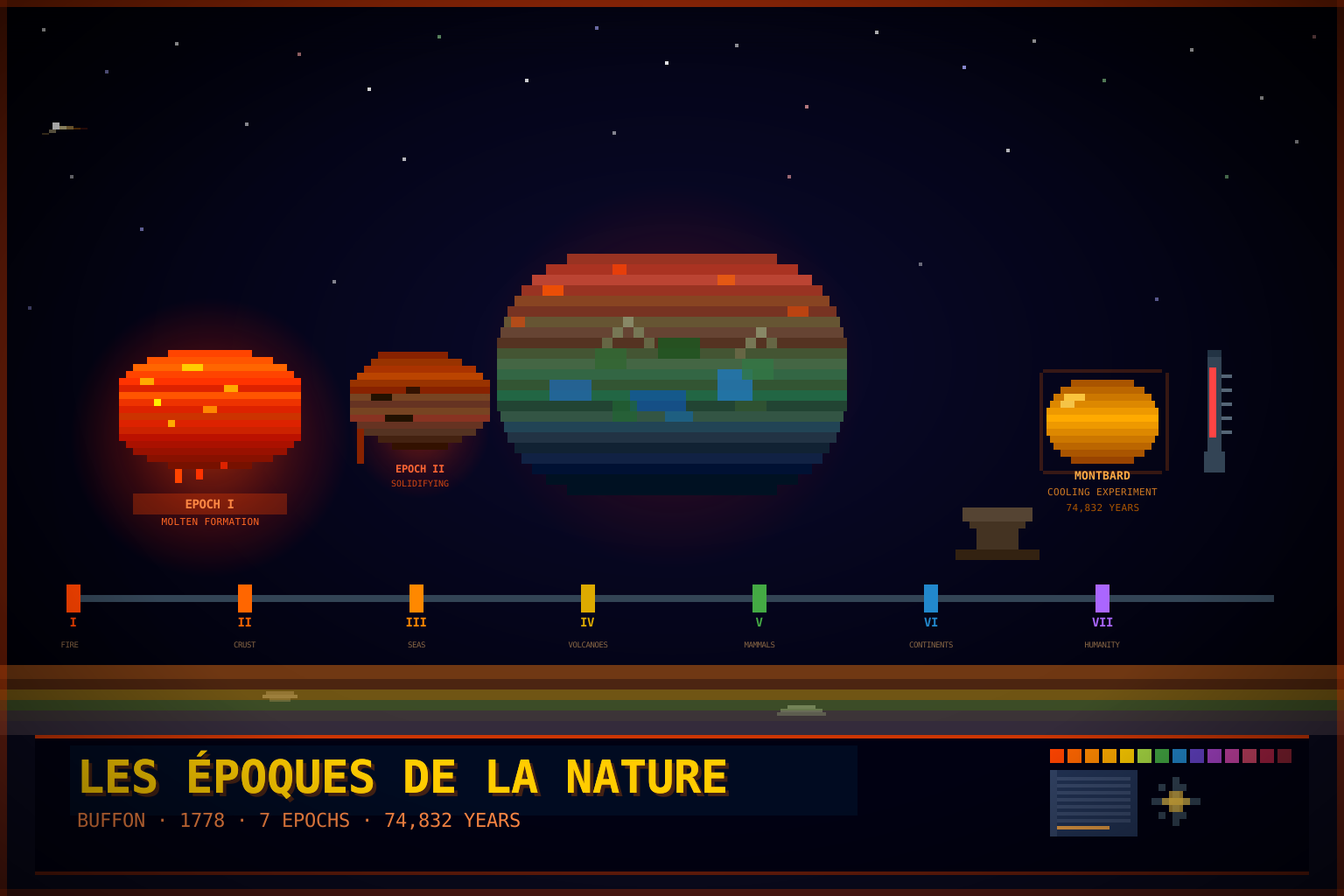
To ground his seven epochs in something more rigorous than analogy, Buffon drew on a sustained program of experiments conducted at his forge at Montbard, in Burgundy, beginning in the 1760s. He heated iron and stone spheres of graduated sizes to incandescence and timed how long each took to cool to the touch, then scaled the results up to a body the size of the Earth on the premise that the planet had originally been a molten mass torn from the sun (by the impact of a comet, in his account) and had been cooling ever since. From this extrapolation he arrived at a published figure of approximately 74,832 years — commonly rounded to roughly 75,000 years — for the Earth to reach its present temperature, a number he presented to the public as a conservative, defensible estimate.
The published figure was itself a deliberate understatement. Buffon’s private manuscripts and working notes, not released in his lifetime, contain calculations extending to several million years — figures he judged too radical for his contemporaries and too provocative for the theological authorities who had already scrutinized his work once before. Even at 75,000 years, however, the public estimate exceeded the traditional Biblical chronology of roughly 6,000 years by more than an order of magnitude, making the Époques one of the first widely read works to argue for an Earth far older than Scripture implied.
The Seven Epochs
Buffon organized his history of the Earth into seven successive epochs, loosely paralleling the seven days of Creation while replacing divine fiat with physical causation:
- The Earth and planets form from molten matter ejected from the sun by a comet’s collision.
- The Earth cools and solidifies, its rocky crust taking shape.
- Waters cover the entire globe as vapors condense, and sediments begin to accumulate.
- The waters recede, exposing continents, volcanic mountains rise, and early terrestrial life appears.
- Elephants, hippopotamuses, and other animals of warm climates once ranged across the globe, including regions later grown cold — evidence Buffon read from fossil remains found in Siberia and northern Europe.
- The continents separate, isolating faunas and reshaping geography.
- Humanity appears and begins to act upon nature, the final epoch in which “the power of man seconded that of nature.”
Theological Friction
The Époques extended a controversy Buffon had weathered nearly three decades earlier. His 1749 Théorie de la Terre, the opening volume of the Histoire Naturelle, had proposed a naturalistic account of Earth’s formation that drew the attention of the Sorbonne’s Faculty of Theology; in January 1751 the faculty notified him that the work contained propositions contrary to religious doctrine. Rather than face formal censure, Buffon wrote to the faculty in March 1751 disclaiming any intent to contradict Scripture, describing his account as a “pure philosophical supposition,” and agreeing to publish the exchange in a later volume — an accommodation that shielded him from official condemnation for the rest of his career. When the Époques de la Nature appeared in 1778 with its far larger timescale, Buffon again framed his conclusions cautiously, but the arithmetic of his cooling-sphere experiments spoke for itself: a planet aged in the tens of thousands of years, built from physical measurement rather than revealed chronology.
Significance
Les Époques de la Nature marks a foundational moment in the emergence of “deep time” as a scientific concept. By deriving the Earth’s age from a repeatable physical experiment rather than genealogical reckoning from religious texts, Buffon reframed the age of the planet as an empirical question open to measurement and revision. His seven-epoch structure, though later superseded, anticipated the stratified, sequential history of the Earth that would become the basis of modern geology, and his fossil evidence of warm-climate animals in cold regions prefigured later arguments for extinction and climatic change. The gulf between his cautious public figure and his far larger private estimates illustrates the tension between empirical conclusions and prevailing religious authority that shaped Enlightenment science, a tension future geologists — from James Hutton to Charles Lyell — would confront more openly.
See Also
- Death of Carl Linnaeus — Buffon and Linnaeus were the era’s two rival systems of natural order
- Antoine Lavoisier — Chemical Experiments and the Oxygen Theory of 1778 — parallel quantitative/experimental Enlightenment science in France
- The Enlightenment Transition of 1778 — same year as Voltaire’s and Rousseau’s deaths; Buffon among the last great philosophes
- Leonhard Euler’s Advances in Celestial Mechanics — contemporary quantitative science applying physical law to natural phenomena
Sources
- Georges-Louis Leclerc, Comte de Buffon - Encyclopædia Britannica
- The Epochs of Nature (University of Chicago Press, translated by Jan Zalasiewicz et al.)
- Buffon - Wikipedia
- Buffon, ou comment le siècle des Lumières envisageait l’origine du monde - Planet-Terre (ENS Lyon)
- Comte de Buffon and the Sorbonne