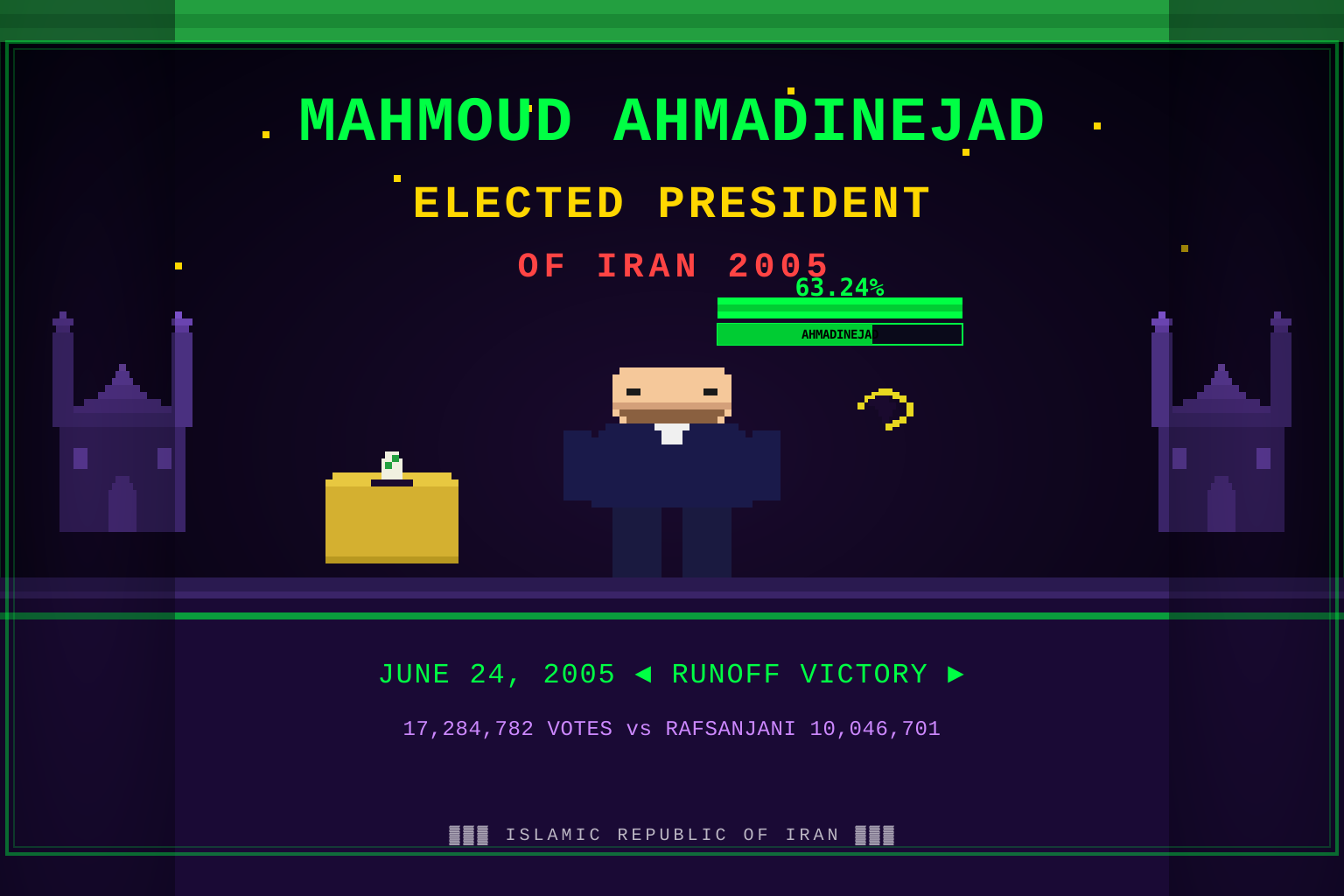
Key figures: Mahmoud Ahmadinejad (President-elect, Mayor of Tehran), Akbar Hashemi Rafsanjani (runoff opponent, former President), Mohammad Khatami (outgoing President), Ali Khamenei (Supreme Leader), Mehdi Karroubi and Mostafa Moin (reformist candidates)
Summary
Mahmoud Ahmadinejad was elected the sixth President of the Islamic Republic of Iran in a two-round contest in June 2005, defeating the veteran centrist Akbar Hashemi Rafsanjani in a runoff held on June 24, 2005. Ahmadinejad, the conservative mayor of Tehran and a political outsider on the national stage, won 17,284,782 votes (63.24%) to Rafsanjani’s 10,046,701 (36.76%). His victory ended eight years of reformist government under President Mohammad Khatami and marked a decisive swing toward the hardline, populist wing of the Iranian establishment. Ahmadinejad was formally endorsed by Supreme Leader Ali Khamenei and took office on August 2, 2005.
Background
The reform era under Khatami
Mohammad Khatami had served two terms as president since 1997, elected on a platform of political liberalisation, civil society, and cautious engagement with the West. By 2005 the reform movement had lost momentum: conservative-dominated institutions, including the Guardian Council and the judiciary, had blocked much of Khatami’s legislative agenda, and public frustration with unfulfilled promises and economic stagnation had eroded reformist enthusiasm. Khatami was constitutionally barred from seeking a third consecutive term.
The field of candidates
The Guardian Council, which vets candidates for eligibility, approved a slate that spanned the political spectrum. The presumed frontrunner was Rafsanjani, a founding figure of the Islamic Republic who had already served as president from 1989 to 1997 and campaigned as a pragmatic elder statesman promising economic modernisation and reduced tensions abroad. Reformists were split between Mostafa Moin and others, while the conservative vote was initially divided among several candidates including Mohammad Bagher Ghalibaf and Ali Larijani. Ahmadinejad, who had been appointed mayor of Tehran in 2003, entered the race with a low national profile and campaigned on an austere, anti-corruption, populist message emphasising the redistribution of Iran’s oil wealth to ordinary and rural Iranians.
The election
The first round was held on June 17, 2005, with a turnout of 62.66%. No candidate secured the majority required for outright victory. Rafsanjani finished first and Ahmadinejad second, edging past better-known conservatives to reach the runoff—a result that surprised many observers and prompted allegations of organised mobilisation on Ahmadinejad’s behalf.
In the runoff on June 24, 2005, held with a turnout of 59.84%, Ahmadinejad won decisively. His campaign framed the contest as a choice between an entrenched, wealthy establishment—personified by Rafsanjani—and a modest servant of the poor. Ahmadinejad’s own austere personal style and his emphasis on economic justice, religious values, and national dignity resonated with lower-income and provincial voters.
Allegations of irregularities
The results drew accusations of interference. Reformist candidate Mehdi Karroubi alleged that networks of mosques, the Islamic Revolutionary Guard Corps (IRGC), and the Basij militia had been used illegally to generate and mobilise support for Ahmadinejad. Rafsanjani likewise complained of “organised and unjust interventions” guiding the vote. Analysts pointed to anomalies such as implausibly high turnout in some provinces. The Guardian Council reviewed the complaints and upheld the results.
Significance
Ahmadinejad’s election reversed the trajectory of Iranian politics and installed the country’s first non-cleric president in more than two decades. His presidency (2005–2013) was defined by confrontational rhetoric toward the West and Israel, expansion of Iran’s nuclear enrichment programme, and generous but inflationary social spending funded by high oil prices. His combative speeches at the United Nations and his denial of the Holocaust drew international condemnation and helped drive a succession of UN Security Council sanctions over the nuclear issue.
Domestically, the 2005 result strengthened the political weight of the IRGC and the hardline conservative bloc, a shift whose consequences became starkly visible in the disputed 2009 presidential election, when Ahmadinejad’s contested re-election triggered the mass “Green Movement” protests. His victory in 2005 thus marked an early inflection point in the Islamic Republic’s turn away from the reformist experiment of the Khatami years toward a more assertive and securitised style of governance.
Sources
- 2005 Iranian presidential election - Wikipedia
- Mahmoud Ahmadinejad - Wikipedia
-
[Mahmoud Ahmadinejad Biography & Facts - Britannica](https://www.britannica.com/biography/Mahmoud-Ahmadinejad) - Mohammad Khatami - Wikipedia