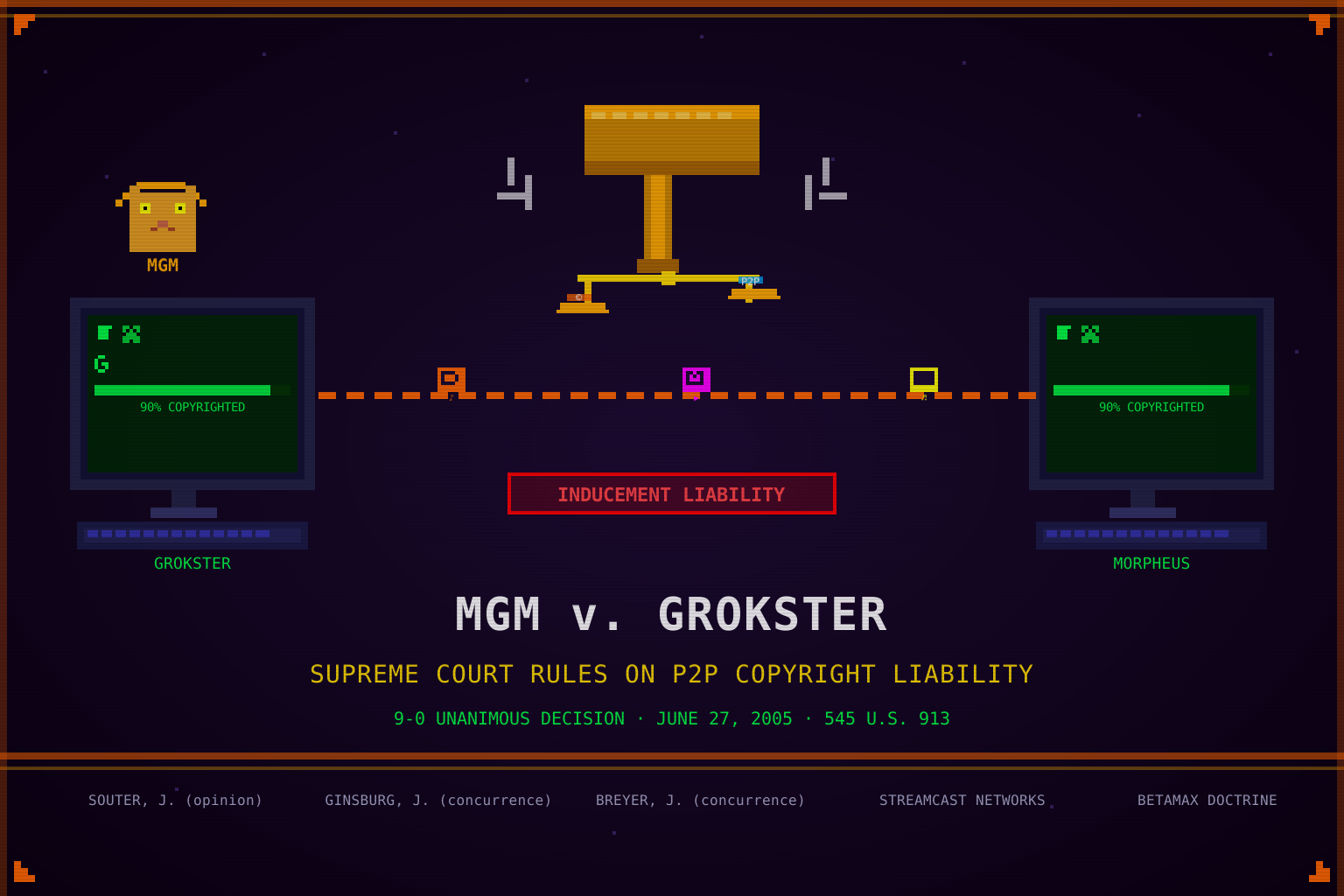
Key figures: Justice David Souter (opinion author), Justice Ruth Bader Ginsburg (concurrence), Justice Stephen Breyer (concurrence), Grokster Ltd., StreamCast Networks (Morpheus), Wayne Rosso (Grokster president)
Summary
On June 27, 2005, the U.S. Supreme Court issued a unanimous 9–0 decision in Metro-Goldwyn-Mayer Studios Inc. v. Grokster, Ltd., 545 U.S. 913, holding that distributors of peer-to-peer (P2P) file-sharing software can be held liable for copyright infringement committed by users if the distributor actively induced or encouraged that infringement. A coalition of 28 major entertainment companies led by MGM had sued Grokster Ltd. and StreamCast Networks (maker of the Morpheus client), arguing that their software was used overwhelmingly to trade unauthorized copies of copyrighted music and films. Internal documents showed that approximately 90 percent of files shared over both networks at the time of litigation were copyrighted material exchanged without authorization.
A federal district court and the Ninth Circuit Court of Appeals had both ruled in the defendants’ favor, relying on the Supreme Court’s 1984 precedent Sony Corp. v. Universal City Studios (the “Betamax case”), which held that a technology maker could not be held liable for infringement by users so long as the product was capable of “substantial non-infringing uses.” The Ninth Circuit found that because Grokster and Morpheus software could be used legally — for sharing public-domain music, independent releases, or authorized files — the Sony safe harbor applied, notwithstanding the predominance of infringing use.
Legal Background: From Betamax to Napster to Grokster
The legal framework governing secondary copyright liability for technology had rested on two pillars since 1984. Under Sony, contributory infringement required knowledge of specific infringement combined with a material contribution; vicarious infringement required the ability to supervise and a financial interest in the infringement. Both doctrines had been developed in the era of physical media.
The rise of the internet tested those limits. In A&M Records, Inc. v. Napster, Inc. (9th Cir. 2001), the Ninth Circuit found Napster liable for contributory and vicarious infringement because Napster operated a centralized index server that allowed it to identify and control infringing transfers. Napster was forced to shut down in July 2001.
Grokster and StreamCast had deliberately designed their software around Napster’s legal vulnerability. Unlike Napster, their FastTrack and Gnutella networks were fully decentralized: no central server indexed files, and the companies had no technical ability to monitor or block specific transfers. They argued — and both lower courts agreed — that this architecture placed them squarely within the Sony safe harbor: they could not supervise infringing conduct they did not host. The case went to the Supreme Court to resolve whether the Sony framework was the exclusive test for secondary liability.
The Inducement Rule
Writing for the unanimous Court, Justice David Souter declined to overturn or revise Sony but articulated a third theory of secondary liability that the Sony analysis did not address: active inducement. Drawing on patent law’s inducement doctrine (35 U.S.C. § 271(b)), the Court held that “one who distributes a device with the object of promoting its use to infringe copyright, as shown by clear expression or other affirmative steps taken to foster infringement, is liable for the resulting acts of infringement by third parties.”
The Court identified three categories of evidence against both defendants:
-
Targeting of former Napster users: Internal emails and marketing materials showed that both Grokster and StreamCast had deliberately positioned their products as Napster replacements, aiming to capture its former user base after the service’s shutdown. StreamCast’s internal documents described its strategic goal as the “next Napster.”
-
Failure to develop filtering tools: Neither company made any attempt to implement content filters to reduce infringing use, despite having the technical capability to do so for certain file types.
-
Advertising revenue tied to infringing use: Both companies earned revenue from advertising delivered to users. Because advertising revenue was tied to volume of use, and the overwhelming majority of use was infringing, both companies financially benefited directly from infringement.
The Court remanded the case for further proceedings on damages. Two concurrences revealed disagreement about how broadly to read Sony in future cases: Justice Ginsburg (joined by Chief Justice Rehnquist and Justice Kennedy) wrote that she would have gone further and found the defendants liable under existing contributory-infringement doctrine; Justice Breyer (joined by Justices Stevens and O’Connor) wrote to defend the Sony standard as a deliberate accommodation for innovation.
Aftermath: Grokster and StreamCast
Following the ruling, Grokster quickly reached a settlement. On November 7, 2005 — less than five months after the Supreme Court’s decision — Grokster announced it was ceasing all distribution of its software. The company’s website was replaced by a notice stating: “There are legal services for downloading music and movies. This service is not one of them.” Grokster paid $50 million to settle claims with the recording and film industries.
StreamCast Networks, maker of Morpheus, continued to litigate. On U.S. District Court remand in 2006, Judge Florence-Marie Cooper found StreamCast liable for inducement, relying on the same internal marketing documents the Supreme Court had cited. StreamCast continued to appeal until it eventually ceased operations in 2008.
Industry and Technological Impact
The decision arrived at a moment when legitimate digital music distribution was beginning to emerge. Apple’s iTunes Music Store, launched in April 2003, had sold its 300 millionth song by January 2005. The Grokster ruling reinforced the legal framework that allowed the recording industry to press other P2P operators and, eventually, to license digital distribution through services that became the foundation of the streaming era (see Digital Music Revolution).
The decision also shaped how successor services structured themselves. BitTorrent, which had been launched in 2001 and grew rapidly in 2004–2005, was careful to avoid the “inducement” conduct the Court identified — the protocol’s creator, Bram Cohen, explicitly distanced himself from infringing use. YouTube, which launched in February 2005 (see YouTube Founded), designed its content ID and takedown systems partly in light of the liability landscape Grokster clarified.
The entertainment industry had sought to push Congress toward a legislative solution — a bill called the INDUCE Act had been introduced in 2004 but died in committee. Grokster made legislation less urgent by supplying a judicially-created liability theory broad enough to reach the most egregious conduct without the Sony safe harbor’s disruption.
Significance
MGM v. Grokster filled a legal gap the entertainment industry had sought to close since Napster’s demise: it established that a technology’s makers could be held liable for users’ copyright infringement based on evidence of intent to foster infringement, even where the technology itself had substantial legitimate uses and even without a centralized server. The ruling reshaped how digital platforms approached copyright compliance — the behavioral and business-conduct evidence it required defendants to avoid became a template for how services designed their copyright policies. It remains a foundational precedent cited in subsequent copyright, platform-liability, and technology-neutral-tool litigation.
Sources
- MGM Studios, Inc. v. Grokster, Ltd. — Wikipedia
- Metro-Goldwyn-Mayer Studios Inc. v. Grokster, Ltd., 545 U.S. 913 (2005) — Supreme Court opinion, Justia
- Analysis of the U.S. Supreme Court’s Grokster Decision — Finnegan LLP
- A&M Records, Inc. v. Napster, Inc. — Wikipedia
- Sony Corp. v. Universal City Studios — Wikipedia