Key figures: National Hurricane Center Director Max Mayfield, Florida Governor Jeb Bush, Mexican federal and Quintana Roo state authorities, FEMA
Summary
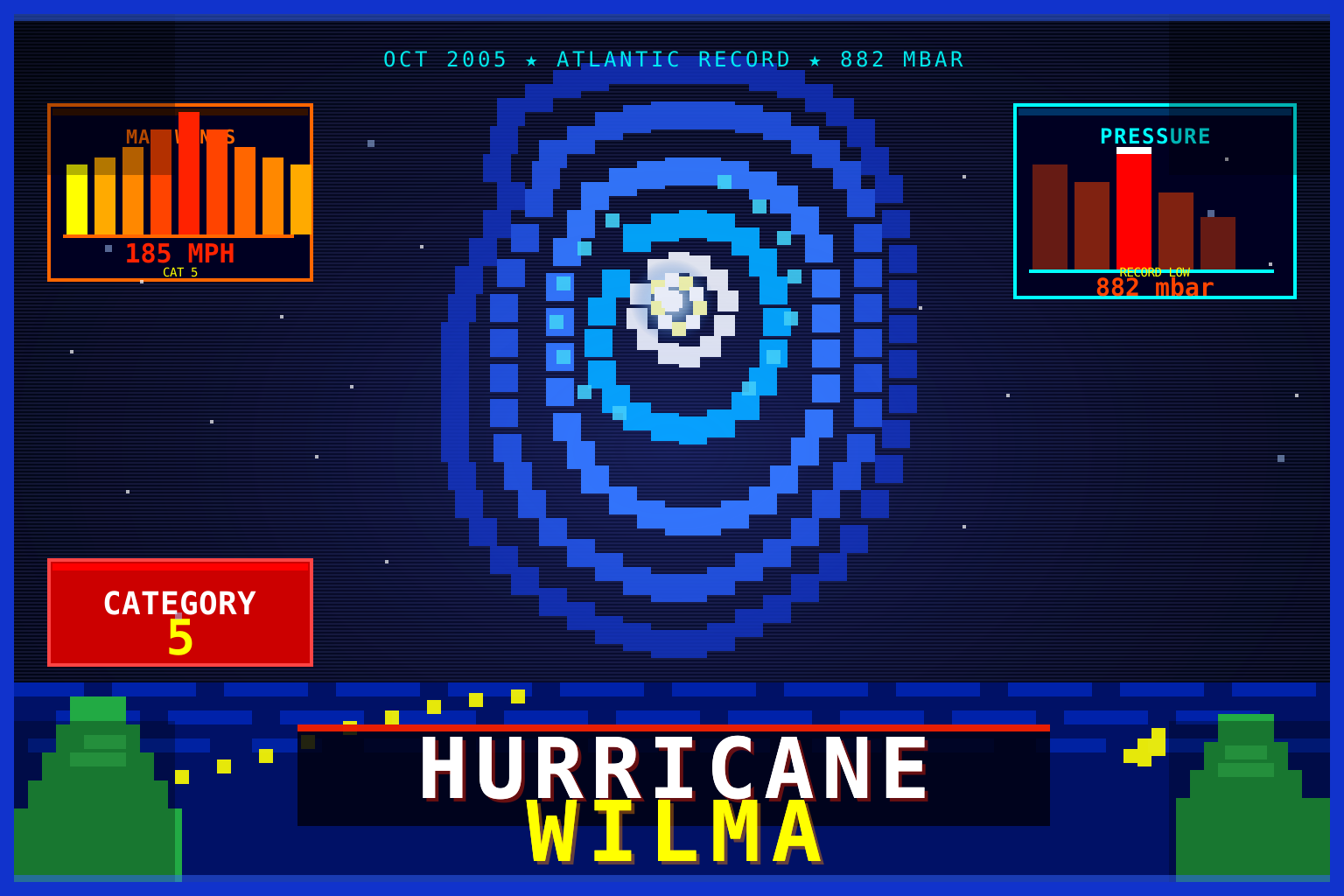
Hurricane Wilma formed as Tropical Depression Twenty-Four in the western Caribbean Sea on October 15, 2005, and became Tropical Storm Wilma on October 17. Over roughly a 24-hour period ending on October 19 it underwent one of the most extreme episodes of rapid intensification ever documented: its minimum central pressure fell from 982 to 882 millibars — a drop of about 97 millibars in 24 hours — as peak sustained winds reached 185 mph (295 km/h), making it a Category 5 hurricane. The 882-millibar reading, taken on October 19, was the lowest central pressure ever measured in an Atlantic hurricane, surpassing the previous record of 888 millibars set by Hurricane Gilbert in 1988. At peak intensity Wilma’s eye contracted to a “pinhole” roughly 2.3 miles (3.7 km) across, among the smallest ever observed.
After weakening from its peak, Wilma made its first landfall on the island of Cozumel and the northeastern Yucatán Peninsula near Puerto Morelos, Mexico, on October 21–22 as a Category 4 and then Category 3 hurricane. It stalled over the Yucatán for nearly two days, battering the resort cities of Cancún, Cozumel, and Playa del Carmen. Re-emerging over the Gulf of Mexico, Wilma accelerated northeast and made its final landfall near Cape Romano in southwest Florida early on October 24 as a Category 3 hurricane with sustained winds of about 120 mph (195 km/h), crossing the peninsula in roughly four and a half hours before exiting near Palm Beach into the Atlantic.
Meteorology and Records
Wilma developed within a broad area of disturbed weather over the western Caribbean during an already historic hurricane season. Feeding on exceptionally warm sea-surface temperatures and low wind shear, it intensified explosively on October 18–19. The National Hurricane Center’s post-storm analysis confirmed the 882-millibar minimum pressure as an Atlantic basin record — a mark that still stood two decades later — and documented the storm’s record 24-hour deepening rate. Reconnaissance aircraft observed the extraordinarily small eye before an eyewall replacement cycle enlarged the circulation and lowered peak winds prior to the Yucatán landfall.
Wilma was the twenty-first storm to receive a name from the 2005 Atlantic list and its final entry; when Tropical Storm Alpha formed on October 22 while Wilma was still active, the National Hurricane Center resorted to the Greek alphabet for the first time in the naming system’s history. Wilma was the season’s record-tying fourth Category 5 hurricane, following Emily, Katrina, and Rita.
Impact in Mexico
Wilma’s slow, grinding passage over the Yucatán Peninsula produced prolonged hurricane-force winds, torrential rainfall exceeding 60 inches (1,500 mm) in places, and severe coastal erosion along the beaches of the Riviera Maya. Cancún and Cozumel — cornerstones of Mexico’s tourism economy — sustained extensive damage to hotels, infrastructure, and the white-sand beaches central to the region’s appeal. Tens of thousands of tourists were stranded in shelters for days. Damage in Mexico was estimated at several billion U.S. dollars, and the rebuilding and beach-restoration effort stretched over the following years.
Impact in Florida
Wilma struck Florida as the state’s first major hurricane landfall since a run of storms in 2004 and the last of the 2005 season. The storm’s compact but powerful wind field caused widespread structural damage across South Florida, shattering high-rise windows in downtown Miami and Fort Lauderdale and flattening agricultural areas around Lake Okeechobee. Its most striking effect was a near-total loss of electrical power: roughly six million customers — close to the entire population of South Florida — lost service, and full restoration took weeks in some areas. The prolonged outages and shortages of fuel, ice, and water exposed gaps in post-storm distribution planning and drew criticism of both state and federal preparedness only weeks after Hurricane Katrina had exposed similar failures on the Gulf Coast.
Casualties and Damage
Wilma was responsible for at least 52 deaths across Haiti, Jamaica, Mexico, and the United States, including about 23 in the United States, most of them in Florida. Damage in the United States was estimated at more than $20 billion, and total damage across Mexico, the Caribbean, and the United States at roughly $27 billion (2005 USD), ranking Wilma among the costliest Atlantic hurricanes on record. Coming after Katrina and Rita, the storm added to a cumulative insured-loss burden that reshaped the property-insurance market in Florida and the Gulf states.
Significance
Hurricane Wilma set the enduring benchmark for Atlantic hurricane intensity — a central pressure of 882 millibars that remained unbroken two decades later — and capped the most active Atlantic hurricane season then on record, which produced a then-unprecedented 28 named storms and forced the first use of the Greek-letter naming system. As the third catastrophic hurricane to strike North America within two months, alongside Katrina and Rita, Wilma intensified scientific and public debate over whether warming ocean temperatures were increasing the frequency of the most powerful storms, and it accelerated reforms in emergency power restoration, building codes, and hurricane insurance across the southeastern United States. It was also the last major hurricane to make landfall in Florida for eleven years, until Hurricane Hermine in 2016.