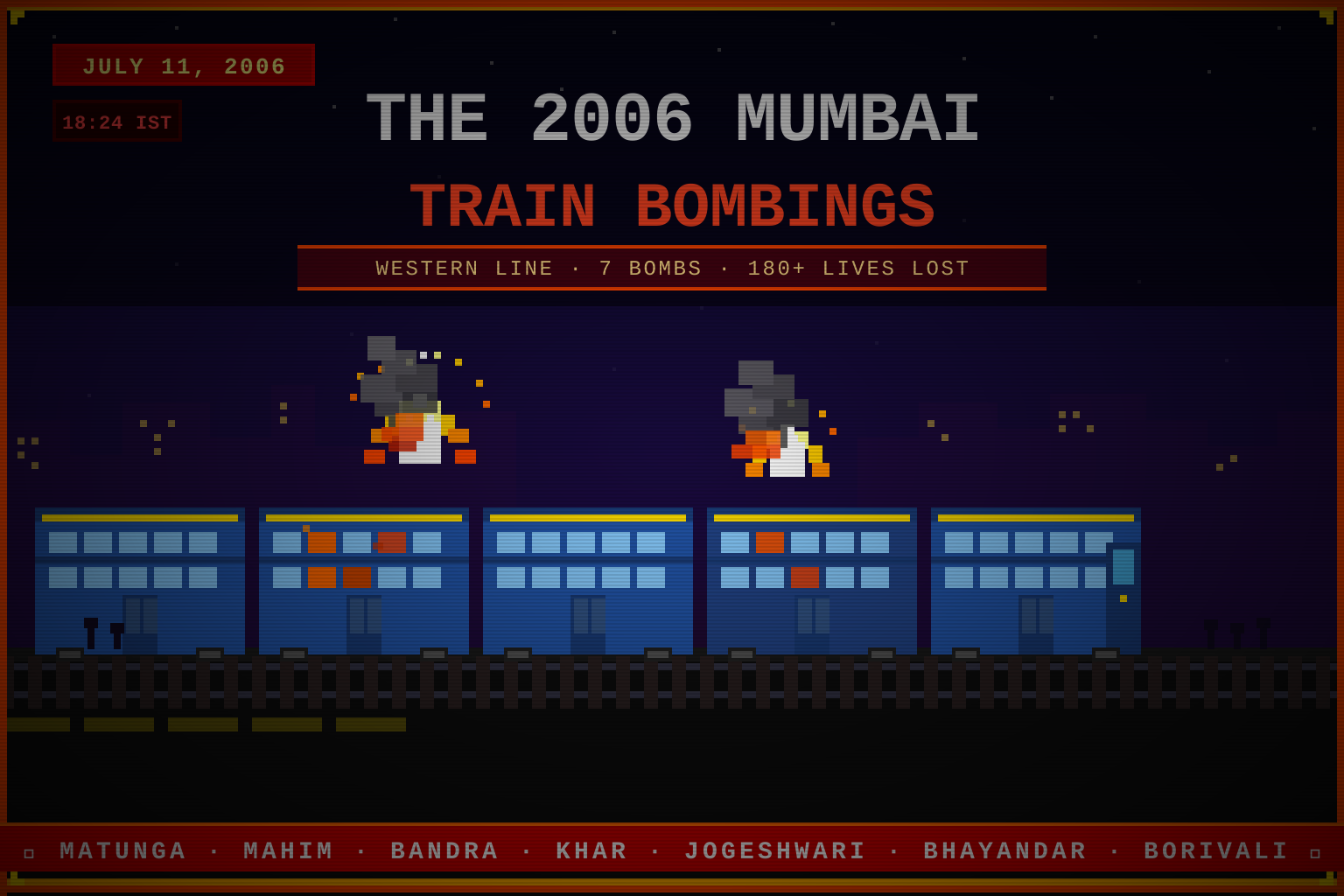
Key figures — the Mumbai Suburban Railway (Western Line) commuters; the Maharashtra Anti-Terrorism Squad (ATS); Lashkar-e-Taiba, named by Indian investigators as the principal conspirator; the Students’ Islamic Movement of India (SIMI), whose members were among the early suspects; the government of Prime Minister Manmohan Singh.
Summary
On the evening of July 11, 2006, seven bombs exploded in the space of roughly eleven minutes — between about 18:24 and 18:35 local time — aboard first-class carriages of packed commuter trains on the Western Line of the Mumbai Suburban Railway, one of the busiest rail networks in the world. The blasts struck at or near the stations of Matunga Road, Mahim Junction, Bandra, Khar Road, Jogeshwari, Bhayandar, and Borivali during the peak evening rush hour, when the trains were carrying far more than their designed capacity of passengers.
The explosions killed more than 180 people — figures reported across official and press accounts range up to about 209 dead — and injured in the region of 700 others, making the attack among the deadliest acts of terrorism in India’s history. The bombs, concealed in pressure cookers placed inside bags and luggage racks, were built from military-grade RDX combined with ammonium nitrate. The coordinated timing, the choice of a mass-transit system carrying millions of daily commuters, and the deliberate targeting of rush-hour crowds marked the attack as a sophisticated, high-casualty operation.
The Attack
Mumbai’s suburban rail system is the arterial network of India’s financial capital, moving several million passengers each day along its Western, Central, and Harbour lines. On the evening of July 11, commuters heading home from the city’s business districts filled the trains beyond capacity. The bombs were placed in first-class compartments and detonated in rapid succession as trains ran along and stopped at stations on the Western Line north of the city centre.
The near-simultaneous explosions overwhelmed the city’s emergency services. Rescue efforts drew heavily on ordinary residents and commuters, who pulled the wounded from shattered carriages and ferried them to hospitals before ambulances could reach the scattered blast sites. Rail service on the Western Line — a lifeline for the metropolis — was suspended and then restored within hours, in what officials and commentators framed as a demonstration of the city’s resilience.
Investigation and Attribution
The Maharashtra Anti-Terrorism Squad (ATS) led the investigation. Indian authorities attributed the bombings principally to the Pakistan-based militant group Lashkar-e-Taiba (LeT), alleging that the plot had been organized with the assistance of local operatives, and Indian officials pointed to elements linked to Pakistan’s intelligence services — claims that Pakistan denied. Members of the banned Students’ Islamic Movement of India (SIMI) were among those arrested, and investigators alleged the attack combined external planning with domestic recruitment and logistics. By October 2006 the ATS had arrested more than a dozen accused and prepared a chargesheet naming a larger group, including individuals it identified as Pakistani nationals who were not in custody.
The bombings occurred amid a fragile and stop-start peace process between India and Pakistan. They intensified diplomatic strain between the two nuclear-armed neighbours and became a recurring point of contention in South Asian security, alongside later attacks attributed to LeT.
The Trial and Its Reversal
The legal aftermath extended across nearly two decades. In September 2015, a special court in Mumbai convicted twelve of the thirteen men brought to trial, sentencing five to death and seven to life imprisonment; one defendant was acquitted. The convictions were widely reported as a measure of closure for the victims and their families.
That outcome was overturned years later. In July 2025, the Bombay High Court acquitted all twelve convicted men, ruling that the prosecution had “utterly failed” to establish the charges and citing serious deficiencies in the evidence, including questions over confessions and identification. The government sought to challenge the acquittals before the Supreme Court, which stayed the High Court’s judgment while clarifying that the released men would not be returned to prison — leaving the case, decades on, without a settled final verdict.
Significance
The July 11, 2006 bombings were among the most lethal terrorist attacks in modern Indian history and a defining moment in the country’s confrontation with mass-casualty terrorism during the mid-2000s. They exposed the vulnerability of dense urban mass-transit systems, which cannot be secured like airports without paralyzing the everyday mobility of millions, and prompted a lasting reassessment of rail and city security across India.
Coming two years before the far larger 2008 Mumbai attacks, the train bombings contributed to a hardening of Indian public and official attitudes toward cross-border militancy and shaped the trajectory of India–Pakistan relations for years afterward. The protracted collapse of the criminal case — from conviction in 2015 to blanket acquittal in 2025 — also became a widely cited example of the difficulty of securing durable justice in complex terrorism prosecutions.
The attack was one of several tests of state and international response mechanisms in the summer of 2006, unfolding within days of the outbreak of the 2006 Lebanon War and weeks before the disruption of the 2006 transatlantic aircraft plot, amid the year’s wider pattern of regional violence, from Darfur to East Timor.
Sources
- Wikipedia: “2006 Mumbai train bombings”
- Britannica: “2006 Mumbai train bombings”
- BBC News: “Mumbai train blasts: Death for five for 2006 bombings”
- EBSCO Research Starters: “Mumbai Train Bombings”