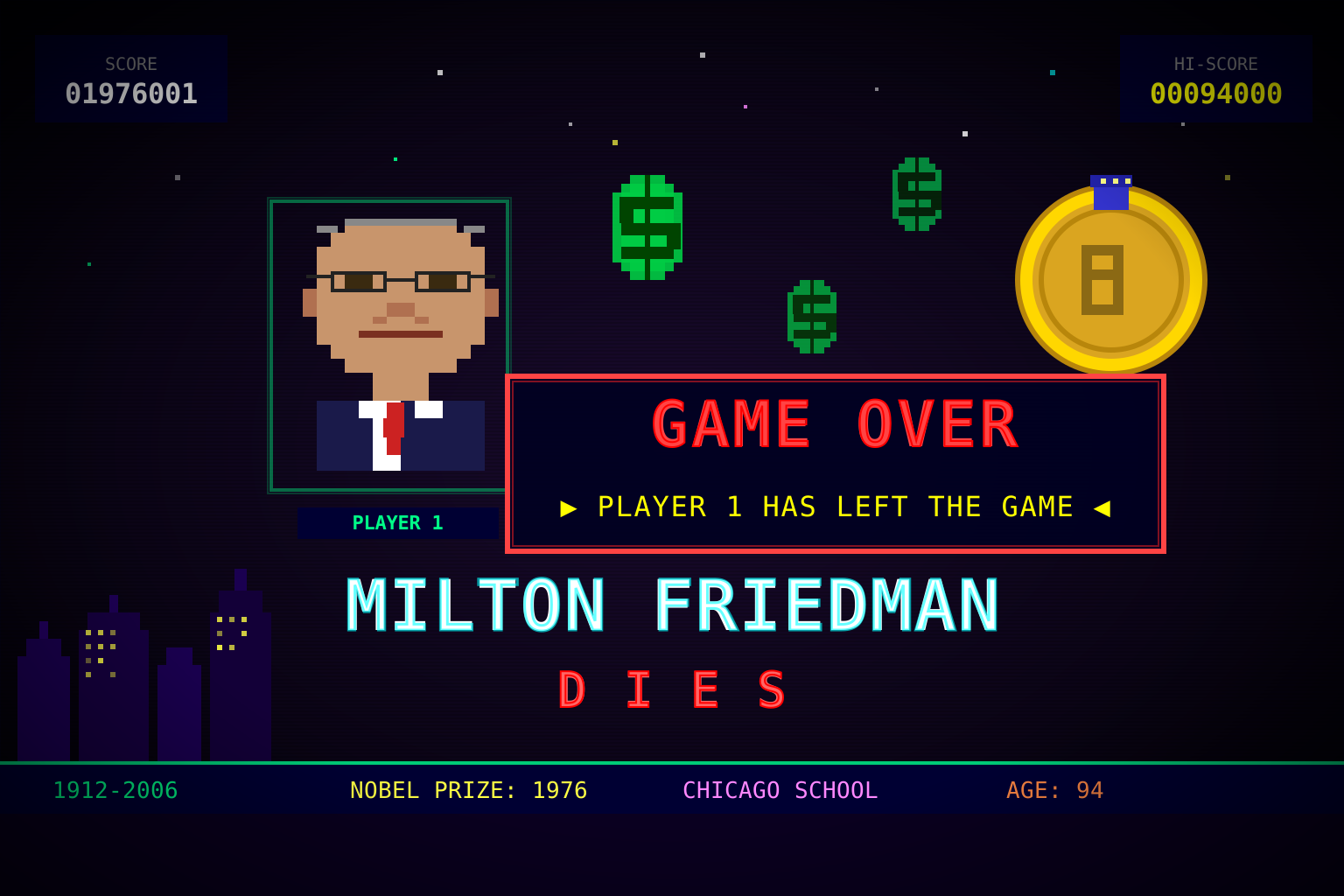
Category: People
Key figures: Milton Friedman (economist, 1912–2006), Rose Friedman (economist, wife and collaborator), Anna Schwartz (co-author, A Monetary History of the United States)
Summary
Milton Friedman, the Nobel Memorial Prize-winning economist widely regarded as the most influential proponent of free-market monetarism in the 20th century, died of heart failure on November 16, 2006, in San Francisco at age 94. He was a senior research fellow at Stanford’s Hoover Institution at the time of his death, having spent the preceding three decades there after 30 years on the faculty of the University of Chicago, where he built and led the “Chicago School” of economics.
Friedman won the 1976 Nobel Memorial Prize in Economic Sciences “for his achievements in the fields of consumption analysis, monetary history and theory and for his demonstration of the complexity of stabilization policy.” His arguments that inflation is fundamentally a monetary phenomenon, and that markets generally allocate resources more efficiently than government intervention, reshaped both academic economics and public policy from the 1960s onward, influencing central bankers and political leaders including Ronald Reagan.
Early Life and Background
Milton Friedman was born on July 31, 1912, in Brooklyn, New York, the son of Jewish immigrants from Beregszász, then part of the Austro-Hungarian Empire (now Berehove, Ukraine). He earned a bachelor’s degree from Rutgers University in 1932, a master’s degree from the University of Chicago in 1933, and a Ph.D. from Columbia University in 1946. In 1938 he married fellow economist Rose Director, who became his lifelong collaborator; the two co-authored several works, including the bestselling Free to Choose.
Career and Ideas
Friedman joined the University of Chicago faculty in 1946 and remained there until 1977, becoming the intellectual leader of the “Chicago School” of economics, which emphasized free markets, limited government intervention, and monetary discipline as the keys to economic stability. He challenged the then-dominant Keynesian consensus, arguing that “inflation is always and everywhere a monetary phenomenon” and that central banks should target steady, predictable growth in the money supply rather than attempting to fine-tune the economy through fiscal policy. After leaving Chicago he joined Stanford University’s Hoover Institution as a senior research fellow, a position he held until his death.
| Work | Year | Notes |
|---|---|---|
| Capitalism and Freedom | 1962 | Argued free markets promote both economic and political freedom |
| A Monetary History of the United States, 1867–1960 | 1963 | Co-written with Anna Schwartz; linked the Great Depression’s severity to Federal Reserve policy failures |
| Free to Choose | 1980 | Bestselling book and PBS television series with Rose Friedman popularizing free-market ideas |
Friedman’s policy advocacy extended well beyond academia. He championed floating exchange rates, an all-volunteer military, negative income tax proposals, and school vouchers — the latter promoted through the Milton and Rose D. Friedman Foundation for Educational Choice. Though he never held a formal position in a presidential administration, he served as an informal economic adviser to Presidents Richard Nixon and Ronald Reagan and influenced monetary policy debates internationally. He received the Presidential Medal of Freedom and the National Medal of Science in 1988.
2006: Death and Legacy
Friedman died of heart failure on November 16, 2006, at his home in San Francisco, at age 94. He was survived by his wife Rose, their two children, and several grandchildren and great-grandchildren. Hoover Institution director John Raisian called him “arguably the greatest economist of the 20th century,” while Stanford president John Hennessy said the university and the country had “lost one of its leading economists.” Tributes noted that Friedman was unusual among academic economists in achieving both scholarly authority and broad public recognition, having brought monetarist ideas into mainstream policy debate through his writing, television appearances, and decades of public commentary.
Significance
Friedman’s 1976 Nobel Prize and subsequent decades of influence marked the ascendance of monetarism and free-market economics as a serious counterweight to Keynesian orthodoxy, reshaping central bank policy and political debate worldwide. His death in November 2006 was widely marked as the passing of the last of the 20th century’s most consequential economists, whose ideas on money supply, deregulation, and market freedom continued to shape economic policy discussions well beyond his lifetime.
Sources
- Wikipedia: Milton Friedman — biography, career, and Nobel Prize details.
- Nobel Prize: Milton Friedman — Facts, 1976 Nobel Memorial Prize in Economic Sciences — official prize citation.
- Hoover Institution: Milton Friedman, noted economist, Nobel laureate, and Hoover senior research fellow, dies at 94 — death details and tributes.
- CNN Money: Nobel economist Milton Friedman dead at 94 — death announcement, November 16, 2006.