Blu-ray vs. HD-DVD: The 2006 Format War
Summary
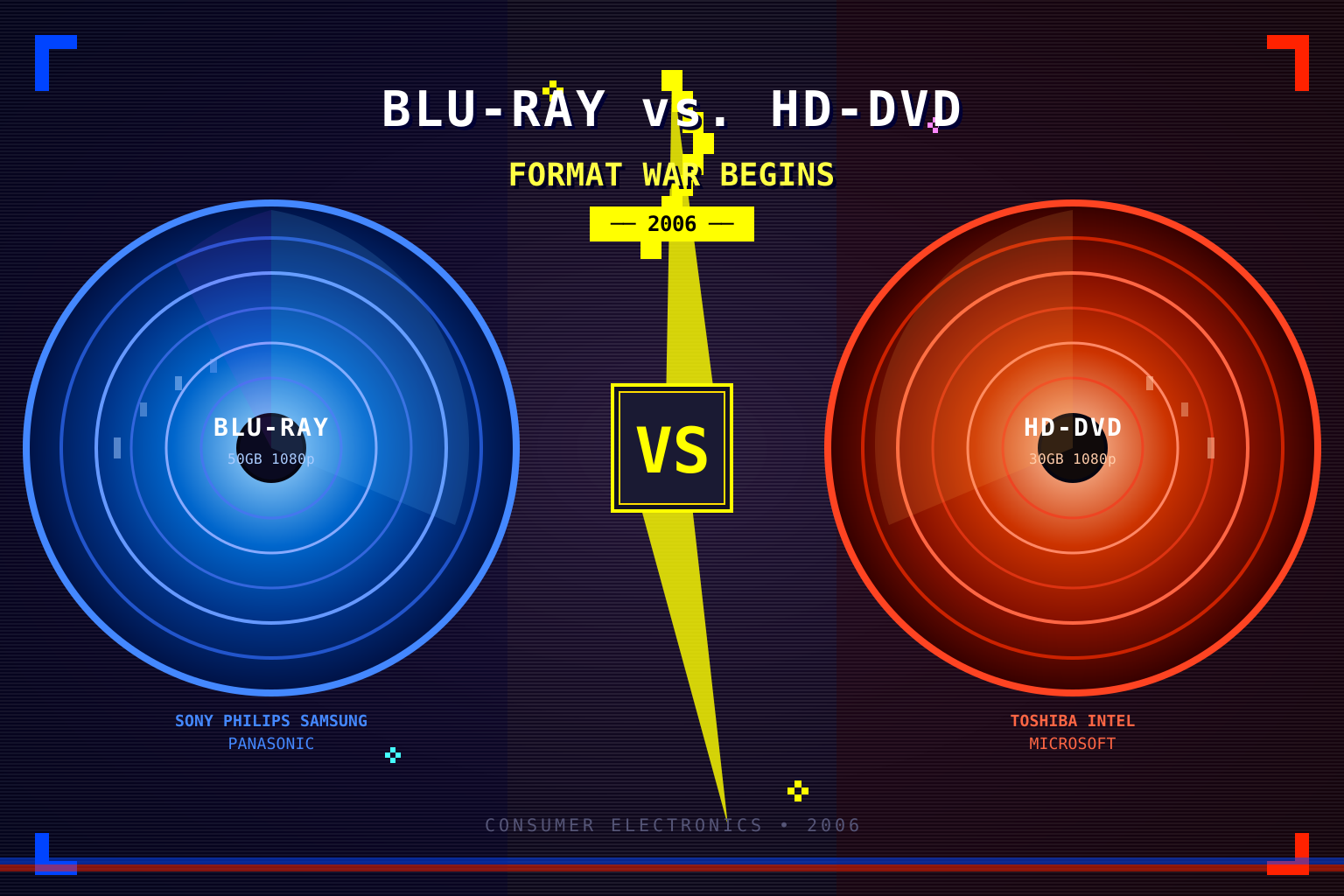
Throughout 2006, the consumer electronics industry split into two rival camps locked in a battle over the next-generation high-definition optical media standard. Blu-ray (backed by Sony, Philips, Samsung, Panasonic, and others under the Blu-ray Disc Association) and HD-DVD (championed by Toshiba, Intel, Microsoft, and the DVD Forum) competed for market dominance with mutually incompatible formats and dramatically different technological approaches.
The format war defined 2006 consumer electronics: hardware manufacturers, studios, and retailers faced an impossible choice between incompatible technologies, while consumers postponed purchasing decisions. By year’s end, neither camp had achieved clear dominance, and the holiday shopping season proved disappointing for both formats. The stalemate continued until February 2008, when Toshiba withdrew HD-DVD support, conceding victory to Blu-ray.
Background: Why Two Standards?
The format war emerged from competing interests within the optical media industry. Standard-definition DVD, launched commercially in 1996, had unified the industry around a single format backed by a consortium of electronics manufacturers. As HDTV adoption grew through the early 2000s, consumer electronics companies began developing next-generation formats capable of delivering 1080p (full HD) content — but two distinct technical camps emerged with incompatible visions.
The DVD Forum — the body governing standard DVD — backed HD-DVD as a straightforward evolution of existing DVD technology. Sony and its partners, fearing loss of control over the standard, separately developed Blu-ray with superior capacity but more complex manufacturing requirements. Both formats used blue-violet laser diodes (~405 nm wavelength) — shorter than the red lasers in standard DVD players — enabling finer data pits and dramatically higher storage density.
Technology Comparison
Blu-ray (BDA — Blu-ray Disc Association)
| Specification | Detail |
|---|---|
| Single-layer capacity | 25 GB |
| Dual-layer capacity | 50 GB |
| Laser wavelength | ~405 nm (blue-violet) |
| Data transfer rate | 36 Mbps (1×) |
| Cover layer thickness | 0.1 mm |
| Lead backers | Sony, Philips, Samsung, Panasonic, Pioneer, Sharp |
Advantages: Higher capacity (critical for uncompressed 1080p video and lossless audio tracks), greater longevity projections, Sony’s vertical integration of studios and hardware.
Disadvantages: More complex disc manufacturing with thinner cover layers, higher initial player manufacturing costs, slower to market than HD-DVD.
HD-DVD (DVD Forum)
| Specification | Detail |
|---|---|
| Single-layer capacity | 15 GB |
| Dual-layer capacity | 30 GB |
| Laser wavelength | ~405 nm (blue-violet) |
| Data transfer rate | 36 Mbps |
| Cover layer thickness | 0.6 mm (same as DVD) |
| Lead backers | Toshiba, NEC, Intel, Microsoft, Sanyo |
Advantages: Simpler manufacturing (backward-compatible drive mechanisms and disc geometry), faster time-to-market, lower initial player prices.
Disadvantages: Lower storage capacity, concerns about long-term competitive position against higher-capacity Blu-ray.
2006 Timeline of Key Events
| Date | Event |
|---|---|
| March 31, 2006 | HD-DVD launches in Japan with Toshiba players; first U.S. HD-DVD movies ship |
| April 18, 2006 | Toshiba HD-A1 ($499) launches in the U.S. — first HD-DVD player available at retail |
| June 20, 2006 | First Blu-ray titles released (Sony Pictures): 50 First Dates, The Fifth Element, Hitch |
| June 25, 2006 | Samsung BD-P1000 ($999) ships — the first Blu-ray player available in the U.S. |
| August 2006 | Paramount and DreamWorks Animation announce exclusive HD-DVD support, shifting the studio balance |
| October 2006 | Google acquires YouTube (see 2006 M&A Wave); streaming emerges as a future alternative to physical media |
| November 11, 2006 | PlayStation 3 launches in Japan with a Blu-ray drive included; the North American launch follows November 17, selling roughly 197,000 units in its first days |
| December 2006 | Holiday season disappoints both camps; standalone player sales stay low; the format war is left unresolved |
2006 Market Dynamics
Player Pricing and Availability
The price gap between the two platforms was significant and strategically important:
- Toshiba HD-A1 (HD-DVD): $499 at launch (April 2006); reduced toward year-end
- Samsung BD-P1000 (Blu-ray): $999 at launch (June 25, 2006) — the first standalone Blu-ray player in the U.S.
- PlayStation 3 (Blu-ray): $499–$599 (November 2006); the most affordable Blu-ray player available and included built-in HD gaming
The PS3 proved a decisive weapon for Blu-ray: Sony sold through roughly 3.6 million PS3 units worldwide by the end of March 2007, each carrying a Blu-ray drive. This gave Blu-ray an installed-base advantage in living rooms that HD-DVD’s standalone player sales could not match.
Studio Alignment in 2006
| Studio | Format Support |
|---|---|
| Sony Pictures | Blu-ray exclusive |
| Disney / Buena Vista | Blu-ray exclusive |
| 20th Century Fox | Blu-ray exclusive |
| Universal Pictures | HD-DVD exclusive |
| Paramount Pictures | Both (then HD-DVD exclusive from Aug. 2006) |
| DreamWorks Animation | HD-DVD exclusive (Aug. 2006 announcement) |
| Warner Bros. | Both formats |
| Weinstein Company | Both formats |
The August 2006 defection of Paramount and DreamWorks Animation to HD-DVD exclusivity (reportedly involving payments from the HD-DVD camp) briefly appeared to swing the war toward HD-DVD. However, Warner Bros.’ dual-format stance and Fox’s Blu-ray exclusivity kept the balance contested.
Consumer Confusion and Market Paralysis
Industry surveys through late 2006 found that format uncertainty was a leading reason consumers deferred buying a high-definition player. Retailers including Best Buy, Circuit City, and Walmart stocked both formats while awaiting a decisive market signal. Early adopters faced the prospect of backing a losing format and ending up with a library of obsolete discs — an outcome that had befallen Betamax buyers in the 1980s.
The PlayStation 3 Factor
Sony’s decision to embed a Blu-ray drive in every PlayStation 3 represented a high-stakes gamble that proved decisive. Unlike standalone player sales, PS3 adoption was driven by gaming demand independent of the format war, yet each unit added a Blu-ray player to a household.
Microsoft countered by selling an optional HD-DVD add-on drive for the Xbox 360 ($199), positioning it as a value option without committing the console’s core gaming proposition to the format. This asymmetry — Blu-ray embedded versus HD-DVD optional — proved critical: Xbox 360 HD-DVD drives were eventually sold off at steep discounts after HD-DVD’s collapse.
Historical Significance
The 2006 format war carried implications beyond consumer electronics:
-
The decline of optical media — neither camp recognized that streaming technologies maturing through 2007–2012 would eventually render physical optical media largely obsolete for mainstream consumers. Netflix’s streaming service launched in 2007; by the mid-2010s, streaming had overtaken physical disc sales as the largest share of U.S. home-entertainment revenue.
-
Sony’s strategic vindication — Sony had previously backed the losing format in the VCR wars (Betamax, 1970s–1980s). The Blu-ray victory represented a rare reversal of that pattern, achieved through vertical integration of hardware, studios, and specifications.
-
Standards competition costs — the two-year format war likely depressed high-definition media adoption during the 2006–2008 period, as consumers deferred purchases. Standalone player sales for both formats combined remained modest through 2006 — well below early industry projections — with Blu-ray’s installed base sustained largely by bundled PlayStation 3 drives rather than dedicated players.
-
The streaming preview — the mainstreaming of online video with YouTube (acquired by Google in October 2006 for $1.65 billion), followed by the 2007 launch of Netflix’s streaming service, foreshadowed the format war’s ultimate irrelevance.
The War’s Resolution
The format war definitively ended in February 2008. Warner Bros. announced exclusive Blu-ray support in January 2008, prompting Toshiba to withdraw HD-DVD entirely on February 19, 2008. The sequence:
- January 4, 2008: Warner Bros. announces Blu-ray exclusivity, effective June 2008
- January 7–11, 2008: CES 2008 HD-DVD booth opens without major studio support
- February 19, 2008: Toshiba formally announces discontinuation of HD-DVD hardware
- April 2008: Paramount and DreamWorks return to Blu-ray support; HD-DVD disc production ends
Blu-ray dominated physical optical media from 2008 onward, but the victory was short-lived as a mass-market proposition. By the mid-2010s, streaming had overtaken physical formats as the largest share of U.S. home-entertainment revenue, and physical media (Blu-ray and DVD combined) continued a steady decline.
Sources
- Wikipedia: Blu-ray, HD-DVD, Format war
- Blu-ray Disc Association technical specifications and press releases (2006)
- DVD Forum / HD-DVD Promotional Group announcements (2006)
- iSuppli: High-Definition Optical Drive Market Report (2006)
- PC Magazine, CNET, Engadget technology reviews and analysis (2006)
- Consumer Reports 2006 high-definition media coverage
- Sony Corporation FY2006 Annual Report (PS3 launch data)
Related
- 2006 Corporate M&A Wave — Google’s $1.65 billion YouTube acquisition in October 2006 signaled streaming’s rise as an alternative to physical media
- MySpace’s 2006 Peak — the same year’s explosion of user-generated digital content reinforced the shift toward online media consumption