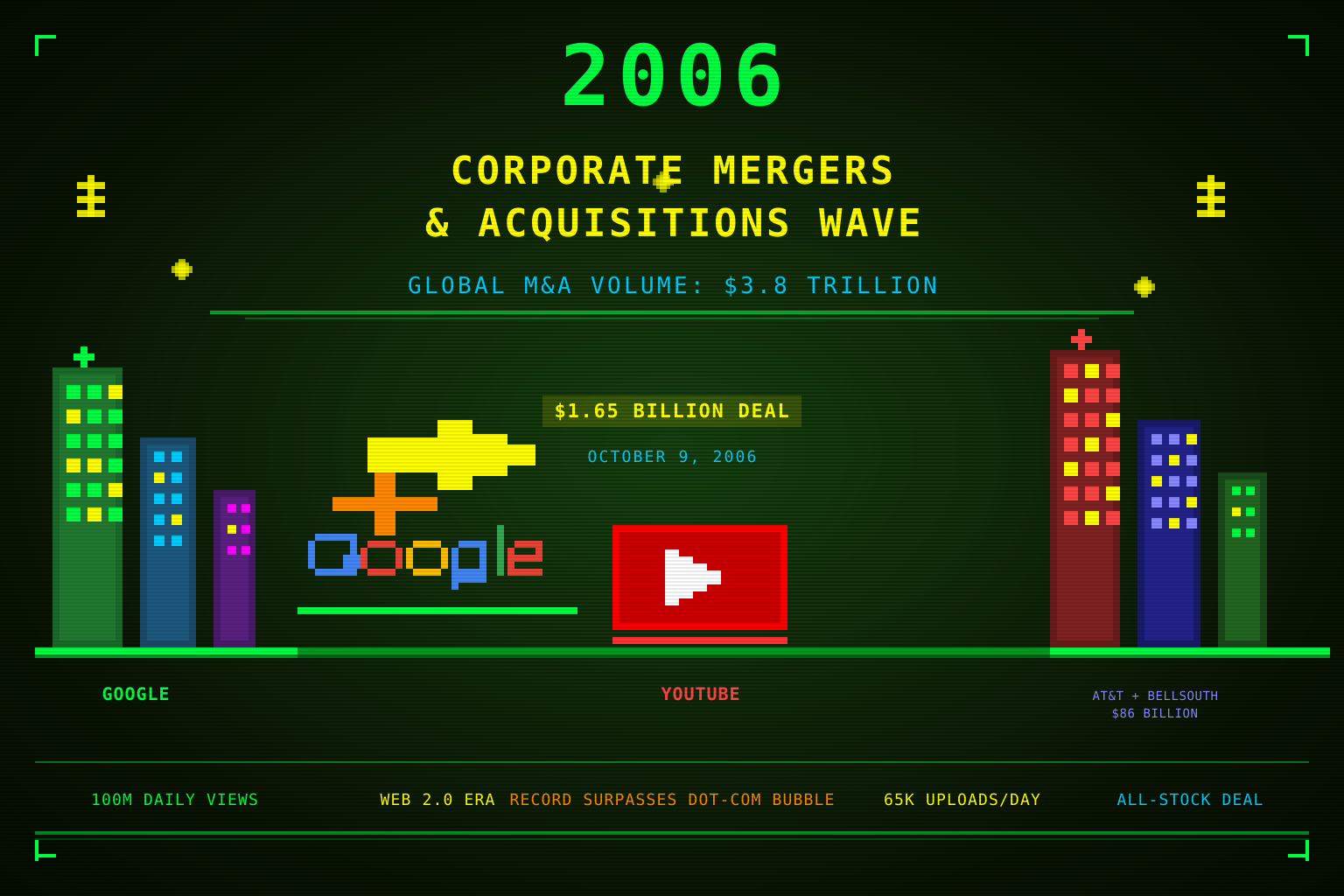
2006 Corporate Mergers and Acquisitions Wave
Summary
2006 witnessed a historic surge in corporate mergers and acquisitions, driven by investor confidence in technology, digital media, and emerging web platforms. According to Thomson Reuters, global M&A volume reached approximately $3.8 trillion in 2006, surpassing the previous record set during the dot-com bubble of 2000 ($3.5 trillion). Technology and media sectors led the wave, with deals validated by proven advertising models, rising internet penetration, and historically low interest rates that made debt-financed acquisition cheap.
The headline deal — Google’s $1.65 billion acquisition of YouTube on October 9, 2006 — became the defining transaction of the Web 2.0 era, signaling that user-generated content platforms were worth billions even without clear profitability. Alongside it, Vivendi’s €1.63 billion acquisition of BMG Music Publishing, AT&T’s acquisition of BellSouth for $86 billion, and a wave of private equity buyouts reshaped the corporate landscape.
Major Deals of 2006
Technology & Digital Media
Google Acquires YouTube — $1.65 Billion (October 9, 2006)
The most symbolically significant deal of the year. YouTube had launched in February 2005 and grown to over 100 million video views per day by mid-2006, with roughly 65,000 new videos uploaded daily. Despite generating negligible revenue (the company was 20 months old and unprofitable), Google paid $1.65 billion in an all-stock deal, betting on the platform’s audience scale and advertising potential.
Key figures: YouTube co-founders Chad Hurley, Steve Chen, and Jawed Karim collectively held equity that converted to Google stock. The deal closed on November 13, 2006 — about five weeks after the October 9 announcement, fast for a transaction of this size. YouTube went on to become one of the most valuable acquisitions in corporate history.
The acquisition paralleled the Blu-ray vs. HD-DVD format war: YouTube’s mainstreaming of online video in 2006 foreshadowed that streaming, not physical media, would eventually dominate home entertainment.
eBay / Skype Integration — $2.6 Billion (originally announced September 2005)
eBay’s acquisition of Skype, announced in September 2005 for $2.6 billion (plus up to $1.5 billion in performance payments), was still being integrated through 2006. CEO Meg Whitman envisioned Skype enabling buyer-seller voice communication inside eBay transactions. The thesis never materialized; eBay sold a 65% stake in Skype to a private equity group in 2009 for $1.9 billion — effectively writing down billions in value — before Skype was eventually acquired by Microsoft in 2011 for $8.5 billion.
News Corporation + MySpace Integration
News Corporation’s $580 million acquisition of MySpace parent Intermix Media (July 2005) was integrated through 2006, the year MySpace reached its traffic peak. Rupert Murdoch positioned MySpace as the anchor of a digital media strategy; Fox Interactive Media (the operating unit) signed a ~$900 million search-advertising deal with Google, announced August 7, 2006, guaranteeing minimum revenue-share payments through 2010. The deal reflected the market’s valuation of MySpace’s 100+ million users.
Telecommunications
AT&T Acquires BellSouth — $86 Billion (announced March 5, 2006)
The largest deal of 2006 by transaction value. AT&T (itself reconstituted from SBC Communications’ 2005 acquisition of AT&T Corp.) purchased BellSouth Corporation for approximately $86 billion in stock. The deal reunited major pieces of the original AT&T (“Ma Bell”) monopoly broken up in 1984 and gave AT&T full ownership of Cingular Wireless (the largest U.S. mobile carrier at the time). Regulators approved the deal in December 2006 after requiring net-neutrality commitments. The combined entity was the largest U.S. telecommunications company.
Sprint Nextel Integration (2005–2006)
Sprint’s $35 billion acquisition of Nextel Communications, completed August 2005, was still integrating through 2006 — an integration widely viewed as troubled due to incompatible network technologies (CDMA vs. iDEN). By 2008, Sprint had written down over $29.7 billion in goodwill impairment from the deal.
Media & Music Publishing
Vivendi Acquires BMG Music Publishing — €1.63 Billion (~$2.09 billion, September 2006)
Bertelsmann’s BMG Music Publishing division, sold to Vivendi’s Universal Music Group, made Universal Music Publishing Group the world’s largest music publisher by catalog size. The deal added BMG’s roster (including catalogs of Bob Dylan, Rolling Stones, Coldplay portions, and thousands of others) to Universal’s existing holdings. The transaction reflected the growing value of music licensing as digital distribution, ringtone revenue, and sync licensing (music in TV/film) expanded.
Viacom Restructures — January 2006
Viacom split into two publicly traded companies effective January 3, 2006: Viacom (retaining MTV Networks, BET, Paramount Pictures) and CBS Corporation (CBS Television, Showtime, Simon & Schuster, outdoor advertising). The split reflected investor frustration with the 1999 merger of Viacom and CBS and marked an early example of media conglomerates unwinding the “bigger is better” acquisitions of the late 1990s.
Finance & Private Equity
Record Private Equity Activity
2006 marked the peak of the leveraged buyout (LBO) boom of the mid-2000s:
- KKR, Blackstone, and Carlyle raised mega-funds exceeding $10 billion each
- The $33 billion acquisition of HCA (hospital operator) by a KKR-led consortium — announced July 2006 and completed that November, billed as the largest LBO to date, surpassing RJR Nabisco (1989)
- Freescale Semiconductor was acquired by a Blackstone-led group for $17.6 billion (September 2006), then the largest-ever technology LBO
- Global private equity deal volume exceeded $700 billion in 2006, according to Dealogic — roughly double the 2004 figure
These deals were enabled by cheap credit: the U.S. Federal Reserve federal funds rate stood at 5.25% (high for the era but below pre-2000 norms), and credit markets offered abundant leveraged loan and high-yield bond financing at tight spreads.
Market Context: Post-Dot-Com Recovery
The 2006 M&A wave represented the market’s full recovery from the 2000–2002 dot-com crash. Unlike the 2000 era — marked by valuations untethered to revenue and payment in inflated equity — 2006’s deals were driven by:
- Proven business models — Google’s advertising system, YouTube’s traffic, MySpace’s user base, AT&T’s telephony cash flow
- Strategic integration logic — acquirers sought operational synergies, not just trophy assets
- Confidence in digital media — advertisers, audiences, and investors had validated the web as a mainstream medium
- Cheap debt financing — historically tight credit spreads made leveraged deals inexpensive relative to projected cash flows
- Record S&P 500 performance — the index rose approximately 13.6% in 2006, providing strong currency for stock-based deals
Macroeconomic Indicators (2006)
| Indicator | 2006 Value |
|---|---|
| U.S. GDP growth | 2.7% |
| Federal funds rate (end of year) | 5.25% |
| U.S. corporate profits (after tax) | +14% YoY |
| Dow Jones Industrial Average (year-end) | ~12,463 (record high) |
| Global M&A volume | ~$3.8 trillion (Thomson Reuters) |
| U.S. 10-year Treasury yield | ~4.7% |
Significance
The 2006 M&A wave marked several structural shifts:
- Validation of the Web 2.0 model — venture-backed startups and digital platforms were worth billions even without profitability, validated by Google/YouTube and the MySpace precedent
- Consolidation of tech giants — Google, Microsoft, and Yahoo! competed aggressively for strategic assets; Google’s YouTube acquisition established a pattern (buy-at-scale rather than build) that continues today
- Birth of the modern media stack — deals combined content (YouTube, MySpace), infrastructure (nascent AWS, Akamai), and distribution (Google’s search monopoly, AT&T’s pipes)
- Unrecognized warning signs — the wave’s scale, the private equity leverage, and the loose credit conditions that enabled it presaged the 2008 financial crisis; housing market stress was already building during the same period, masked by record corporate profits and equity market performance
The acquisitions of 2006 created durable elements of today’s tech landscape: Google’s video and advertising dominance, Microsoft’s eventual acquisition of Skype, and the principle — established by YouTube’s sale — that platforms monetize user-generated content at scale regardless of near-term profitability.
Sources
- Thomson Reuters: 2006 Global M&A Review (January 2007)
- Dealogic: 2006 Private Equity Report
- Wikipedia: List of largest mergers and acquisitions, YouTube history
- U.S. Federal Reserve: Federal funds rate historical data
- Bureau of Economic Analysis: U.S. GDP 2006 annual estimates
- Google Inc. SEC Form 8-K (YouTube acquisition), October 9, 2006
- Wall Street Journal: 2006 M&A coverage and year-end retrospectives
- Financial Times: “Record M&A Year Driven by Cheap Money and Tech Confidence” (December 2006)
- Forbes: AT&T-BellSouth deal analysis, March–December 2006
Related
- MySpace’s 2006 Peak — News Corporation’s $580 million MySpace acquisition was a precursor and parallel to the YouTube deal
- Vivendi acquires BMG Music Publishing — one of the year’s major media deals, detailed in its own article
- Blu-ray vs. HD-DVD Format War — Sony’s Blu-ray strategy depended on vertical integration of hardware and studio content built through prior M&A activity