MySpace’s 2006 Peak: The Pre-Facebook Era of Social Networking
Summary
In 2006, MySpace reached its zenith as the dominant social networking platform in the United States and globally, surpassing Google in unique visitors and establishing itself as the cultural center of user-generated web content and emerging independent music. Founded by Tom Anderson and Chris DeWolfe in August 2003, MySpace passed to News Corporation in July 2005 when the media conglomerate acquired its parent company, Intermix Media, for $580 million. By early 2006 MySpace was the world’s largest social network — a position it held until Facebook’s global expansion overtook it in 2008.
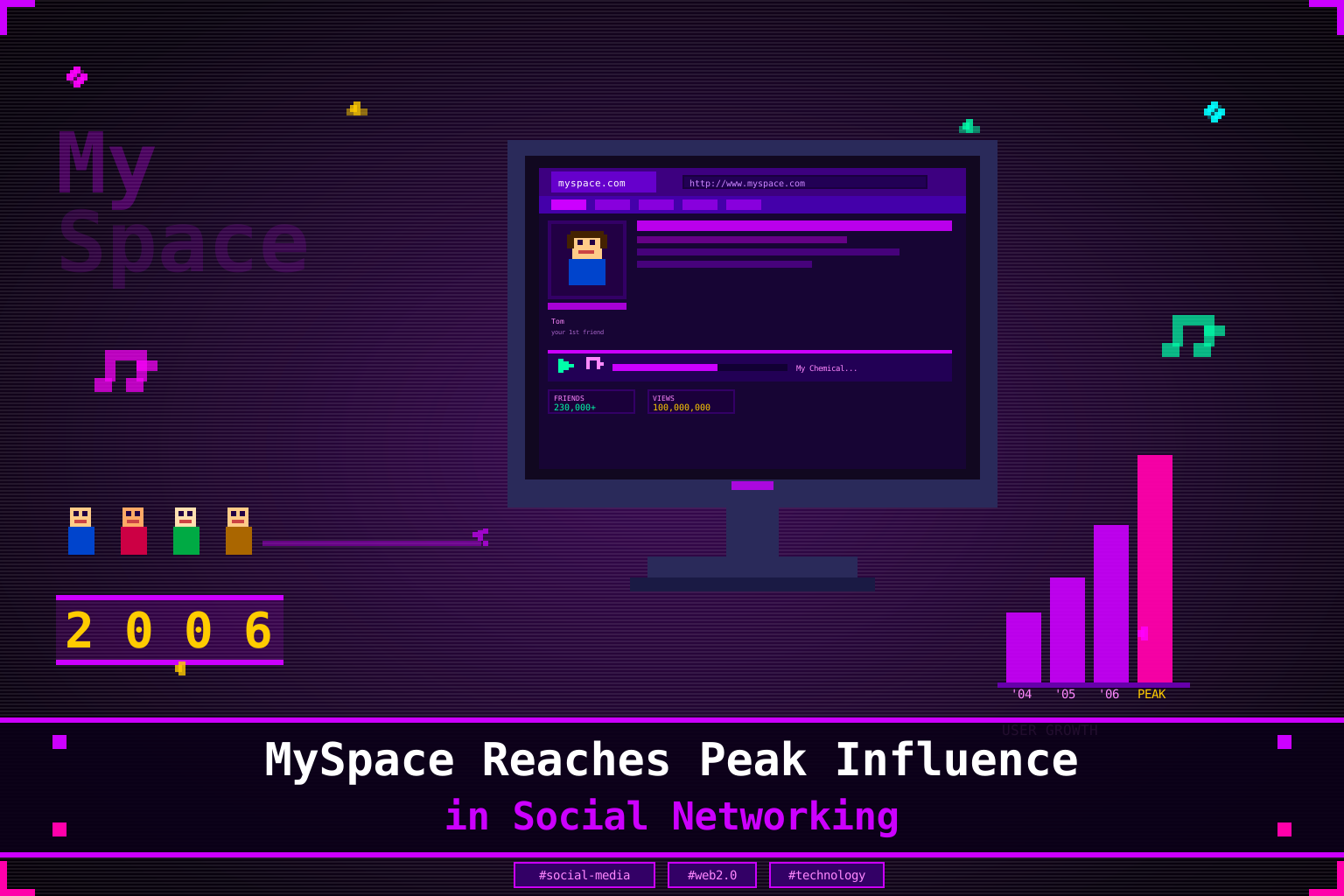
By mid-2006, MySpace was registering approximately 230,000 new users per day and crossed 100 million total accounts in August 2006. According to Hitwise, MySpace became the most-visited website in the United States for the week ending July 8, 2006, drawing roughly 4.5% of all U.S. internet visits — a milestone widely reported at the time and read as validation of News Corporation’s acquisition of MySpace’s parent company the prior year.
Timeline of Key 2006 Milestones
| Date | Event |
|---|---|
| January 2006 | MySpace crosses 50 million registered users |
| March 2006 | Platform launches MySpace Music, formalizing the music-discovery feature |
| July 2006 | Becomes the most-visited website in the U.S. (Hitwise, week ending July 8) |
| August 2006 | Crosses 100 million registered accounts; Fox Interactive Media signs a ~$900 million search-advertising deal with Google (announced August 7) |
| September 2006 | Facebook opens registration to the general public, beginning its challenge to MySpace |
| October 2006 | Google’s acquisition of YouTube (see 2006 M&A Wave) intensifies competition for digital advertising budgets |
| December 2006 | MySpace remains the dominant U.S. social network heading into 2007, though Facebook’s growth accelerates |
Key Achievements of 2006
Market Dominance
- MySpace ranked as the most-visited U.S. website by internet visits in July 2006, as measured by Hitwise
- The ~$900 million search-advertising agreement with Google, announced in August 2006 through Fox Interactive Media, guaranteed minimum ad revenue and reflected the platform’s massive traffic at the time
- News Corporation projected MySpace as the anchor of its digital-media strategy, positioning it as the company’s flagship internet property
- At its peak in mid-2006, MySpace drew approximately 4.5% of all U.S. internet visits (Hitwise)
Cultural Significance
MySpace defined the social web for the mid-2000s generation, serving as:
- Customizable personal profiles — users could customize profiles with raw HTML, CSS, and embedded media, including background music via embedded media players. Facebook’s forthcoming model would deliberately strip this freedom in favor of uniformity.
- Music discovery and artist platform — independent musicians, bands, and unsigned artists used MySpace pages to reach audiences directly. Acts such as Lily Allen and (through fan-driven demo-sharing) the Arctic Monkeys built early followings associated with MySpace before or around their mainstream label deals, and established artists including Nine Inch Nails used the platform to distribute free tracks.
- Youth culture hub — MySpace became synonymous with teen and young-adult online identity, displacing earlier platforms like Xanga and Friendster. By 2006 it was embedded in high-school and college social life as the primary means of maintaining friendships online.
- Early influencer culture — profiles with millions of “friends” (particularly musicians and celebrities) prefigured the influencer economy that would later dominate Instagram and TikTok.
Monetization Challenges
Despite massive traffic, MySpace’s advertising model struggled to convert reach into sustainable revenue for several structural reasons:
- The platform’s customization freedom led to aesthetic chaos — garish color schemes, auto-playing music tracks, and animated GIF backgrounds made advertising placement visually inconsistent and drove up page-load times
- News Corporation’s content-heavy integration strategy (attempting to fold in news, music, and video verticals from Fox properties) conflicted with MySpace’s peer-to-peer community DNA
- User data utilization remained primitive compared to Facebook’s later profile-based targeting; MySpace largely sold contextual display ads
- Spam accounts, fake celebrity profiles, and early-form bots degraded user experience without any effective moderation infrastructure
Historical Context: Pre-Facebook Era
In January 2006, Facebook was still a university-restricted network requiring an .edu email address. It did not open to the general public until September 26, 2006 — the same year MySpace was at its height. The platforms represented fundamentally different philosophies:
| Dimension | MySpace (2006) | Facebook (2006) |
|---|---|---|
| Profile style | Fully customizable HTML/CSS | Standardized templates |
| User base | Open to all | .edu email required (until Sept.) |
| Content | Music, video, blogs, friends | Status updates, photos, wall |
| Business model | Display advertising | Not yet monetized at scale |
| Founder involvement | DeWolfe/Anderson; News Corp. oversight | Zuckerberg in full control |
The two platforms’ contrasting trajectories would play out over the following two years: Facebook’s structured, algorithm-ready data model proved far more tractable for targeted advertising than MySpace’s chaos.
MySpace’s Influence on the Music Industry
One of MySpace’s most lasting contributions was the democratization of music discovery. Before streaming platforms matured, MySpace Music served as a de facto distribution channel:
- Bands could upload songs for free streaming; listeners could embed those players in their own profiles
- Record labels increasingly used MySpace profile “friend counts” and play totals as proxy metrics for signing decisions
- The Arctic Monkeys became the era’s emblematic case of online, fan-driven buzz: their rise is widely associated with demo-sharing and MySpace, though the band has noted that fans, rather than the group itself, ran its early MySpace presence
- Lily Allen posted rough demos to MySpace in 2005; the following she built there is credited with helping secure her Regal Recordings deal ahead of the 2006 release of Alright, Still
This model directly prefigured Spotify’s artist-page approach, SoundCloud’s independent distribution, and Bandcamp’s direct-to-fan model.
Decline: 2007–2011
MySpace’s decline unfolded in stages after its 2006 peak:
- 2007 — Facebook’s open platform launch attracted developers and third-party apps (eventually 25,000+). MySpace’s equivalent developer ecosystem never coalesced.
- 2008 — Facebook surpassed MySpace in global unique monthly visitors (April 2008 per comScore).
- 2009 — News Corporation began writing down MySpace’s value. User engagement metrics deteriorated as spam and abandoned profiles degraded the experience.
- 2011 — News Corporation sold MySpace to Specific Media for $35 million — less than 7% of the 2005 acquisition price. The transaction stands as one of the most dramatic value destructions in media history.
Significance
MySpace’s 2006 peak represents a pivotal moment in web history — the last era of the “open web” before Facebook’s standardized, closed ecosystem dominated social media. The platform pioneered:
- User-generated profile pages at scale before any real precedent existed
- Direct artist-to-fan music distribution channels, prefiguring Spotify and SoundCloud
- Chronological friend feeds as the basis for what social media became
- Embedding culture — the norm of embedding external media (YouTube clips, music players) into pages
MySpace’s peak coincided with the 2006 corporate M&A wave, both reflecting broader market confidence in Web 2.0 platforms. Google’s October 2006 acquisition of YouTube for $1.65 billion rested on similar logic — the belief that user-generated-content platforms with large audiences carried strategic value ahead of proven profitability — the same premise behind News Corporation’s $580 million purchase of MySpace’s parent a year earlier.
Sources
- Wikipedia: MySpace, History of MySpace
- comScore Media Metrix monthly U.S. traffic reports, July 2006
- Hitwise U.S. internet usage statistics, 2006
- News Corporation Annual Reports 2005–2006 (Fox Interactive Media division)
- Time Magazine: “MySpace Nation” (July 17, 2006)
- Wired Magazine: “The Rise and Inglorious Fall of Myspace” (January 2011)
- Business Insider: “The Rise And Fall Of MySpace” retrospective (June 2011)
Related
- Facebook’s News Feed and Open Registration — the September 2006 changes that positioned Facebook to overtake MySpace
- 2006 Corporate M&A Wave — News Corporation’s MySpace acquisition amid the year’s technology-deal surge
- Blu-ray vs. HD-DVD Format War — the same year’s contest over how media would be distributed and consumed