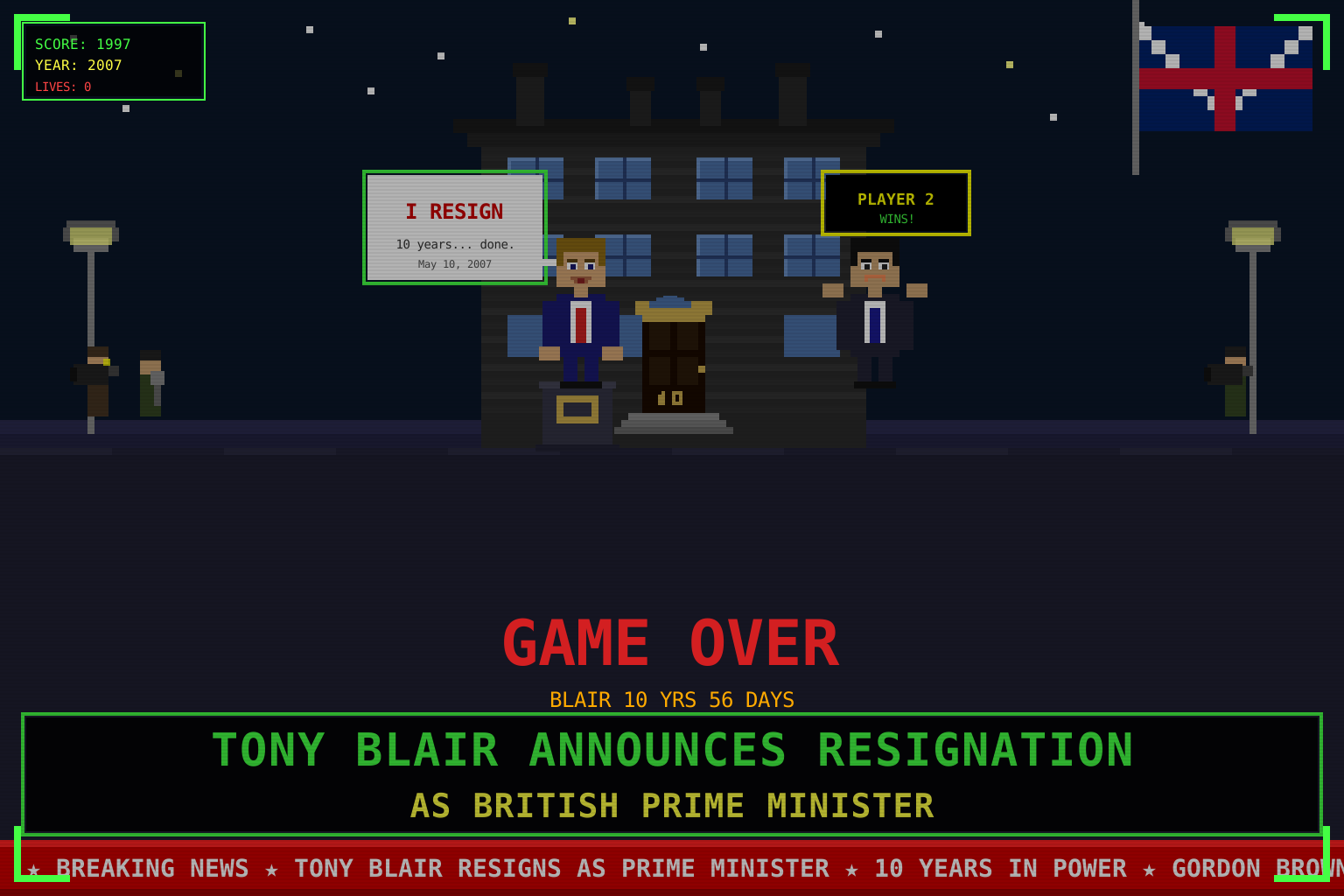
Key figures: Tony Blair (outgoing Prime Minister), Gordon Brown (Chancellor and successor), Queen Elizabeth II, David Cameron (Conservative opposition leader)
Summary
On May 10, 2007, Tony Blair announced his intention to resign as British Prime Minister, ending one of the longest and most consequential tenures in modern British political history. After 10 years and 56 days as Prime Minister (May 2, 1997 – June 27, 2007) and nearly 13 years as Labour Party leader, Blair declared he would step down by the end of June to allow an orderly transition to Gordon Brown, his Chancellor of the Exchequer. His announcement came amid declining public support following the Iraq War, domestic pressures over public-service reform, and internal Labour demands for a departure date. Blair’s exit marked the end of an era defined by “New Labour,” constitutional modernization, and Britain’s assertive post-Cold War foreign policy.
The New Labour Project (1994–2007)
Blair became Labour Party leader in July 1994 following the sudden death of John Smith, inheriting a party that had lost four consecutive general elections (1979, 1983, 1987, 1992). He and his ally Gordon Brown rebranded the party as “New Labour” — modelled partly on Bill Clinton’s “New Democrats” — abandoning the old Clause IV of the party constitution (which had committed Labour to the common ownership of the means of production) at a special conference on April 29, 1995. The symbolic break signalled that New Labour would govern from the centre, embracing market economics while expanding public services.
The 1997 general election delivered Labour its largest parliamentary majority to that point: 418 seats (out of 659) and a majority of 179. Blair was 43 years old on taking office, and his telegenic style contrasted with the perceived drabness of his predecessor, John Major. The government moved quickly in its first year, granting operational independence to the Bank of England (May 1997), signing the Good Friday Agreement for Northern Ireland (April 10, 1998), and passing the Human Rights Act (royal assent November 9, 1998). Blair’s domestic agenda blended increased investment in the National Health Service and state education with market-friendly reforms including Private Finance Initiative contracts and Academy schools.
Labour’s 2001 re-election confirmed New Labour’s dominance: the party won 412 seats and a majority of 167, the first time Labour had won two consecutive full terms in government. The 2003 invasion of Iraq would, however, prove the turning point of Blair’s premiership.
The Iraq War and Political Decline
The March 20, 2003 invasion of Iraq became the defining crisis of Blair’s premiership. Despite a February 15, 2003 protest march in London — one of the largest in British history, with crowd estimates ranging widely into the hundreds of thousands and beyond — Blair committed British forces alongside the American-led coalition. The stated justification centred on Iraq’s alleged weapons of mass destruction, set out in a September 2002 government dossier; Andrew Gilligan’s May 2003 BBC report alleging the dossier had been “sexed up” triggered the Hutton Inquiry.
The Hutton Report (January 28, 2004) largely exonerated the government while heavily criticizing the BBC, leading to the resignations of BBC director-general Greg Dyke and chairman Gavyn Davies. The parallel Butler Review (July 14, 2004) concluded that intelligence on Iraqi WMD had been presented with “undue certainty.” No weapons of mass destruction were found after the invasion.
The 2005 general election, held May 5, saw Labour’s majority fall to 66 seats even as it won a third term; the party’s vote share dropped to roughly 35 percent, its lowest winning share in decades, reflecting disillusionment over Iraq. Internal pressure for Blair’s departure intensified through 2006, and on September 7, 2006 he announced he would leave within a year. Labour’s poor showing in the May 2007 local elections accelerated his decision to name a specific date.
Constitutional Reforms
Despite the Iraq shadow, Blair’s decade produced constitutional changes of historic magnitude. Devolution legislation — the Scotland Act 1998 and the Government of Wales Act 1998 — established the Scottish Parliament (first elections May 6, 1999; 129 MSPs) and the National Assembly for Wales (60 members), ending centuries of exclusive Westminster governance over Scotland and Wales.
The Good Friday Agreement (April 10, 1998), brokered alongside Irish Taoiseach Bertie Ahern with U.S. Senator George Mitchell chairing the talks, ended the major phase of the Troubles in Northern Ireland, a conflict that had claimed roughly 3,500 lives since 1969. A May 22, 1998 referendum returned 71% in favour in Northern Ireland and 94% in the Republic of Ireland.
The House of Lords Act 1999 removed the right of most hereditary peers to sit and vote, leaving 92 hereditary peers alongside life peers. The Human Rights Act 1998 incorporated the European Convention on Human Rights into domestic law, enabling UK courts to declare primary legislation incompatible with Convention rights for the first time.
Key Facts
- Announcement date: May 10, 2007 — Blair announced his intention to step down; his formal resignation and the transfer of power occurred June 27, 2007.
- Length of tenure: Blair served as Prime Minister for 10 years and 56 days — the longest-serving Labour Prime Minister in history, surpassing Clement Attlee.
- Electoral record: Blair led Labour to three consecutive general-election victories (1997, 2001, 2005), though the 2005 win came with his smallest majority, signalling eroding public support.
- Succession: Gordon Brown, elected Labour leader unopposed on June 24, 2007, took office June 27 — the first mid-Parliament change of Prime Minister since John Major succeeded Margaret Thatcher in 1990.
- Iraq War context: The 2003 invasion damaged Blair’s credibility; the Hutton Inquiry (2003–2004) examined the death of weapons scientist Dr David Kelly, and the ongoing insurgency sustained anti-war pressure for his exit.
- Constitutional legacy: Devolution to Scotland and Wales, the Good Friday Agreement, abolition of most hereditary peers, the Human Rights Act, and Bank of England independence.
The Transition to Gordon Brown
Gordon Brown had been Chancellor of the Exchequer since May 2, 1997 — the day Blair took office — and was widely regarded as Blair’s eventual successor under an informal understanding reportedly reached at the Granita restaurant in Islington in 1994. When Blair set his departure date, Labour’s succession machinery moved quickly: no serious rival emerged, and the only left-wing challenger, John McDonnell, withdrew on May 16, 2007 after failing to secure the required nominations from Labour MPs. Brown was elected Labour leader on June 24, 2007 and accepted the Queen’s invitation to form a government on June 27.
Brown inherited significant challenges: the Northern Rock bank run would follow in September 2007, the Iraq War troop surge was ongoing, and Afghanistan was deteriorating. His early standing faded after he declined to call a snap election in October 2007, widely seen as a strategic miscalculation.
Significance
Tony Blair’s resignation in May 2007 represented the conclusion of the “New Labour” project. His decade in office transformed the Labour Party from an ideologically left-wing force into a centrist governing party, implementing market-friendly economic policies while expanding public investment. His partnership first with Bill Clinton and later with George W. Bush redefined Britain’s transatlantic relationship, particularly through his support for military interventions in Kosovo (1999), Afghanistan (2001), and Iraq (2003).
The Iraq invasion proved Blair’s greatest political liability. Despite the 2005 election victory, the ongoing insurgency and the revelations of intelligence failures made Iraq a lasting burden on his premiership. By May 2007 his exit was viewed by many British observers as necessary for Labour’s electoral prospects. Blair’s departure, alongside Nicolas Sarkozy’s French election victory on May 6 and Gordon Brown’s succession on June 27, reshaped Western European leadership on the eve of the 2008 financial crisis. His legacy remained contested: supporters cited devolution, constitutional reform, and peace in Northern Ireland; critics emphasized the Iraq War and its intelligence failures.