Key figures: Nicolas Sarkozy (Union for a Popular Movement, UMP), Ségolène Royal (Socialist Party), François Bayrou (Union for French Democracy, UDF), Jacques Chirac (outgoing president)
Summary
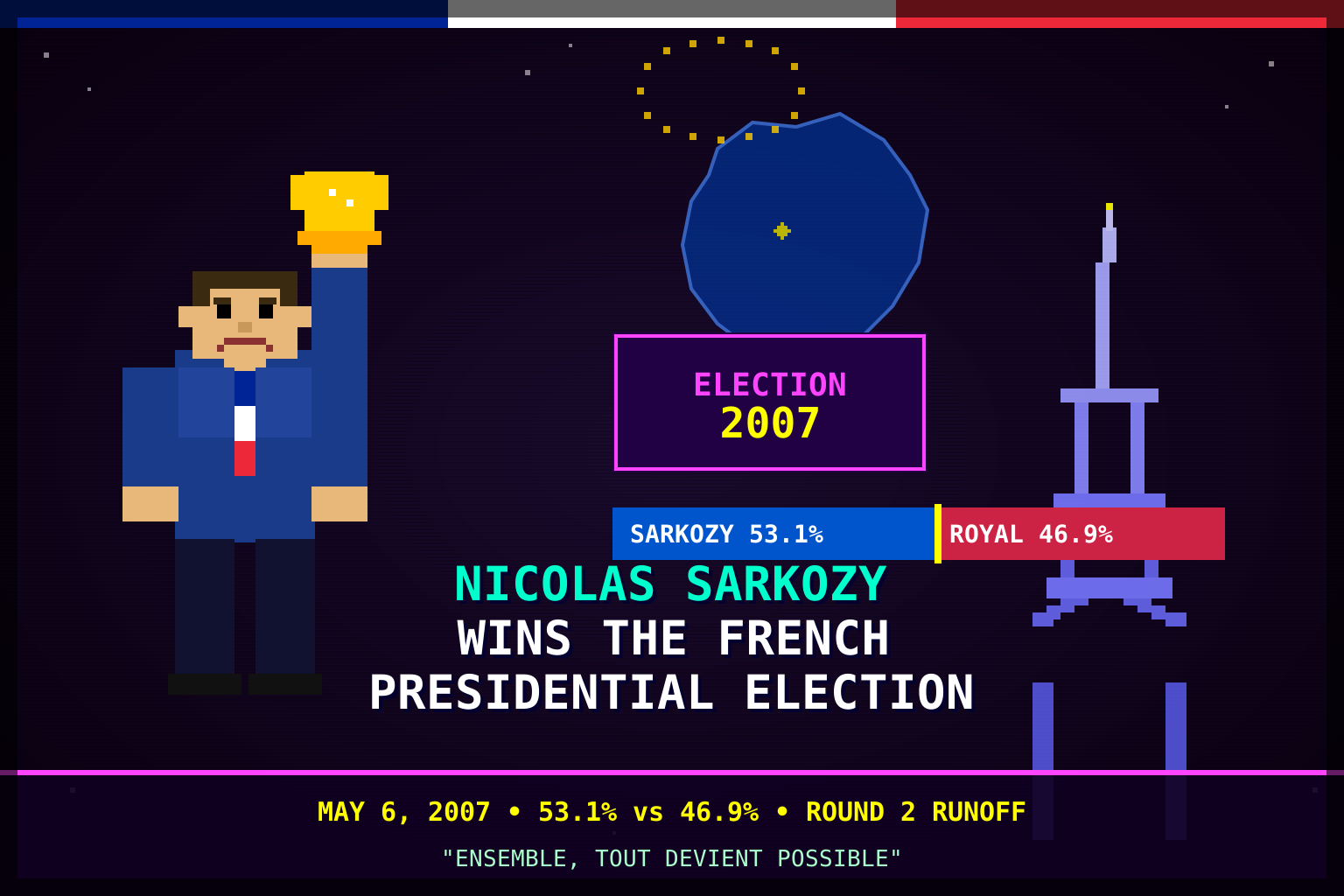
Nicolas Sarkozy won France’s 2007 presidential election in a two-round vote — the first round on April 22 and the decisive runoff on May 6, 2007 — taking 53.1% of the final vote against Socialist candidate Ségolène Royal (46.9%). His victory ended 12 years of Jacques Chirac’s presidency and marked a rightward shift in French politics. Sarkozy’s campaign centred on law-and-order, economic reform, control of immigration, and closer ties with the United States. Inaugurated on May 16, 2007 at the age of 52, he became one of Western Europe’s most prominent conservative leaders and reoriented France toward the Atlantic Alliance and away from the Gaullist tradition of scepticism toward American foreign policy.
The Candidates and Campaign
The 2007 election was notable for the breadth of its field. Sarkozy, who had served as Interior Minister under Chirac (2002–2004 and 2005–2007), ran on a platform of “rupture” with the establishment — despite being an insider — pledging to modernize France’s labour markets, tighten security, and assert national identity. His slogan was “Ensemble, tout devient possible” (“Together, everything becomes possible”).
Ségolène Royal, the Socialist Party candidate, was the first woman to win a major French party’s presidential nomination. A former minister under François Mitterrand and president of the Poitou-Charentes region, her campaign struggled to project a coherent economic programme.
François Bayrou, the centrist UDF candidate, ran a strong third-place campaign emphasizing reconciliation between left and right, taking 18.6% in the first round — his best-ever performance. He declined to endorse either finalist for the runoff.
The campaign drew intense public engagement: the sole Sarkozy–Royal televised debate, on May 2, 2007, drew an audience estimated at around 20 million viewers, among the largest for a French political debate in decades.
Key Facts
- Election dates: First-round voting occurred April 22, 2007, with the decisive runoff on May 6, 2007; Sarkozy was inaugurated as President on May 16, 2007.
- First-round results (April 22): Sarkozy led with 31.2%, followed by Royal at 25.9%, Bayrou at 18.6%, and far-right National Front candidate Jean-Marie Le Pen at 10.4% — a sharp fall from Le Pen’s shock 2002 runoff qualification; turnout reached 83.8%, the highest in decades.
- Runoff margin (May 6): Sarkozy defeated Royal 53.1% to 46.9%, a decisive margin granting a strong electoral mandate.
- Campaign themes: Control of immigration, law and order, economic dynamism, and a “rupture” with the traditional left, appealing to working- and middle-class voters frustrated by economic stagnation.
- European context: Sarkozy’s victory aligned France with other centre-right leaders such as German Chancellor Angela Merkel and positioned Paris for closer coordination with Washington.
- Gender milestone: Royal became the first woman to reach a French presidential runoff.
Sarkozy’s Early Presidency (2007–2008)
Sarkozy moved quickly to reshape French politics and foreign policy. He assembled a government that included prominent figures from the left — among them Bernard Kouchner as Foreign Minister — in a deliberate “opening” (ouverture) strategy. He created a Ministry of Immigration and National Identity, a controversial new portfolio criticized by civil-liberties groups.
He also rehabilitated France’s Atlantic relationship, culminating in France’s return to NATO’s integrated military command in 2009 — a break with the doctrine adopted under Charles de Gaulle in 1966. His first major domestic reform, targeting the special pension regimes of rail and public-sector workers, triggered mass strikes in November 2007.
The Treaty of Lisbon, signed December 13, 2007, owed much to Franco-German pressure under Sarkozy and Merkel; it revived the substance of the European Constitution that French voters had rejected in a 2005 referendum, and France ratified it by parliamentary vote rather than a new referendum.
Significance
Nicolas Sarkozy’s 2007 election marked a pivotal moment in French and European politics. His presidency signalled a move away from the Gaullist independence doctrine toward the Atlantic Alliance and a more assertive European role, symbolized by France’s fuller NATO participation and his coordination with American and German leaders during the 2008 financial crisis.
Domestically, the result reflected anxieties over immigration, identity, and France’s place in a globalizing economy. His single five-year term (2007–2012) saw significant social tension, including strikes over pension reform. His media-savvy, personalist political style influenced conservative politicians across Europe, and his 2007 campaign established templates for identity-focused, immigration-sceptical rhetoric that resurfaced throughout the 2010s.
In the broader 2007 context, Sarkozy’s victory came within weeks of Tony Blair’s resignation and Gordon Brown’s succession as UK Prime Minister, reshaping Western European leadership on the eve of the global financial crisis.