Summary
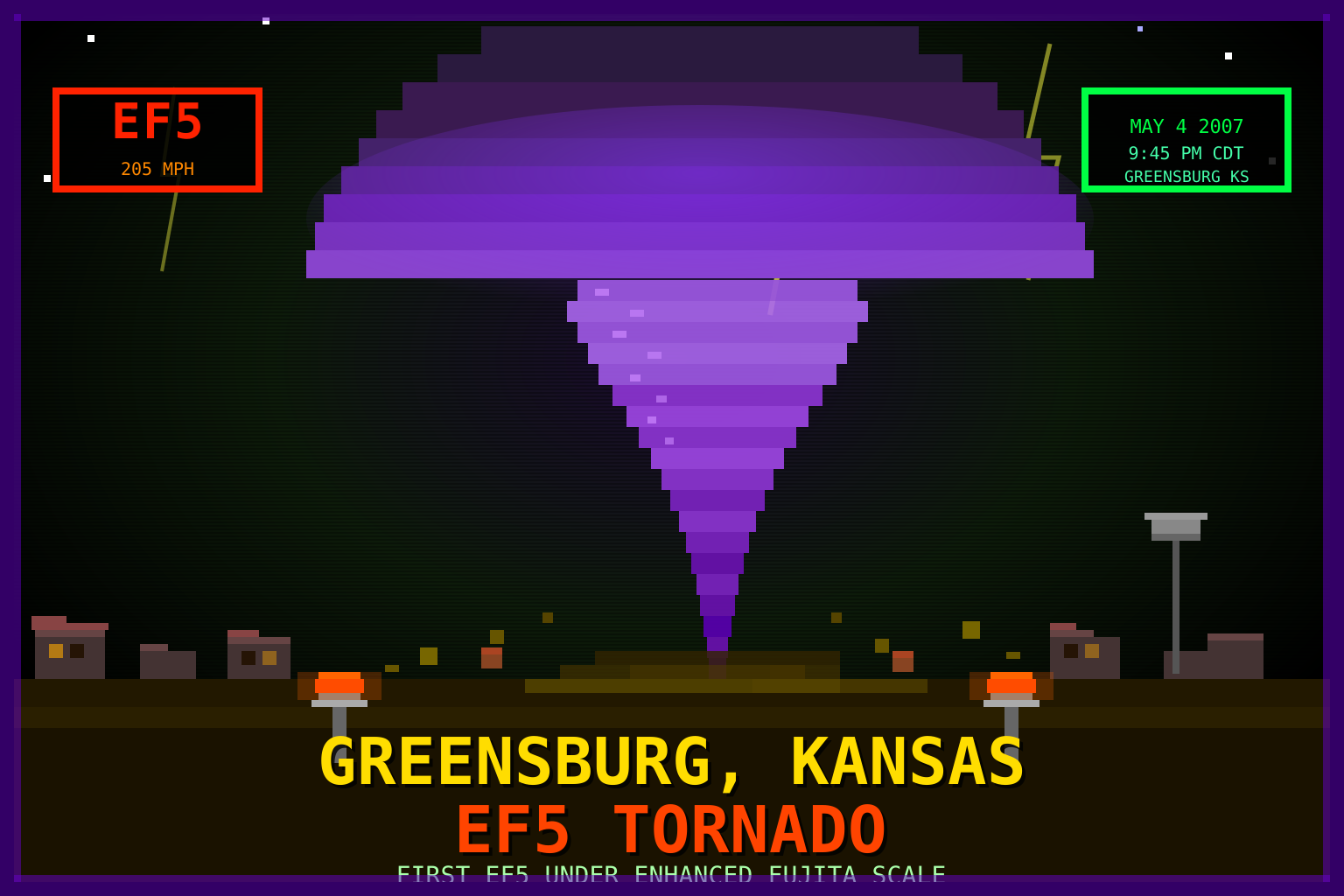
On May 4, 2007, at approximately 9:45 p.m. CDT, an EF5 tornado struck Greensburg, Kansas, with peak winds estimated at 205 mph and a path width of 1.7 miles. The tornado destroyed or severely damaged approximately 95% of Greensburg’s structures—961 homes and businesses completely destroyed, 216 sustained major damage—across a town of 1,400 residents. Eleven people were killed and 63 were injured; the relatively low casualty count was attributed to the National Weather Service issuing tornado warnings 39 minutes before impact and activating the town’s sirens 20 minutes before the storm arrived, allowing most residents to reach shelter. The tornado was historically significant as the first twister rated EF5 under the Enhanced Fujita Scale, which had been adopted just three months earlier on February 1, 2007, replacing the original Fujita Scale that had been in use since 1971.
The Tornado: Meteorological Details
The storm that produced the Greensburg tornado was part of a larger severe-weather outbreak affecting the central United States from May 4–6, 2007, with more than 100 tornadoes reported across seven states during the outbreak. The Greensburg tornado itself was on the ground for approximately 22 miles across Kiowa County, remaining near maximum intensity for almost its entire track. Storm-survey teams from the National Weather Service rated it EF5 on the new Enhanced Fujita Scale, which assesses tornado intensity through 28 damage indicators tied to structural engineering standards—a more scientifically rigorous approach than the original Fujita Scale’s purely observational wind-speed estimates. Because 2007 was the first year the EF Scale was operational, the Greensburg tornado holds the distinction of being the inaugural EF5 in recorded history. The Kiowa County Emergency Management office had pre-positioned resources after the morning forecast highlighted a severe-weather risk, a preparedness decision that the later death toll analysis credited as life-saving. The storm caused an estimated $151 million in insured losses across the region, with Greensburg accounting for the majority.
The Recovery: Greensburg GreenTown
The Greensburg tornado’s most enduring legacy lay not in its destructive power but in the innovative recovery that followed. In the immediate aftermath, the town faced a choice: rebuild exactly what had existed or reimagine the community. Governor Kathleen Sebelius convened a state-level task force and, in the months after the disaster, residents and officials launched the Greensburg GreenTown initiative—a nonprofit led by Daniel Wallach—which made the town a national model for sustainable, climate-resilient disaster reconstruction.
The town adopted a city ordinance requiring all new municipal buildings larger than 4,000 square feet to meet LEED Platinum certification, with a minimum 42% improvement in energy efficiency over code baseline. By 2012, twelve of Greensburg’s public buildings had achieved LEED Platinum certification, more per capita than any other municipality in the United States at the time. The rebuilt Kiowa County Memorial Hospital achieved LEED Platinum and cut its energy bills by 40% compared to the pre-tornado facility. A wind farm of 10 turbines (each rated 1.25 MW, manufactured by Suzlon and developed and owned by John Deere Renewable Energy) was completed in 2010 five miles south of town, generating 12.5 MW—enough to supply approximately 4,000 homes annually and meet roughly 110% of Greensburg’s electricity demand, making it the first U.S. town to target 100% renewable electricity generation.
Financing came from multiple sources: a USDA Rural Development loan of $17.4 million on a total project cost of $23.3 million, supplemented by Kansas state grants and federal Economic Development Administration funds. The U.S. Department of Energy and the National Renewable Energy Laboratory partnered on technical assistance. The town’s population, which fell from 1,400 to roughly 900 immediately after the tornado, recovered to approximately 1,100 by 2012, with the rebuilt main street and civic infrastructure serving as a national demonstration site.
Significance
The Greensburg recovery resonated far beyond Kansas because it arrived at a critical juncture in American energy and climate policy. The Energy Policy Act of 2005 had created production tax credits and loan guarantees for renewable energy, accelerating the wind industry’s growth (see: China Renewable Energy 2007 for a parallel expansion internationally). The Greensburg wind farm became one of the most-cited examples in congressional testimony during 2007–2009 debates over federal renewable portfolio standards and what would become the American Recovery and Reinvestment Act of 2009, which allocated $90 billion for clean energy.
The tornado also reinforced growing awareness of extreme weather risk at a time when U.S. policymakers were beginning to confront climate adaptation. Federal Emergency Management Agency (FEMA) incorporated Greensburg’s rebuilding principles into updated post-disaster guidance documents in 2009. The nuclear energy industry, which was simultaneously mounting its own case for low-carbon generation (see: Nuclear Power Renaissance 2007), pointed to Greensburg as evidence that distributed renewable energy could serve as a resilient backup for communities facing grid disruption. By 2010, Greensburg had become a standard case study in urban planning, disaster-recovery, and sustainability curricula at universities nationwide. The town was the subject of a Planet Green/Discovery Channel documentary series, Greensburg, that aired from 2008 to 2010 and brought international attention to the project.
Sources
- Greensburg tornado (Wikipedia)
- Tornado outbreak of May 4–6, 2007 (Wikipedia)
- Following a Devastating Tornado, Town and Hospital Rebuild to Harness Wind Energy (U.S. Climate Resilience Toolkit)
- NPR: Tornado Warning May Have Saved Lives
- Enhanced Fujita Scale (Wikipedia)
- Greensburg GreenTown (Wikipedia)