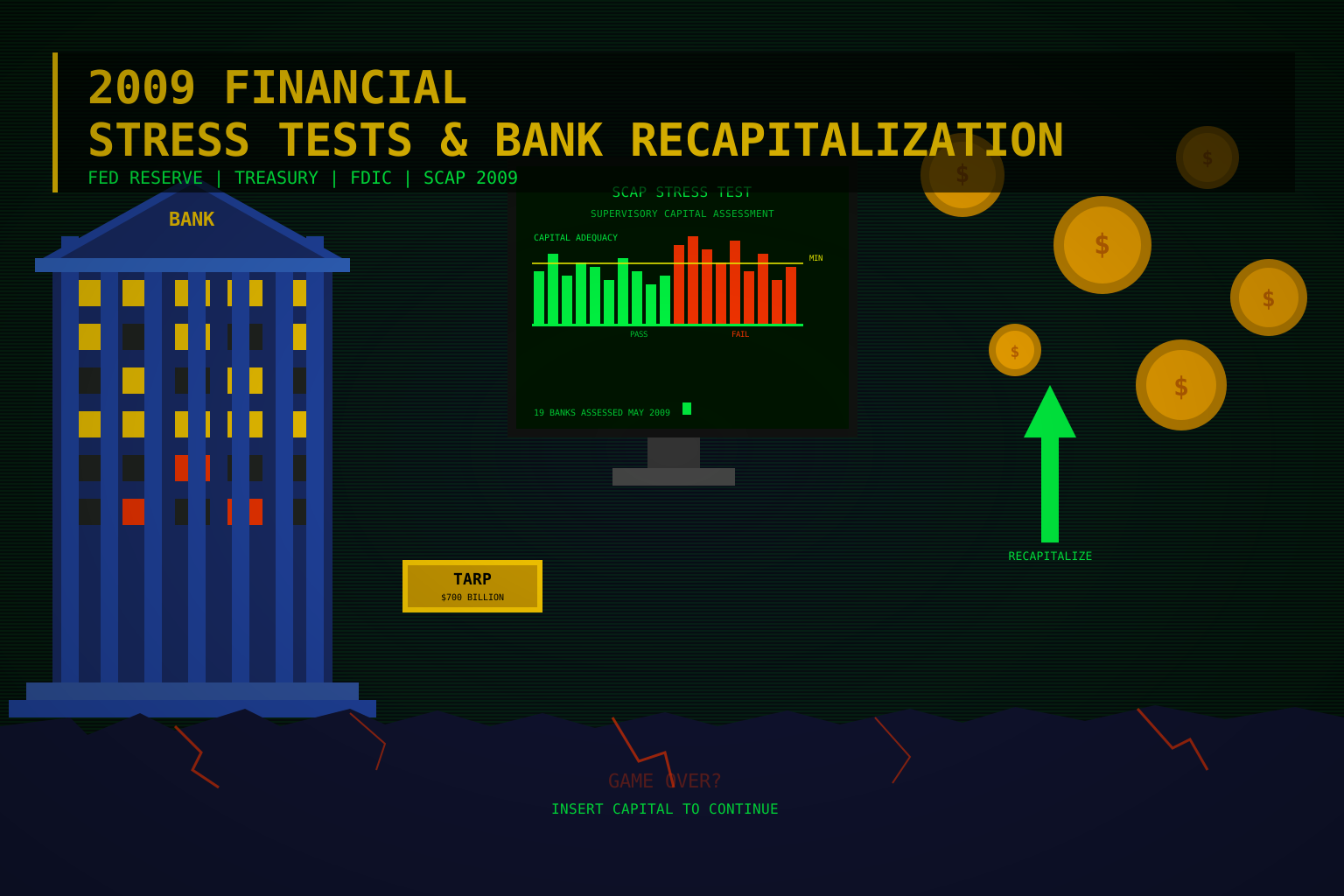
2009 Financial System Stress Tests and Bank Recapitalization
Society & Economics
Key figures: Federal Reserve Chair Ben Bernanke; Treasury Secretary Timothy Geithner; FDIC Chair Sheila Bair; OCC Comptroller John Dugan; bank CEOs Jamie Dimon (JPMorgan Chase), Lloyd Blankfein (Goldman Sachs), Brian Moynihan (Bank of America, from Dec. 2009), Vikram Pandit (Citigroup)
Summary
In May 2009, the U.S. Federal Reserve and Treasury Department completed the Supervisory Capital Assessment Program (SCAP)—colloquially known as the “stress tests”—a rigorous evaluation of the capital adequacy of the nation’s 19 largest bank holding companies under adverse economic scenarios. Initiated in February 2009 in response to continuing credit market dysfunction and uncertainty over bank solvency following the September 2008 Lehman Brothers collapse, the stress tests represented an unprecedented exercise in public transparency in U.S. banking oversight.
The program targeted bank holding companies with more than $100 billion in assets as of year-end 2008, collectively accounting for about two-thirds of U.S. banking system assets and about one-half of all U.S. loans. The 19 institutions were: Bank of America, JPMorgan Chase, Citigroup, Wells Fargo, Goldman Sachs, Morgan Stanley, MetLife, PNC Financial Services, U.S. Bancorp, Bank of New York Mellon, GMAC (later renamed Ally Financial), SunTrust Banks, BB&T, Regions Financial, Fifth Third Bancorp, American Express, Capital One, State Street, and KeyCorp.
The tests hypothesized a severe “adverse scenario” extending through 2009–2010: unemployment rising to 10.3% (it actually hit 10.0% in October 2009), U.S. house prices falling an additional 22% on top of prior declines (cumulative peak-to-trough decline exceeding 30%), GDP contracting 3.3% in 2009 and remaining flat in 2010, and corporate loan losses rising sharply. Regulators assessed whether each bank would maintain a Tier 1 capital ratio of at least 6% and a Tier 1 common ratio of at least 4% under these conditions.
Results Released May 7, 2009
The public release of stress-test results on May 7, 2009 marked the first time U.S. regulators had publicly disclosed bank-specific supervisory assessments at this granular level. The results revealed that 10 of the 19 banks needed a combined $74.6 billion in additional Tier 1 common capital (the announcement was sometimes rounded to “$134 billion in total capital needs” when including all capital buffers). The largest Tier 1 common shortfalls were:
| Bank | Capital Shortfall |
|---|---|
| Bank of America | $33.9 billion |
| Wells Fargo | $13.7 billion |
| GMAC | $11.5 billion |
| Citigroup | $5.5 billion (Tier 1 common; total capital needs higher) |
| Regions Financial | $2.5 billion |
| SunTrust Banks | $2.2 billion |
| Morgan Stanley | $1.8 billion |
| KeyCorp | $1.8 billion |
| Fifth Third Bancorp | $1.1 billion |
| PNC Financial | $0.6 billion |
Nine banks—JPMorgan Chase, Goldman Sachs, MetLife, American Express, Bank of New York Mellon, BB&T, Capital One, U.S. Bancorp, and State Street—had no required capital raise. JPMorgan Chase’s no-shortfall result was widely credited to CEO Jamie Dimon’s conservative capital management during the pre-crisis years; Goldman Sachs’s position reflected its early repayment of TARP funds ($10 billion accepted in October 2008, repaid June 2009).
Background: From Panic to Assessment (2008–Early 2009)
The stress tests emerged from an acute period of financial panic. The September 15, 2008 Lehman Brothers bankruptcy—the largest in U.S. history ($600+ billion in assets)—froze interbank lending markets almost immediately. The Fed Funds rate, already at 2%, was cut to a target range of 0–0.25% by December 2008. The Federal Reserve deployed unprecedented emergency facilities: the Commercial Paper Funding Facility (CPFF), the Term Asset-Backed Securities Loan Facility (TALF), and expanded repo operations.
Congress passed the $700 billion Troubled Asset Relief Program (TARP) in October 2008 after an initial House defeat (September 29) sent the Dow Jones Industrial Average down 778 points in a single day—its largest-ever single-day point drop at that time. Treasury Secretary Henry Paulson initially used TARP to purchase preferred stock in major banks rather than “toxic assets” as the original TARP title implied, injecting $125 billion into the first nine banks on October 14, 2008.
By January 2009, as the Obama administration took office, financial markets remained distressed. The DJIA fell from 9,034 on January 2 to a 12-year low of 6,547 on March 9, 2009—a 27.5% drop in under ten weeks. Bank stocks had fallen 60–90% from their 2007 peaks. Economists debated “nationalization” of insolvent banks versus the Bernanke-Geithner approach of supervised recapitalization. Treasury Secretary Geithner unveiled the Financial Stability Plan on February 10, 2009, of which the stress tests were the centerpiece—but his vague initial presentation caused a 380-point market drop that day, reflecting lingering investor skepticism.
Market and Policy Impact
The May 7 results triggered an almost immediate market recovery. The S&P 500 rose 4.2% on May 7 alone and continued climbing through the summer: from its March 9 low of 677, the index reached 1,025 by September 2—a 51% gain in six months. Bank stocks led the recovery; the KBW Bank Index rose 143% from March 6 to December 31, 2009.
The capital-raising that followed was fast and surprisingly large. Banks had six months to raise required capital from private markets, with TARP as a backstop. In practice:
- Bank of America raised $19.3 billion through a common stock offering (May 2009) and $26.3 billion more by year-end via a combination of equity sales and asset disposals.
- Wells Fargo raised $8.6 billion in a May stock offering, oversubscribed within hours.
- Citigroup converted $25 billion in TARP preferred shares to common equity (completing the conversion in July 2009), diluting existing shareholders but eliminating the preferred dividend obligation.
- GMAC (soon renamed Ally Financial) received a third TARP injection of $3.8 billion in December 2009, bringing its total TARP support to $17.2 billion.
By the end of 2009, all 19 tested banks had certified their capital adequacy. Goldman Sachs, JPMorgan Chase, Morgan Stanley, American Express, and several smaller banks fully repaid their TARP capital by December 2009. Total TARP principal repayments reached $116 billion by year-end 2009, against $245 billion disbursed to financial institutions.
Methodology and Transparency
The stress tests were notable for their methodological transparency—a sharp departure from prior banking supervisory practice. The Federal Reserve published a 21-page white paper detailing the scenarios, capital standards, and bank-specific methodologies on February 25, 2009, before results were finalized. This advance disclosure had mixed effects: it gave markets time to process the logic but also intensified lobbying from individual banks disputing preliminary findings. Citigroup and Bank of America both engaged in extended negotiations with regulators over their shortfall figures in April 2009; the final numbers reflected some downward revisions from preliminary estimates.
Critics (including IMF chief economist Olivier Blanchard and Nobel laureate Joseph Stiglitz) argued the scenarios were not severe enough—the “adverse scenario” was more optimistic than the actual 2009 economic trajectory in several metrics—and that the tests gave banks a false bill of health. Defenders countered that the tests’ primary purpose was to reduce uncertainty, not to simulate maximum loss scenarios, and that their combination of transparency and credibility was the key policy innovation.
Legislative Aftermath
The stress tests directly shaped subsequent financial regulation. The Dodd-Frank Wall Street Reform and Consumer Protection Act (signed July 21, 2010) codified annual stress testing (DFAST — Dodd-Frank Act Stress Tests) as a permanent supervisory requirement for banks with $10 billion or more in assets. The Fed’s post-Dodd-Frank stress tests (CCAR — Comprehensive Capital Analysis and Review) expanded the annual exercise, added qualitative assessment of risk-management practices, and gave the Fed explicit authority to deny capital distributions (dividends, buybacks) to failing banks. The 2009 SCAP is thus the direct ancestor of a permanent feature of U.S. banking supervision.
The episode also foreshadowed European bank stress tests: the European Banking Authority (EBA) conducted its first EU-wide stress test in 2010, using methodology modeled partly on the 2009 U.S. exercise—though the EU tests were widely criticized for laxer scenarios and less disclosure. That gap contributed to the 2011 European sovereign-debt crisis, in which several banks deemed solvent by EBA tests subsequently required bailouts.
Connection to 2009 Economic Events
The stress tests did not occur in isolation. In the same period, General Motors filed for Chapter 11 bankruptcy on June 1, 2009—the fourth-largest U.S. bankruptcy in history—and Chrysler completed its Chapter 11 restructuring in April–June 2009, with the federal government taking major ownership stakes in both. The American Recovery and Reinvestment Act (ARRA), signed February 17, 2009, injected $787 billion in fiscal stimulus alongside the financial-sector recapitalization. Meanwhile, Bernard Madoff’s June 2009 sentencing to 150 years—for a $65 billion fraud—reinforced public anger at financial-sector misconduct even as stabilization efforts proceeded.
Significance
The Supervisory Capital Assessment Program is widely regarded as the turning point in the U.S. recovery from the 2008 financial crisis. By publishing bank-specific results, it replaced the market’s fear of hidden insolvency with a credible, quantified account of each institution’s capital needs—reducing uncertainty enough to reopen private capital markets, which supplied the bulk of the required recapitalization within months. The May 7 disclosure coincided with the start of a sustained equity-market rebound and a rapid wave of TARP repayments, signaling that the acute phase of the banking panic had passed. Its methodological innovation—transparency paired with a public backstop—was institutionalized by the Dodd-Frank Act as the annual DFAST and CCAR exercises, making the 2009 program the direct ancestor of a permanent feature of U.S. bank supervision and a model, if an imperfectly imitated one, for subsequent European stress tests.
Sources
- Wikipedia — Supervisory Capital Assessment Program: https://en.wikipedia.org/wiki/Supervisory_Capital_Assessment_Program
- Federal Reserve Board — “The Supervisory Capital Assessment Program: Design and Implementation” (April 24, 2009): https://www.federalreserve.gov/
- U.S. Treasury — TARP Monthly Reports (2009): https://www.treasury.gov/
- Financial Times — “Stress Test Results” coverage (May 7–10, 2009): https://www.ft.com/
- Congressional Budget Office — “Report on the Troubled Asset Relief Program” (March 2010): https://www.cbo.gov/
- ProPublica — TARP Tracker (individual bank repayment data): https://projects.propublica.org/bailout/