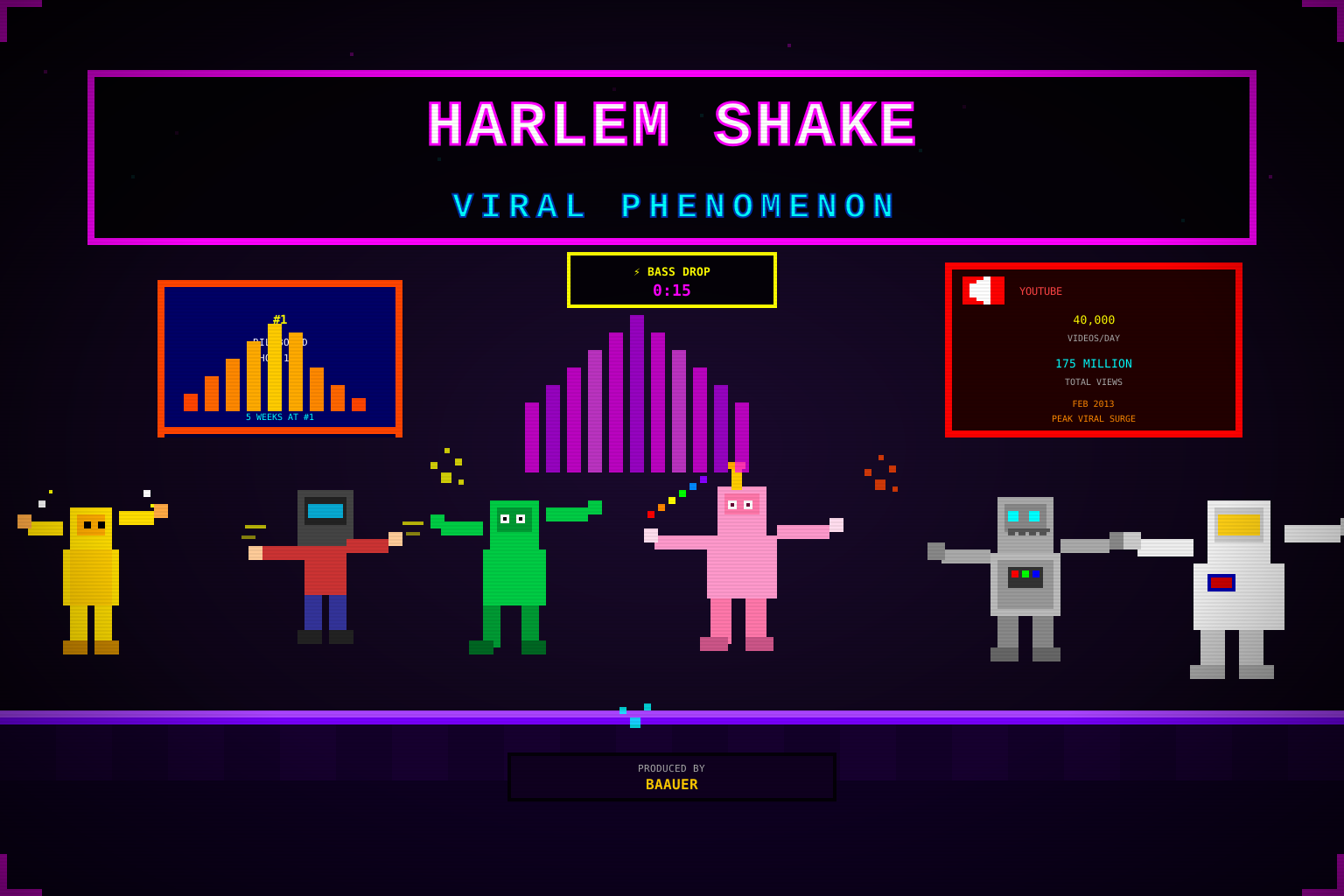
Key figures: Baauer (Harry Bauer Rodrigues, producer/DJ); Filthy Frank (George Miller, internet personality whose January 2013 video inspired the format); The Sunny Coast Skate (Australian group whose parody set the meme’s standard two-part structure)
Summary
In January 2013, internet personality Filthy Frank (George Miller) uploaded a short comedy sketch to YouTube featuring himself and friends wildly dancing to “Harlem Shake,” a single produced by Baauer (Harry Bauer Rodrigues) and released on Mad Decent Records on May 22, 2012. After a few parodies went viral in early February, the format exploded into a global phenomenon. By February 10, 2013—the trend’s peak—users worldwide were uploading over 4,000 Harlem Shake videos per day. By February 14, that number had surged to 40,000 videos with 175 million views accumulated. The song itself rocketed up the charts, eventually reaching #1 on the Billboard Hot 100 chart for five consecutive weeks following the meme’s viral surge.
The Harlem Shake videos followed a rigid two-part format: they opened with an extended solo showing one person (often in a helmet or mask) dancing awkwardly while those around them ignored the beat; then at the 0:15 bass-drop the scene cut to the entire group dancing wildly, often in absurd costumes or with physical props. The format’s creative floor was low enough for anyone to participate yet high enough to reward originality, making it infinitely adaptable across institutions, demographics, and cultures.
Origins: The Harlem Shake Dance vs. the Meme
Despite sharing a name, the Harlem Shake meme has little relation to the original Harlem Shake dance move. The original Harlem Shake is a street dance originating in Harlem, New York, in 1981, attributed to a dancer known as “Al B” (Albert Boyce). The move involves a rhythmic, rolling motion of the shoulders and arms with a drunken or exaggerated body-sway—distinct, fluid, and deeply rooted in African-American vernacular dance traditions. The dance gained popularity at the Apollo Theater and in Harlem street culture throughout the 1980s and was later referenced in hip-hop music videos.
Baauer’s track samples the phrase “do the Harlem Shake” from a 2001 Philly’s Most Wanted recording, which itself referenced the original dance. When Filthy Frank’s group performed their comedic, spastic movements in early 2013 and labeled them “the Harlem Shake,” the meme effectively appropriated and diverged from the original meaning. This disconnect drew criticism from Harlem residents, black cultural commentators, and hip-hop artists—most notably rapper Alvin Aqua Blanco, who publicly noted that the meme had nothing to do with the authentic Harlem Shake. The appropriation controversy became a notable sub-text of the meme’s broader cultural moment, foreshadowing debates over digital culture and cultural ownership that would recur with later viral trends.
The Production: Baauer’s “Harlem Shake”
Harry Bauer Rodrigues, born in 1989 and raised in New York City, produced “Harlem Shake” as a track on the Baltimore/London-based Mad Decent label, founded by DJ Diplo. The track combined elements of trap music—an Atlanta-originated subgenre characterized by heavy 808 bass drums, triplet hi-hats, and layered synthesizer chords—with a distinctive vocal sample and a dramatic bass drop at its midpoint. Mad Decent released the song as a free digital download on May 22, 2012, long before the meme emerged, and for eight months it circulated primarily in electronic-dance-music communities with modest attention.
Baauer was 23 years old and had released only a handful of tracks when the meme catapulted “Harlem Shake” to #1 on the Billboard Hot 100 on February 21, 2013. The song remained at #1 for five consecutive weeks. It simultaneously peaked at #1 in the United Kingdom, Australia, Ireland, Sweden, Norway, and 10 other national charts. The speed of chart ascent—driven almost entirely by YouTube streams rather than traditional radio airplay or iTunes downloads—was unprecedented in modern chart history. Within a month, Baauer had signed a management deal with Scooter Braun (Justin Bieber’s manager) and was receiving invitations to headline major music festivals.
The Viral Mechanics: Scale and Velocity
The Harlem Shake meme’s spread illustrated a new model of viral content propagation in the YouTube-era internet:
- January 30, 2013: George Miller (Filthy Frank) uploaded his original video.
- February 2, 2013: Three content creators—The Sunny Coast Skate group, TheAuzz3000, and Maker Studios’ DizastaMusic—uploaded parodies within hours of each other. These videos were algorithmically amplified by YouTube’s recommendation engine.
- February 5–9, 2013: Upload rate accelerated from hundreds to thousands per day. Sports teams (University of Georgia swim team), military units (US troops in Afghanistan), and office groups released versions.
- February 10, 2013: Peak upload rate: 4,000+ videos per day.
- February 14, 2013: 40,000 total videos; 175 million cumulative views.
- March 24, 2013: Cumulative video collection reached 1 billion views, averaging 20+ million views per day at the trend’s height.
The meme’s explosive early growth was partly attributable to “copy-cat clusters”: once one university swim team uploaded a video, rival teams felt compelled to respond. This competitive social dynamic—imitation as participation rather than mere consumption—proved a key driver of the meme’s reach into organized institutions such as sporting teams, military platoons, and corporate offices.
Chart Impact and Music Industry Transformation
The Harlem Shake’s Billboard chart performance was not only commercially significant but institutionally transformative. Baauer’s track debuted at #1 on the Billboard Hot 100 on February 21, 2013, driven by YouTube streaming data rather than by radio airplay or digital download sales. This event forced Billboard to publicly acknowledge and then formally institutionalize a change the publication had debated for two years: incorporating YouTube streaming data as a weighted metric in Hot 100 calculations.
Prior to the Harlem Shake, Billboard’s Hot 100 was weighted toward radio airplay and Nielsen SoundScan download data, with streaming playing a smaller role. The meme demonstrated that a song could reach #1 without radio airplay, and that streaming volume could dwarf traditional metrics. “Harlem Shake” became the first song to reach the top of the reformulated chart, and Billboard publicly confirmed on March 1, 2013, that online streams (including YouTube) would henceforth count alongside digital sales and radio plays. This shift had lasting consequences: it restructured incentives for artists and labels toward virality and online presence, contributed to the later rise of streaming-driven chart strategies, and marked a formal inflection point in how the music industry measured cultural relevance.
Global and Political Reach
The Harlem Shake transcended entertainment to become a vehicle for political expression in politically volatile regions:
- Egypt: In February 2013, young Egyptians uploaded Harlem Shake videos outside the Egyptian Muslim Brotherhood’s headquarters in Cairo. The Brotherhood condemned the videos as “obscene” and “immoral,” and participants were briefly detained. The episode illustrated how a frivolous internet meme could simultaneously challenge conservative social norms and demonstrate the reach of social media as a protest tool—themes with particular resonance in a country undergoing the post-Arab-Spring political transformation.
- Tunisia: Student activists in Tunisia uploaded Harlem Shake videos in public spaces, defying social and legal restrictions on public dancing and mixed-gender behavior, using the viral format as a form of civil disobedience.
- Norway: Norwegian soldiers deployed internationally recorded a version that went viral domestically, prompting mild controversy about military decorum.
These episodes underscored that the meme’s global spread was not uniform: the same video format carried different social meanings in different political contexts, functioning simultaneously as entertainment, protest, and cultural challenge.
Decline and Legacy
By mid-March 2013, the trend was losing momentum as novelty wore off and oversaturation set in—commentators declared it “over” even as occasional new versions continued appearing. The Harlem Shake’s rapid rise and fall followed the pattern sociologists had begun documenting as characteristic of internet virality: compressed cycle times compared to traditional cultural trends, with saturation achieved in weeks rather than months or years.
Despite its brevity, the Harlem Shake’s influence persisted. It established the dominant template for viral group-participation videos:
- A simple, copyable format that rewarded creative variations
- Institutional participation (sports teams, military units, corporations)
- Platform-driven amplification through algorithmic recommendation
Subsequent viral phenomena borrowed directly from this template: the Ice Bucket Challenge (August 2014), the Mannequin Challenge (October 2016), and, most directly, TikTok’s viral dance format, which codified the short group-dance-video into a platform-native content category. The Harlem Shake prefigured how social media platforms would deliberately cultivate viral dance challenges as growth mechanisms, a strategy TikTok institutionalized from its 2016 launch onward.
The phenomenon also demonstrated that digital culture could create global, near-simultaneous content-participation events that cross demographic, institutional, and national boundaries—a model of cultural spread with no clear precedent before the smartphone era.
Significance
The Harlem Shake represented a pivotal moment in internet culture and social media history. It demonstrated the power of short-form video to spread globally at unprecedented speed—reaching billions of viewers in weeks through platforms like YouTube, Twitter, and Facebook—and showed that online virality could drive mainstream commercial success without radio airplay or traditional marketing. The meme’s penetration across institutional boundaries (sports teams, military units, corporations, government agencies) showed how viral trends had become a standard mode of organizational culture and employee engagement by 2013. Its forced transformation of the Billboard Hot 100 methodology cemented streaming as a primary measure of music industry success.
For a companion view of how digital culture and social media identity evolved in the same year, see Selfie: Oxford’s Word of the Year 2013, which tracks the parallel normalization of smartphone self-portraiture as a social medium.
Sources
- Harlem Shake (meme) — Wikipedia
-
[Harlem Shake Know Your Meme](https://knowyourmeme.com/memes/harlem-shake) -
[The ‘Harlem Shake’ Walked So TikTok Could Run Vice](https://www.vice.com/en/article/harlem-shake-origin-story/) -
[Harlem Shake Dictionary.com](https://www.dictionary.com/culture/memes/harlem-shake) - Billboard Hot 100 Methodology Update — Billboard
- How the Harlem Shake Conquered the World — The Atlantic