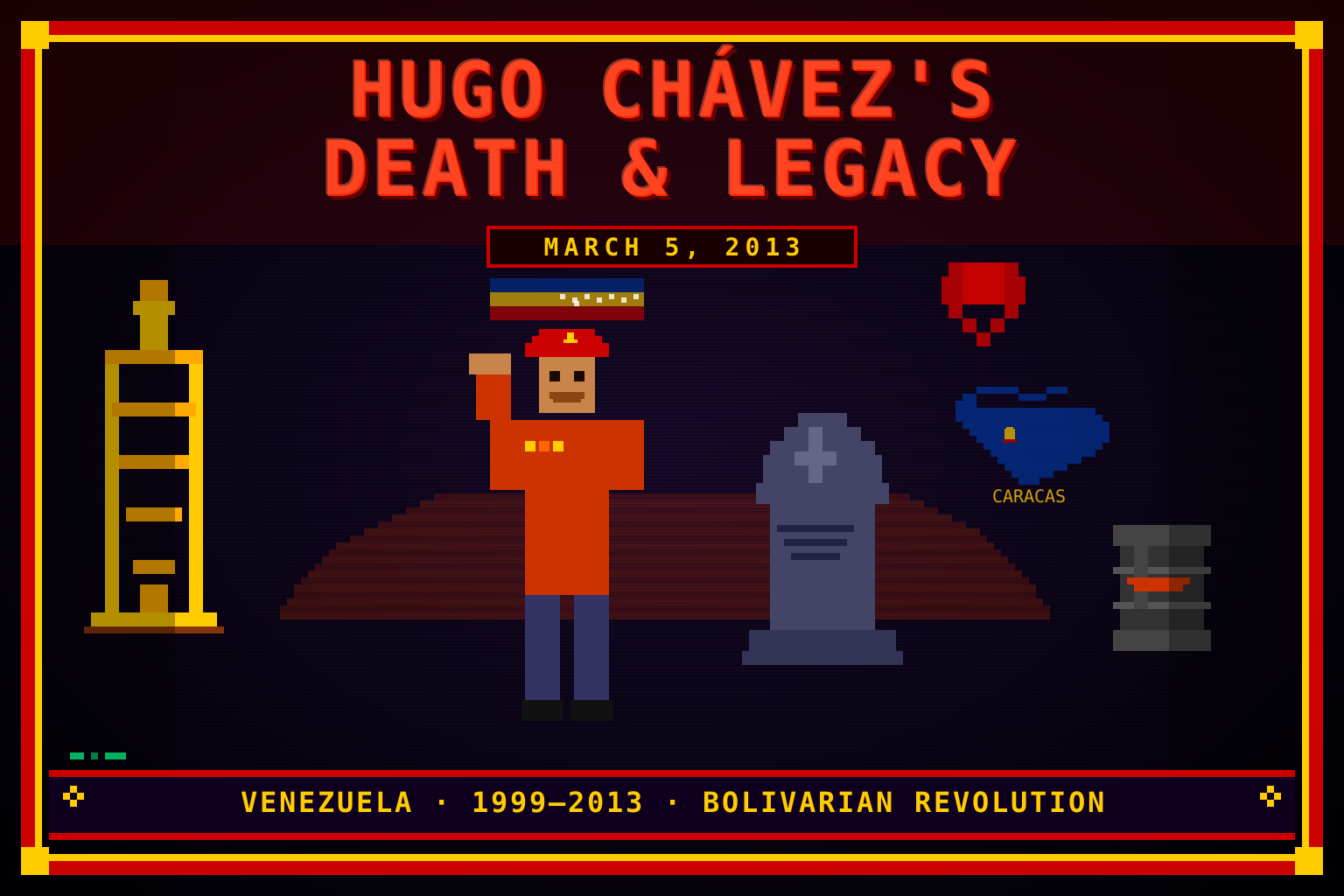
Key figures: Hugo Chávez (President of Venezuela, 1999–2013), Nicolás Maduro (Vice President, successor), Raúl Castro (Cuba), Henrique Capriles (opposition candidate), Diosdado Cabello (National Assembly President)
Summary
Hugo Rafael Chávez Frías, the sixth president of Venezuela, died on March 5, 2013, at 4:25 PM local time in Caracas, at age 58, from complications of an undisclosed cancer. His death ended a 14-year presidency that had reshaped Venezuela’s political economy and regional geopolitics, and set in motion a succession struggle that would define Latin American politics for years.
Chávez was born on July 28, 1954, in Sabaneta, Barinas, to a family of modest means. He rose through Venezuela’s military, reaching the rank of lieutenant colonel before attempting a coup against President Carlos Andrés Pérez on February 4, 1992. The coup failed, Chávez was imprisoned, and his televised 63-second speech accepting responsibility and promising “for now” the uprising was over made him a national figure. Pardoned in 1994, he formed the Fifth Republic Movement and won the December 6, 1998 presidential election with 56.2% of the vote, defeating Henrique Salas Römer.
Health Crisis Timeline
Chávez’s illness unfolded over 21 months under extraordinary secrecy:
- June 10, 2011: Chávez undergoes emergency surgery in Cuba for what is initially described as a pelvic abscess. Post-surgery, he discloses the discovery of a cancerous mass “about the size of a baseball” in his pelvic region.
- July 4, 2011: Addresses the Venezuelan nation from Cuba, publicly disclosing his cancer diagnosis for the first time.
- October 2011: Returns to Venezuela, declaring himself cancer-free after chemotherapy and radiation.
- February 21, 2012: Announces the cancer has returned; undergoes a second surgery in Cuba.
- October 7, 2012: Wins his fourth presidential election against opposition candidate Henrique Capriles with 55.1% of the vote—his narrowest margin of victory—amid questions about his health.
- November 2012: Cancer metastasizes. Chávez names Maduro as his preferred successor.
- December 8, 2012: Returns to Cuba for a fourth operation, his last public appearance in Venezuela.
- December 9–March 5, 2013: Remains hospitalized in Havana, communicating only sporadically through state media. Venezuelan officials release occasional photographs to demonstrate he is alive, but Chávez never returns to Venezuela under his own power.
- March 5, 2013: Maduro announces Chávez’s death in a televised address, alleging without evidence that enemies of Venezuela had “inoculated” Chávez with cancer—a conspiracy theory that circulated among Chavista supporters.
The specific cancer type was never officially disclosed. Most medical analysts who examined the available evidence concluded it was likely a pelvic rhabdomyosarcoma or a related sarcoma, an aggressive and rare cancer with a poor prognosis.
The State Funeral
Chávez’s body was flown from Havana to Caracas on March 6. His state funeral, held on March 8, 2013 at the Military Academy in Caracas, drew:
- 72 official delegations from 55 nations
- Heads of state and government from across Latin America and the Caribbean, including Evo Morales (Bolivia), Rafael Correa (Ecuador), Cristina Fernández de Kirchner (Argentina), and Dilma Rousseff (Brazil)
- Cuban leader Raúl Castro, Iran’s Mahmoud Ahmadinejad, Belarus’s Alexander Lukashenko
- Actor and political activist Sean Penn; civil rights leader Jesse Jackson
An estimated 200,000 people filed past Chávez’s open casket in the days following his death. His remains were interred at the Mountain Barracks (Cuartel de la Montaña) in Caracas—the site of the failed 1992 coup that launched his political career—which was subsequently converted into a mausoleum and museum.
Plans to embalm Chávez in the manner of Lenin and Mao were ultimately abandoned after Venezuelan officials acknowledged that the body had deteriorated too much for successful embalming.
The Bolivarian Revolution: Key Policies
Chávez’s presidency was anchored in what he called the Bolivarian Revolution, a left-nationalist project drawing on the legacy of independence hero Simón Bolívar. Its central pillars:
Social Missions (Misiones)
Between 2003 and 2012, the government channeled petroleum revenues into a network of social programs called misiones (missions):
- Misión Barrio Adentro: A Cuban-staffed primary healthcare program that deployed more than 30,000 Cuban doctors and nurses into low-income urban neighborhoods, credited with dramatically expanding primary care access.
- Misión Robinson I & II: Literacy programs that taught an estimated 1.5 million Venezuelans to read between 2003 and 2005; the Venezuelan government declared the country “illiteracy-free” in 2005.
- Misión Sucre: Subsidized university enrollment, increasing tertiary enrollment from 668,000 (1998) to more than 2.6 million (2012).
The World Bank and ECLAC (UN Economic Commission for Latin America) documented significant reductions in poverty during the oil-boom years: the overall household poverty rate fell from roughly 50% in 1998 to about 27% in 2010 (extreme poverty fell more sharply, from around 17% to 7%), though the decline was not linear and reversed during the 2002–2003 oil strike.
Oil Nationalization and PDVSA
Chávez dramatically expanded state control over PDVSA (Petróleos de Venezuela, S.A.), the national oil company. Following a catastrophic industry strike in 2002–2003, he fired approximately 19,000 PDVSA workers and replaced them with loyalists, subordinating the company’s technical operations to political goals. Venezuela’s oil revenues fueled the misiones but also gave Chávez a geopolitical tool: the Petrocaribe initiative (founded 2005) supplied petroleum at preferential rates to 18 Caribbean and Central American nations in exchange for political alignment.
Anti-American Posture
Chávez cultivated close relationships with Cuba, Iran, Russia, China, and Belarus, positioning Venezuela as an anti-imperialist pole. He called U.S. President George W. Bush “the devil” in a September 20, 2006 speech at the United Nations General Assembly, noting the podium still smelled of sulfur the day after Bush had spoken—a moment that received global media coverage and a standing ovation from some delegates.
Legacy and Post-Chávez Venezuela
Chávez’s death exposed the structural fragility of the Bolivarian model. His successor, Nicolás Maduro, won the April 14, 2013 presidential election by a margin of only 1.5 percentage points (50.6% to Capriles’ 49.1%)—a result Capriles contested, citing irregularities. The result underscored the degree to which Chávez’s personal charisma had been central to the movement’s electoral coalition.
Within two years, Venezuela entered a deepening economic crisis driven by collapsing oil prices, currency controls, and the erosion of PDVSA’s productive capacity. By 2016, the country experienced the world’s highest inflation rate and severe shortages of food and medicine. By 2019, an estimated 5 million Venezuelans had emigrated—one of the largest displacement crises in Latin American history—and Maduro’s government faced international sanctions and a contested legitimacy crisis after opposition leader Juan Guaidó declared himself interim president in January 2019.
Chávez’s legacy thus bifurcates sharply:
- Supporters credit him with historic poverty reduction, expanded healthcare and education access, and restoring national sovereignty over oil revenues.
- Critics argue the misiones were fiscally unsustainable, that PDVSA’s politicization crippled the country’s productive base, and that his concentration of executive power and suppression of independent institutions planted the seeds of the authoritarianism that followed under Maduro.
See Also
- Nelson Mandela’s Death and Legacy (2013) — another globally significant leader who died in 2013, offering a contrasting model of political transition
- Malala Yousafzai: Education Advocate (2013) — contemporaneous figure whose activism represented a different mode of political and social leadership in 2013
Sources
- Death and state funeral of Hugo Chávez - Wikipedia
-
[Hugo Chavez Death, Maduro, Coup, & Facts Britannica](https://www.britannica.com/biography/Hugo-Chavez) - Hugo Chávez’s legacy: A country in crisis — NACLA Report on the Americas, 2013
- Venezuela’s Economic Implosion — Council on Foreign Relations