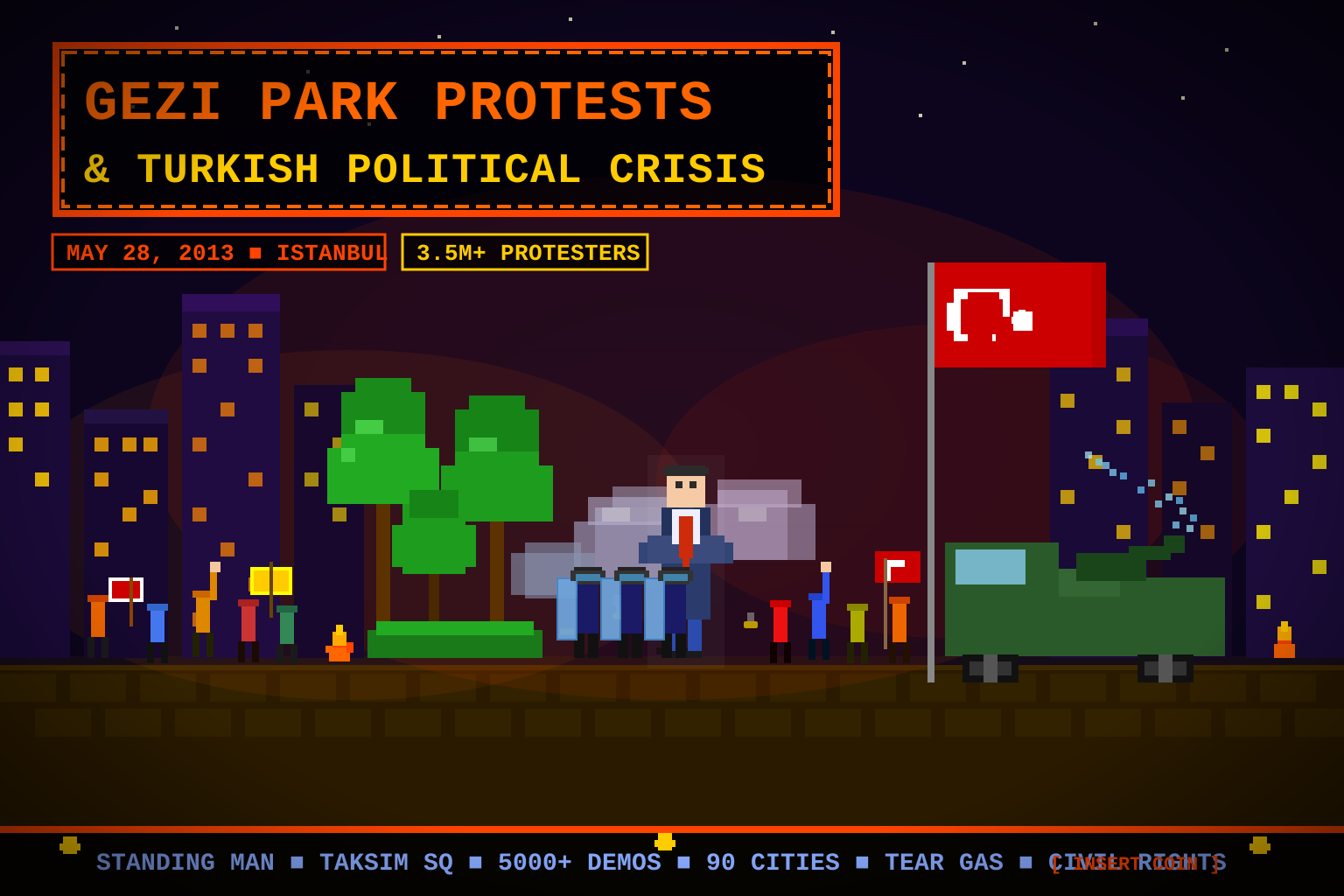
Key figures: Recep Tayyip Erdoğan (Prime Minister), Erdem Gündüz (“Standing Man” initiator), Abdullah Gül (President), Kemal Kılıçdaroğlu (CHP opposition leader)
Summary
On May 28, 2013, Turkish police violently dispersed approximately 50 environmental activists camped in Istanbul’s Gezi Park to prevent its demolition as part of an urban redevelopment plan. The heavy-handed response—characterized by tear gas, water cannons, and riot police tactics—triggered a cascade of civil unrest that would become one of Turkey’s largest mass protest movements. Over the following three months, demonstrations spread to 90+ cities nationwide, with an estimated 3.5 to 7.5 million Turks participating in nearly 5,000 separate demonstrations. The protests evolved beyond environmental concerns into a broader referendum on government authoritarianism, police accountability, and civil liberties under Prime Minister Recep Tayyip Erdoğan’s increasingly assertive administration.
The movement’s most iconic moment came when protester Erdem Gündüz initiated the “Standing Man” silent vigil in Taksim Square, standing motionless for hours with arms crossed—a meditation-like protest that spread to hundreds of copycat actions across the country and symbolized the movement’s non-violent resistance to state power.
Origins and Escalation
Gezi Park, a small public green space adjacent to Istanbul’s Taksim Square, had been targeted by the Erdoğan government’s urban-renewal initiative to reconstruct an Ottoman-era military barracks (the Taksim Artillery Barracks) demolished in 1940. The revived barracks would house a museum and commercial space, including a shopping mall. To activists, the demolition of one of central Istanbul’s few remaining green areas represented a pattern of government indifference to public input and preference for commercial mega-projects.
The initial occupation began on May 27, 2013, when a small group of environmentalists chained themselves to trees. On the morning of May 28, riot police deployed pepper spray and bulldozers to clear the site, burning tents and supplies. Videos of sleeping protesters being doused with chemical agents spread rapidly on Twitter and Facebook, and within hours demonstrators flooded Taksim Square from across Istanbul.
By June 1, Prime Minister Erdoğan delivered a defiant televised address from Tunis, dismissing protesters as “looters” (çapulcu), a term protesters subsequently reappropriated as a badge of honor—”chapuling” entered international lexicon and was referenced in Wikipedia within days. The government deployed water cannons laced with tear gas concentrate to Taksim Square; doctors documented hundreds of cases of chemical burns and respiratory distress. An estimated 2.5 million protesters took to the streets across Turkey on June 1 alone, the movement’s single largest mobilization day.
Government Response and Crackdown
Authorities deployed tear gas in quantities unprecedented in Turkish history—the Turkish Medical Association documented the use of 130,000 tear-gas canisters during the protests, a number later confirmed by independent investigators. Police used TOMA (riot control vehicles with pressurized water) that independent testing showed contained diluted tear gas and pepper spray solutions, leaving protesters with chemical burns hours after exposure.
Erdoğan rejected calls for dialogue in his initial statements, scheduling campaign rallies in Istanbul and Ankara where he mobilized his AKP base against the protesters. Only on June 12–13 did he agree to meet with protest representatives; those talks collapsed when police moved to clear Gezi Park on June 15, firing rubber bullets and deploying armored vehicles to disperse remaining occupiers. The park was formally reopened on July 5, though scattered protests continued through August 2013.
At least eight people, most of them protesters, died during the unrest—including 14-year-old Berkin Elvan, struck in the head by a tear-gas canister while out to buy bread on June 16, 2013, who fell into a coma and died on March 11, 2014, reigniting protests. The government prosecuted hundreds of demonstrators, while convictions of senior officials or police for the violence were rare.
The “Standing Man” and Cultural Resonance
On June 17, 2013, Turkish choreographer and dancer Erdem Gündüz stood alone in Taksim Square for eight hours without speaking, facing the Atatürk Cultural Center. Within hours, dozens joined him; by nightfall, hundreds of silent figures stood across Taksim. The image spread globally via social media, inspiring solidarity vigils in cities including New York, Berlin, and Tokyo. Turkish comedian Nurseli İdiz joined the next morning; by June 18, “Standing Man” protests had appeared in 33 Turkish cities.
The movement also accelerated Turkey’s social-media activism. At the time of the protests, Turkey had 34 million internet users and 11 million Twitter accounts—Gezi became the first major political crisis driven substantially by domestic social media coverage, bypassing television networks that initially ignored the demonstrations. CNN Türk’s decision to broadcast a penguin documentary while CNN International covered the Taksim clashes became a symbol of mainstream-media capture, driving hundreds of thousands to subscribe to VPN services to access international news.
Political Aftermath and Legacy
The Gezi protests fundamentally reshaped Turkish politics:
- AKP polarization: Erdoğan’s hardline response consolidated his rural and conservative base while alienating urban, professional, and secular voters. The AKP won municipal elections in March 2014, suggesting the crackdown did not broadly damage electoral support.
- Internet censorship: Following the protests, the Turkish parliament amended the internet law (Law No. 5651) in 2014, expanding the government’s power to block websites without prior court orders and to require providers to retain user data. Twitter and YouTube were blocked multiple times between 2014 and 2016.
- Judicial crackdown: In 2019–2022, Turkish prosecutors charged 16 civil-society figures, including philanthropist Osman Kavala, with attempting to overthrow the government by financing the Gezi protests. Kavala’s prosecution drew European Court of Human Rights condemnation, and Turkey faced EU Article 46 proceedings over his continued detention.
- Democratic erosion: Human Rights Watch and Freedom House both cited Gezi as a turning point in their annual Turkey assessments, documenting subsequent restrictions on assembly, press freedom, and judicial independence that accelerated after the 2016 attempted coup.
The protests halted Erdoğan’s Taksim barracks project indefinitely; as of 2025, Gezi Park remains a public space, though under periodic threat of commercialization.
Regional Context
The Gezi protests unfolded against a broader regional backdrop of the Arab Spring’s aftermath. Turkey had positioned itself under Erdoğan as a model for Muslim-majority democracies—secular constitution, competitive elections, economic growth—but the protests complicated that narrative. Demonstrators drew explicit comparisons to uprisings in Egypt, Syria, and Tunisia, and Erdoğan’s response echoed crackdown tactics employed by authoritarian Arab governments. The protests preceded by months the Syrian chemical-weapons crisis that would consume international attention that summer and test Turkey’s pivotal role as a NATO member bordering Syria’s civil war.