Key figures: Edward Snowden, Glenn Greenwald, Laura Poitras, Barton Gellman, James Clapper, Keith Alexander, Barack Obama
Summary
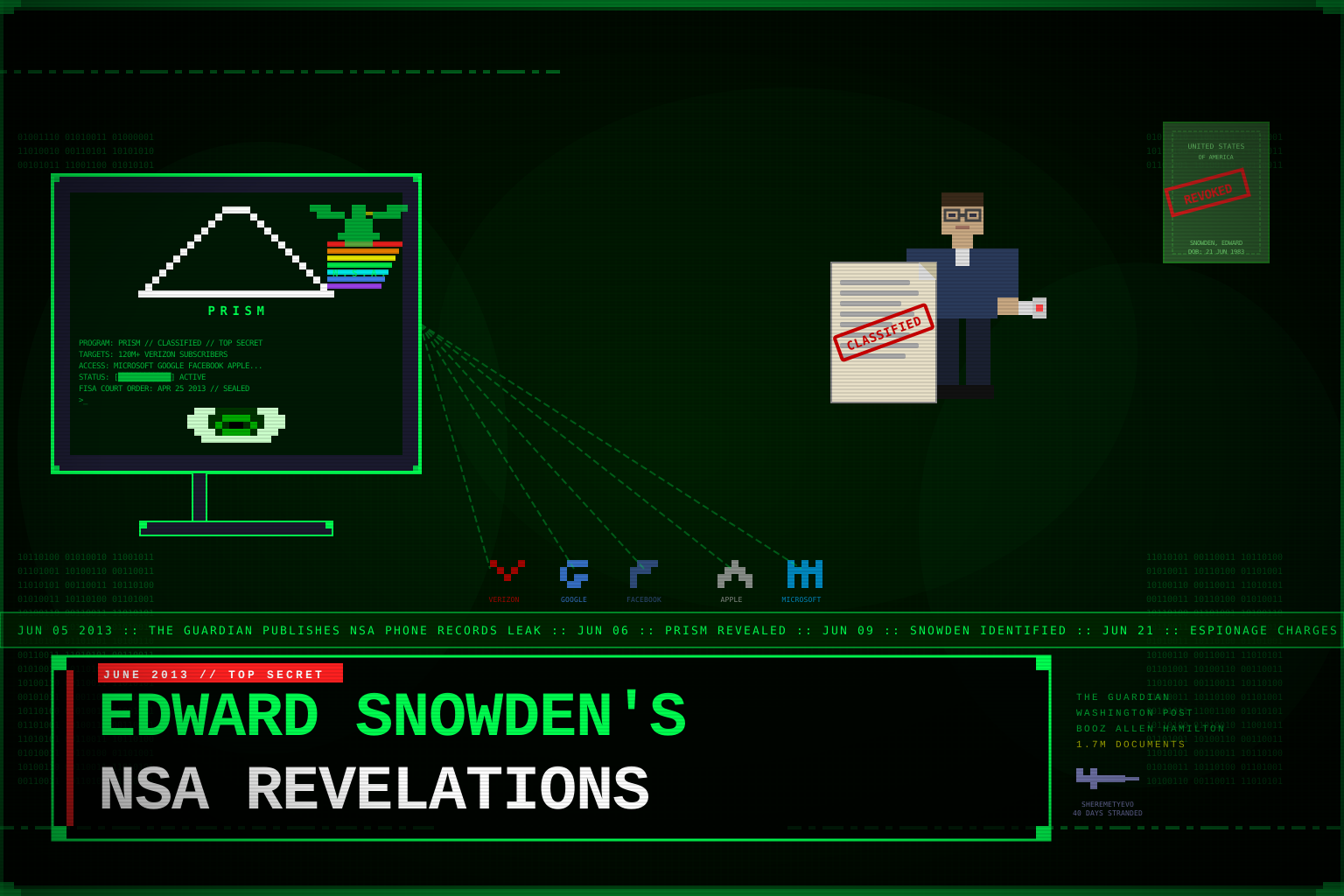
In June 2013, Edward Snowden, a 29-year-old NSA contractor employed by Booz Allen Hamilton in Hawaii, revealed classified documents exposing sweeping U.S. government surveillance programs. On June 5, 2013, The Guardian published the first article, disclosing that the NSA had collected phone records from over 120 million Verizon subscribers under a secret FISA court order dated April 25, 2013. The following day, June 6, The Guardian and The Washington Post simultaneously published details of PRISM, a clandestine surveillance program granting the NSA direct access to data on servers of major technology companies including Microsoft, Yahoo, Google, Facebook, Apple, YouTube, Skype, and AOL.
Snowden had begun downloading classified documents in April 2012 and strategically contacted journalist Glenn Greenwald and documentary filmmaker Laura Poitras before his public exposure. He flew to Hong Kong on May 20, 2013, and on June 9, 2013, publicly identified himself in a video interview. The U.S. Department of Justice unsealed espionage charges against him on June 21, 2013, under the Espionage Act of 1917. Snowden was stranded in Moscow’s Sheremetyevo Airport for 39 days after the U.S. government revoked his passport before Russia granted him temporary asylum on August 1, 2013.
The revelations ultimately encompassed an estimated 1.7 million classified NSA documents. Beyond PRISM and bulk telephone metadata collection, subsequent publications exposed additional programs:
- XKeyscore: A system the NSA described as its “widest-reaching” internet collection program, capable of searching through email, online chats, and browsing histories of millions of individuals
- MUSCULAR: Joint NSA–GCHQ operation tapping fiber-optic cables linking Yahoo and Google data centers, reportedly intercepting 181 million records in a single 30-day period
- Tempora: A British GCHQ program intercepting and storing vast quantities of internet data from undersea fiber-optic cables, shared with the NSA
- Boundless Informant: A data analysis tool revealing the NSA collected over 97 billion pieces of intelligence globally in a single 30-day period in March 2013
- FAIRVIEW and STORMBREW: Programs enabling bulk collection of international internet traffic through partnerships with U.S. telecommunications companies
Key Programs Disclosed
Bulk Telephone Metadata Collection (Section 215)
The first revelation centered on the NSA’s use of Section 215 of the USA PATRIOT Act to compel Verizon to hand over metadata on all domestic calls—approximately 120 million records daily. Similar orders applied to AT&T and Sprint. The program did not capture call content but recorded caller and recipient numbers, call duration, location data, and other routing information, enabling pattern analysis of communication networks.
PRISM (Section 702)
Under PRISM, launched in 2007 under the PRISM program name, the NSA collected internet communications from users of nine major U.S. tech companies via Section 702 of the FISA Amendments Act. Leaked slides presented PRISM as enabling collection of email, chat, video, photos, stored data, VoIP, file transfers, and social networking details. Participating companies denied providing “direct access” to their servers, asserting compliance was limited to legally mandated responses to specific requests.
Surveillance of Foreign Leaders
Documents revealed the NSA monitored the personal mobile phone of German Chancellor Angela Merkel—surveillance that reportedly began as early as 2002 and continued until shortly before Obama’s inauguration. The NSA also monitored at least 35 other world leaders. The revelations severely strained diplomatic relations with Germany, France, Mexico, Brazil, and Spain, all of which summoned U.S. ambassadors for formal protests.
Legislative and Legal Response
The revelations catalyzed the most significant U.S. surveillance reform in a generation. In June 2015, Congress passed the USA FREEDOM Act, the first legislative rollback of NSA surveillance authorities since the 1970s Church Committee reforms. The act ended bulk collection of domestic telephone metadata under Section 215 and required the NSA to instead query records held by telephone companies.
In May 2015, the Second Circuit Court of Appeals ruled that the NSA’s bulk phone metadata collection program was illegal, exceeding what Section 215 authorized. A 2019 report by the Privacy and Civil Liberties Oversight Board later revealed that the reformed phone metadata program had been shut down in 2019 after collecting records it was not authorized to gather.
At the international level, the European Court of Justice cited the Snowden revelations directly in its 2015 Schrems I judgment, which invalidated the EU-U.S. Safe Harbor framework governing the transfer of personal data of European citizens to the United States. A successor framework, Privacy Shield, was similarly struck down in 2020.
International Fallout
The NSA documents revealed that the agency had worked closely with allied intelligence agencies through the “Five Eyes” partnership (United States, United Kingdom, Canada, Australia, New Zealand) while simultaneously conducting surveillance on citizens and leaders of other allied nations. Brazil, Germany, and France proposed a UN General Assembly resolution on the right to privacy in the digital age, adopted on November 26, 2013.
Brazilian President Dilma Rousseff canceled a scheduled state visit to Washington in September 2013 after documents revealed the NSA had intercepted communications between her and her aides, as well as monitoring Petrobras, Brazil’s state oil company. German prosecutors opened an investigation into surveillance of Merkel’s phone in November 2013, a case not formally closed until 2015.
Aftermath and Snowden’s Situation
Snowden lived in Russia under asylum, later receiving permanent residency in 2020 and Russian citizenship in September 2022. As of 2025, he has never returned to the United States and faces three felony charges carrying a combined maximum sentence of 30 years. The Obama administration declined to pardon him; the Trump administration in 2017 and Biden administration also did not grant clemency.
Within the technology sector, the Snowden revelations directly accelerated the adoption of end-to-end encryption. WhatsApp, originally unencrypted, introduced end-to-end encryption for all messages in 2016. Apple introduced default encryption on iPhone storage with iOS 8 in 2014, prompting public criticism from FBI Director James Comey. Google, Facebook, and Microsoft significantly expanded the use of HTTPS and other encryption technologies across their services.
Significance
Snowden’s disclosures represent a watershed moment in public understanding of mass digital surveillance infrastructure. The documents confirmed the existence of surveillance architecture that privacy advocates had warned about for years but had no documentary basis to prove. The revelations enabled informed democratic debate on the trade-offs between security and civil liberties, reshaping national and international legal frameworks governing digital intelligence activities.
The Snowden affair coincided with—and partly accelerated—broader 2013 debates over digital privacy. Growing public awareness of corporate data collection, illustrated by controversies around products like Google Glass, intersected with revealed government collection to produce a sustained public reckoning over surveillance capitalism and state surveillance as parallel phenomena. The Bitcoin price surge of 2013 similarly reflected growing distrust of centralized institutions—financial and governmental alike—that the NSA revelations reinforced.