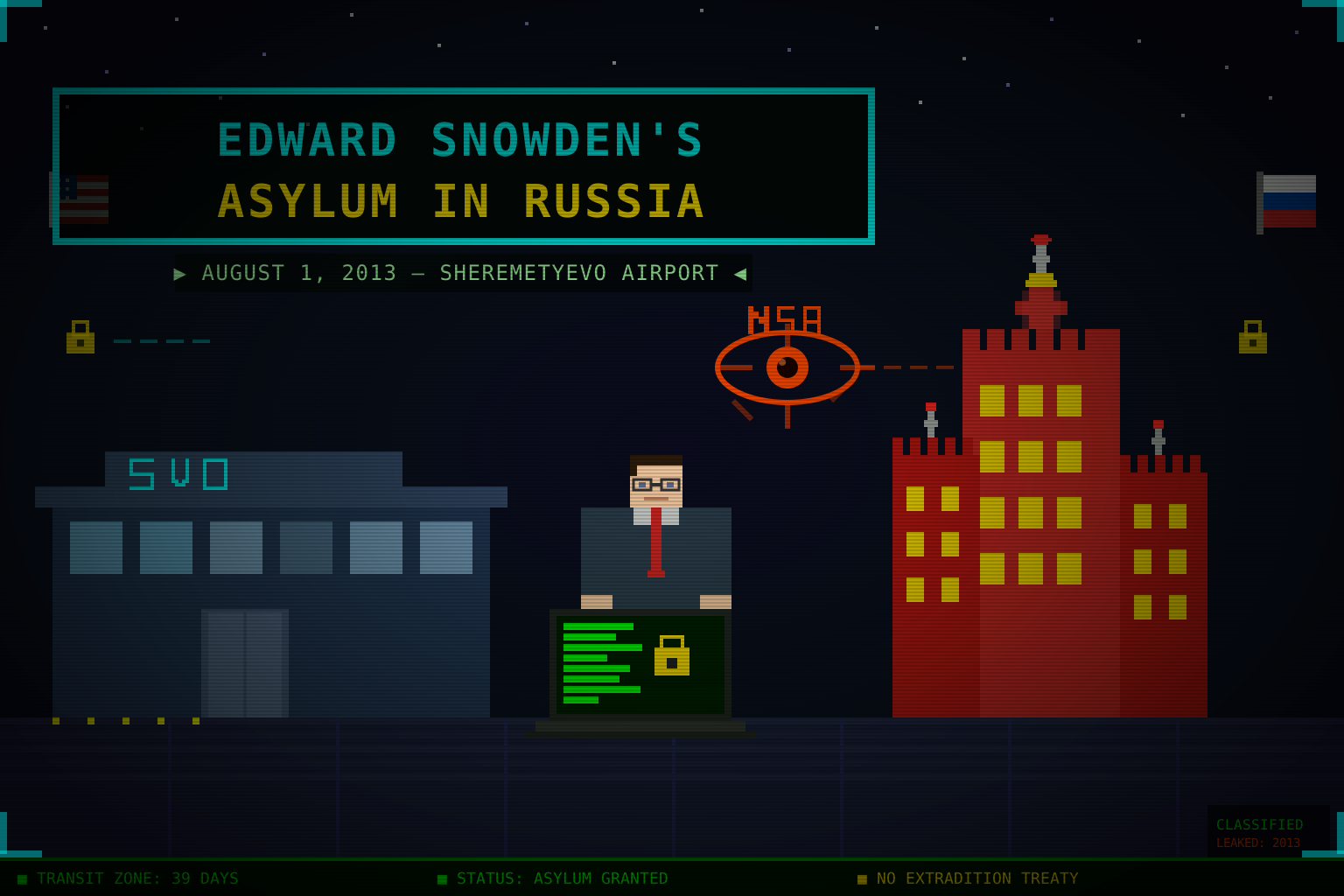
Key figures: Edward Snowden (NSA contractor, whistleblower), Vladimir Putin (Russian President), Anatoly Kucherena (Snowden’s Russian human-rights lawyer), Glenn Greenwald (journalist, The Guardian), Laura Poitras (documentary filmmaker), Barack Obama (U.S. President), Eric Holder (U.S. Attorney General), John Kerry (U.S. Secretary of State)
Summary
Edward Snowden, the former NSA contractor who had disclosed classified surveillance programs beginning in June 2013, was granted temporary political asylum in Russia on August 1, 2013. The decision ended Snowden’s 39-day confinement in the international transit zone of Moscow’s Sheremetyevo International Airport and marked a dramatic resolution to a geopolitical standoff between the United States and Russia over his custody.
Snowden’s disclosures—the most significant leak of classified NSA material in the agency’s history—had transformed global debates about mass surveillance, privacy, and the legal architecture of post-9/11 counterterrorism programs. His asylum in Russia, a country with which the United States had no extradition treaty covering political crimes, established him as a permanent figure at the intersection of national security and civil-liberties politics.
Background: The NSA Disclosures
What Snowden Revealed
Snowden had worked as a systems administrator and infrastructure analyst for NSA contractors Booz Allen Hamilton and Dell, giving him unusually broad access to classified networks. Between late 2012 and May 2013, he systematically copied an estimated 1.5 million classified documents—a figure the NSA later revised and disputed, but which represented an unprecedented volume of material from a single source.
The primary NSA surveillance revelations included:
- PRISM: A classified program granting the NSA direct access to user data from Microsoft, Yahoo, Google, Facebook, PalTalk, YouTube, Skype, AOL, and Apple under Section 702 of the Foreign Intelligence Surveillance Act (FISA). The companies’ actual level of cooperation was disputed.
- Section 215 bulk metadata collection: The NSA’s collection of call records—numbers called, call duration, and geolocation—for virtually all U.S. telephone customers under a broad interpretation of the USA PATRIOT Act’s Section 215. The program collected metadata from hundreds of millions of Americans without individualized suspicion.
- XKeyscore: A classified system allowing NSA analysts to search vast databases of internet communications with minimal oversight.
- Tempora: A British GCHQ program tapping transatlantic fiber-optic cables, conducted in partnership with the NSA and shared under the Five Eyes intelligence-sharing framework.
- MUSCULAR: A covert operation in which the NSA and GCHQ secretly intercepted data flowing between Google’s and Yahoo’s data centers, exploiting links not covered by FISA warrants.
These revelations prompted immediate legal challenges, Congressional investigations, and international diplomatic crises affecting U.S. relationships with Germany, Brazil, France, and other allies.
Flight and the Moscow Airport Stranding
Departure from Hawaii
On May 20, 2013, Snowden departed Hawaii—where he had been living while working as a Booz Allen contractor at the NSA’s signals intelligence facility in Kunia—and traveled to Hong Kong. He had told his supervisor he was seeking treatment for epilepsy. In Hong Kong, he met with journalist Glenn Greenwald of The Guardian, documentary filmmaker Laura Poitras, and Ewen MacAskill of The Guardian over several days, providing them with documents and context for publication. (Barton Gellman of The Washington Post, who worked the same trove, did so remotely from the United States and did not travel to Hong Kong.)
On June 5, 2013, The Guardian published the first story—the court order compelling Verizon to provide bulk telephone metadata to the NSA under Section 215. The following day, June 6, The Washington Post and The Guardian published the PRISM story. On June 9, Snowden publicly identified himself in a video published by The Guardian, becoming the most prominent American intelligence whistleblower since Daniel Ellsberg released the Pentagon Papers in 1971.
The Passport Revocation
On June 22, 2013—one day before Snowden was planning to board a flight from Hong Kong to Moscow—the U.S. State Department revoked his passport. The move was intended to prevent him from traveling further, but it instead trapped him in transit.
Snowden’s flight to Moscow on Aeroflot SU213 on June 23 was understood at the time to be a transit connection toward Cuba and then Ecuador, which had received a formal asylum application. However, when Snowden arrived at Sheremetyevo, Aeroflot and other carriers refused to board him without a valid travel document. The Cuban government, reportedly under U.S. pressure, denied him transit. Ecuador—after initially signaling openness—backed down under U.S. pressure on trade preferences. Snowden was effectively stateless and trapped.
Life in the Transit Zone
For 39 days (June 23–August 1, 2013), Snowden lived in the transit zone of Sheremetyevo’s Terminal F, an international corridor normally used by connecting passengers who do not enter Russian customs and immigration. The Russian government confirmed he was present on its territory but treated him as not having formally entered Russia.
During this period, Snowden:
- Applied for asylum in at least 21 countries, including Germany, France, India, Brazil, China, Austria, Norway, Poland, and Spain—all of which declined or did not respond favorably.
- Met regularly with Russian human-rights lawyer Anatoly Kucherena, who became his primary Russian contact and legal advisor.
- Gave a brief press conference on July 12 at the airport, his first public appearance since arriving in Moscow, at which he was joined by representatives from Amnesty International, Human Rights Watch, and WikiLeaks. He described his situation as a direct result of U.S. government pressure on transit nations.
- Maintained limited communications with journalists and supporters, primarily through Sarah Harrison, a WikiLeaks employee who accompanied him in the airport zone throughout his stay.
Russian President Vladimir Putin said on July 1 that Russia would grant Snowden asylum only if he stopped “activities damaging to the United States”—a statement widely interpreted as an attempt to trade his asylum for a halt to disclosures, rather than a humanitarian commitment. Snowden responded that he would not make such a commitment, and the condition was subsequently dropped.
Asylum Decision
On July 16, 2013, Snowden formally submitted his asylum application to Russian immigration authorities through Kucherena. On August 1, 2013, the Russian Federal Migration Service approved the application, granting Snowden a one-year temporary asylum—a classification typically used for individuals facing persecution in their home country, distinct from formal refugee status.
At approximately 3:30 p.m. Moscow time on August 1, Snowden left the Sheremetyevo transit zone, physically entering Russian territory for the first time. A brief press conference was held by Kucherena. Snowden did not speak publicly, reportedly leaving immediately for an undisclosed Moscow location arranged by his Russian contacts.
The Obama administration responded with immediate criticism. Secretary of State Kerry called the decision “extremely disappointing” and said it ran counter to assurances Russia had provided. The White House announced it was “deeply disappointed” and said the decision could complicate U.S.–Russia relations.
Geopolitical Fallout
The Obama–Putin Summit Cancellation
On August 7, 2013—six days after Snowden received asylum—the Obama White House announced it was canceling a planned bilateral summit meeting with Putin scheduled for Moscow in September, citing not only the Snowden decision but also “lack of progress” on missile defense, trade, and human rights issues. The Snowden cancellation was the most visible symbol of deteriorating U.S.–Russia relations in the summer of 2013, a deterioration that would accelerate dramatically when Russian forces moved into Crimea in late February 2014, culminating in its formal annexation on March 18, 2014.
Intelligence Assessment
U.S. intelligence officials alleged Snowden’s documents would be exploited by Russian intelligence services (FSB). Snowden and his supporters denied that he had provided material to Russian authorities, and independent analysts noted that the documents he carried were on encrypted drives whose passwords he had not shared with his Russian hosts. The question of what Russian intelligence knew or obtained from Snowden’s presence in Russia remained a persistent source of controversy and Congressional investigation.
Diplomatic Dimensions in 2013
Snowden’s asylum coincided with a period of intensive U.S. diplomacy on multiple fronts. The Syria chemical weapons framework was being negotiated during the same months, and the Iran nuclear talks were gaining momentum through back-channels. The U.S. government found itself simultaneously managing a major embarrassment over Russia’s harboring of Snowden while needing Russian cooperation on both the Syria and Iran diplomatic tracks—illustrating the complex, compartmentalized nature of great-power diplomacy.
Life in Russia and Later Legal Status
Following his asylum grant, Snowden relocated to an apartment in Moscow whose location was not publicly disclosed. He took remote employment at an unnamed Russian technology company and maintained public engagement primarily through video conferences, interviews, and his work with the Freedom of the Press Foundation—a nonprofit he joined as board member in 2013 and as president in 2014.
His Russian legal status evolved over subsequent years:
| Date | Status |
|---|---|
| August 1, 2013 | One-year temporary asylum |
| August 2014 | Three-year residency permit |
| October 2020 | Permanent residency granted |
| September 26, 2022 | Russian citizenship granted by decree of President Putin |
In 2022, following his citizenship grant, Snowden’s U.S. attorney Anatoly Kucherena confirmed he retained his U.S. citizenship as well, making him a dual national—though the U.S. government has not formally recognized the validity of his Russian naturalization in the context of his status as a fugitive from federal prosecution.
Significance
Whistleblowing and Geopolitics
Snowden’s asylum in Russia represented an unusual convergence of Cold War-era geopolitical theater with contemporary digital civil-liberties politics. Unlike classical Cold War defectors—who typically sought to serve the intelligence interests of their host country—Snowden sought refuge in Russia not to serve Russian interests but to escape U.S. prosecution for acts he characterized as constitutionally protected whistleblowing.
This distinction complicated public assessment of his case. For digital-rights advocates and civil libertarians, he was a courageous exposer of illegal surveillance; for U.S. national security officials, he was a traitor who had compromised programs protecting American lives; for Russia, his presence offered both humanitarian credibility and diplomatic leverage.
Policy Impact
Snowden’s revelations—enabled by his subsequent safe haven in Russia—ultimately produced significant legal and policy changes:
- The USA FREEDOM Act (signed June 2, 2015) ended the bulk collection of domestic telephone metadata under Section 215, replacing it with a targeted system requiring the NSA to obtain court orders for specific records.
- President Obama announced reforms to NSA surveillance practices in January 2014, including new oversight requirements and restrictions on use of collected data.
- Numerous countries enacted or strengthened digital privacy legislation following the revelations, including the European Court of Justice’s 2015 Schrems ruling that invalidated the U.S.–EU Safe Harbor data-transfer framework.
2013 Cultural Context
The Snowden asylum story unfolded in a year defined by technology and surveillance anxieties. The iPhone 5S launch with Touch ID in September 2013 represented one dimension of that year’s biometric and personal data debates; Snowden’s asylum represented another—the question of what governments do with the data their citizens generate. The juxtaposition of the NSA revelations and Gravity’s release—a film about an astronaut stranded without state protection or communication—gave 2013 a particular cultural coherence around themes of isolation, surveillance, and the limits of institutional power.
Sources
- Edward Snowden — Wikipedia
- NSA surveillance disclosures (2013) — Wikipedia
- Edward Snowden granted asylum in Russia — BBC News
- Edward Snowden’s Timeline: NSA leaker’s life and latest news — NPR
- USA FREEDOM Act — Wikipedia
- NSA Leaker Edward Snowden Gets Russian Asylum — CNN
- The Snowden Files: The Inside Story of the World’s Most Wanted Man — Luke Harding (2014)